
Translation of the Holy Gospel According to Luke (16:1-9)
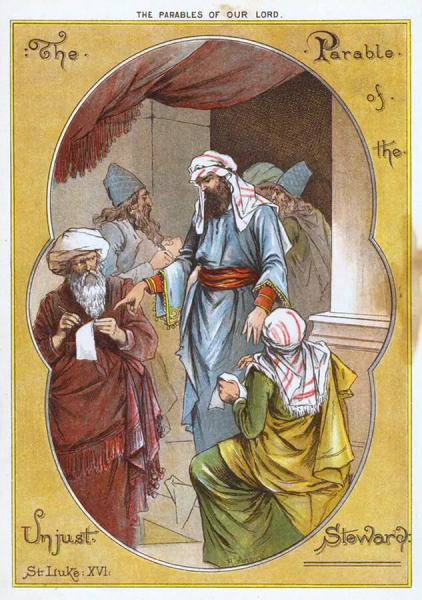
The Little Ones Own
Coloured Picture Paper, cir. 1890
At that time, Jesus said to His disciples this parable: There was a certain man, who had a steward; and the same was accused unto him that he had wasted his goods; and he called him, and said to him: How is it that I hear this of thee? Give an account of thy stewardship, for now thou canst be steward no longer, And the steward said within himself: What shall I do, because my lord takes away from me the stewardship? To dig I am not able; to beg I am ashamed. I know what I will do, that when I shall be put out of the stewardship, they may receive me into their houses, Therefore calling together every one of his lord’s debtors, he said to the first: How much dost thou owe my lord? But he said: A hundred barrels of oil. And he said to him: Take thy bill, and sit down quickly, and write fifty. Then he said to another: And how much dost thou owe my lord? Who said: A hundred quarters of wheat. He said to him: Take thy bill, and write eighty. And the lord commended the unjust steward, as much as he had done wisely: for the children of this world are wiser in their generation than the children of light. And I say to you: Make unto you friends of the mammon of iniquity, that when you shall fail, they may receive you into everlasting dwellings.
A Message From St. John Chrysostom’s Homilies on Matthew: 41
But if thou desire not to be punished even here, pass judgment on thyself, exact thine own penalty. Listen to Paul, when he saith, If we would judge ourselves, we should not be judged (1 Cor 11:31). If thou do this, proceeding in order thou shall even arrive at a crown.
But how are we to exact our own penalty? one may ask.
Lament, groan bitterly, humble, afflict thyself, call to remembrance thy sins in their particulars. This thing is no small torture to a man’s soul. If any man hath been in a state of contrition, he knows that the soul is punished by this more than anything. If any hath been living in remembrance of sins, he knows the anguish thence arising. Therefore doth God appoint righteousness as a reward for such repentance, saying, Be thou first to tell thy sins, that thou mayest be justified (LXX Isa 43:26). For it is not, it is not indeed, a small step towards amendment, to lay together all our sins, and to be continually revolving and reckoning them up with their particulars. For he that is doing this will be so heartbroken, as not to think himself worthy so much as to live; and he that thinks thus, will be tenderer than any wax. For tell me not of acts of fornication only, nor of adulteries, nor of these things that are manifest, and acknowledged amongst all men: but lay together also thy secret crafts, and thy false accusations, and thine evil speakings, and thy vain gloryings, and thine envy, and all such things. For neither will these bring a trifling punishment. For the reviler too shall fall into hell; and the drunkard hath no part in the kingdom; and he that lovest not his neighbor so offends God, as to find no help even in his own martyrdom; and he that neglects his own hath denied the faith, and he who overlooks the poor is sent into the fire.
Account not then these things to be little, but put all together, and write them as in a book. For if thou write them down, God blots them out; even as on the other hand, if thou omit writing them, God both inscribes them, and exacts their penalty. It were then far better for them to be written by us, and blotted out above, than on the contrary, when we have forgotten them, for God to bring them before our eyes in that day.
Therefore, that this may not be so, let us reckon up all with strictness, and we shall find ourselves answerable for much. For who is clear from covetousness? Nay, tell me not of the quantity, but since even in a small amount we shall pay the same penalty, consider this and repent. Who is rid of all insolence? Yet this casts into hell. Who hath not secretly spoken evil of his neighbor? Yet this deprives one of the Kingdom. Who hath not been self-willed? Yet this man is more unclean than all. Who hath not looked with unchaste eyes? Yet this is a complete adulterer. Who hath not been angry with his brother without a cause? Yet such an one is in danger of the council (Matt 5:22) Who hath not sworn? Yet this thing is of the evil one. Who hath not forsworn himself? but this man is something more than of the evil one. Who hath not served mammon? but this man is fallen away from the genuine service of Christ.
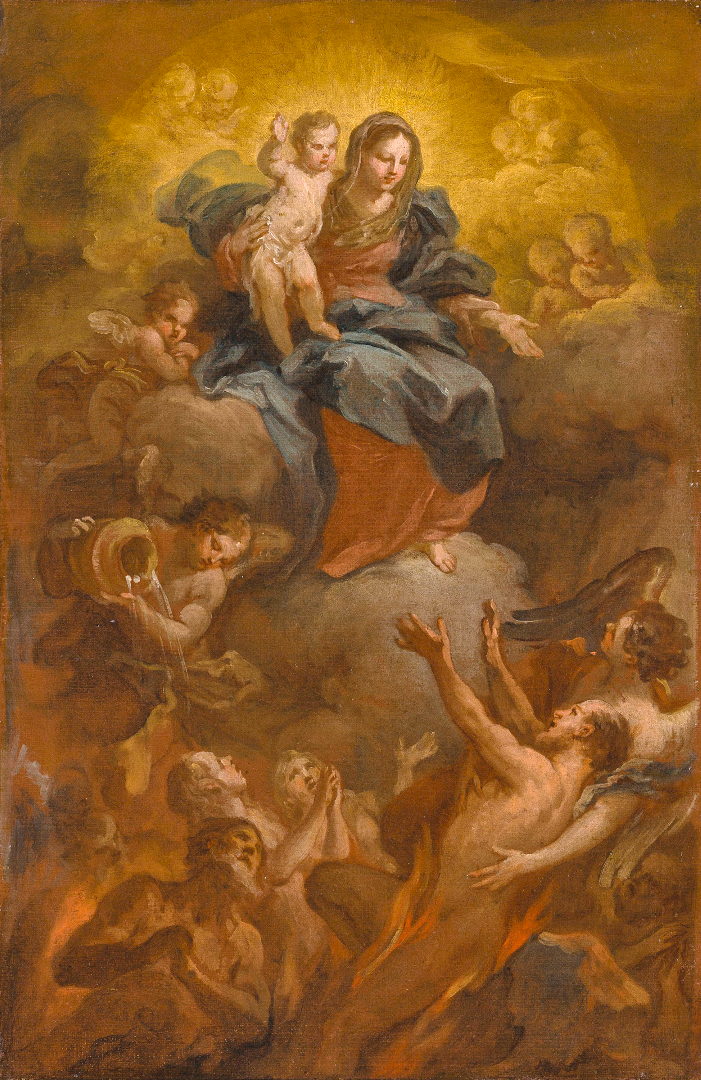
Releasing Souls from Purgatory, Sebastiano Conca, 1748
I have also other things greater than these to mention: but even these are enough, and able, if a man be not made of stone, nor utterly past feeling, to bring him to compunction. For if each one of them casts into hell, what will they not bring to pass when all are met together?
How then can one be saved? it may be asked. By application of the countervailing remedies: alms, prayers, compunction, repentance, humility, a contrite heart, contempt of possessions. For God hath marked out for us innumerable ways of salvation, if we be willing to attend. Let us then attend, and let us every way cleanse out our wounds, showing mercy, remitting our anger against them that have displeased us, giving thanks for all things to God, fasting according to our power, praying sincerely, making unto ourselves friends of the mammon of unrighteousness (Luck 16:9) For so shall we be able to obtain pardon for our offenses, and to win the promised good things; whereof may we all be counted worthy, by the grace and love toward man of our Lord Jesus Christ, to whom be glory and might forever and ever. Amen.