
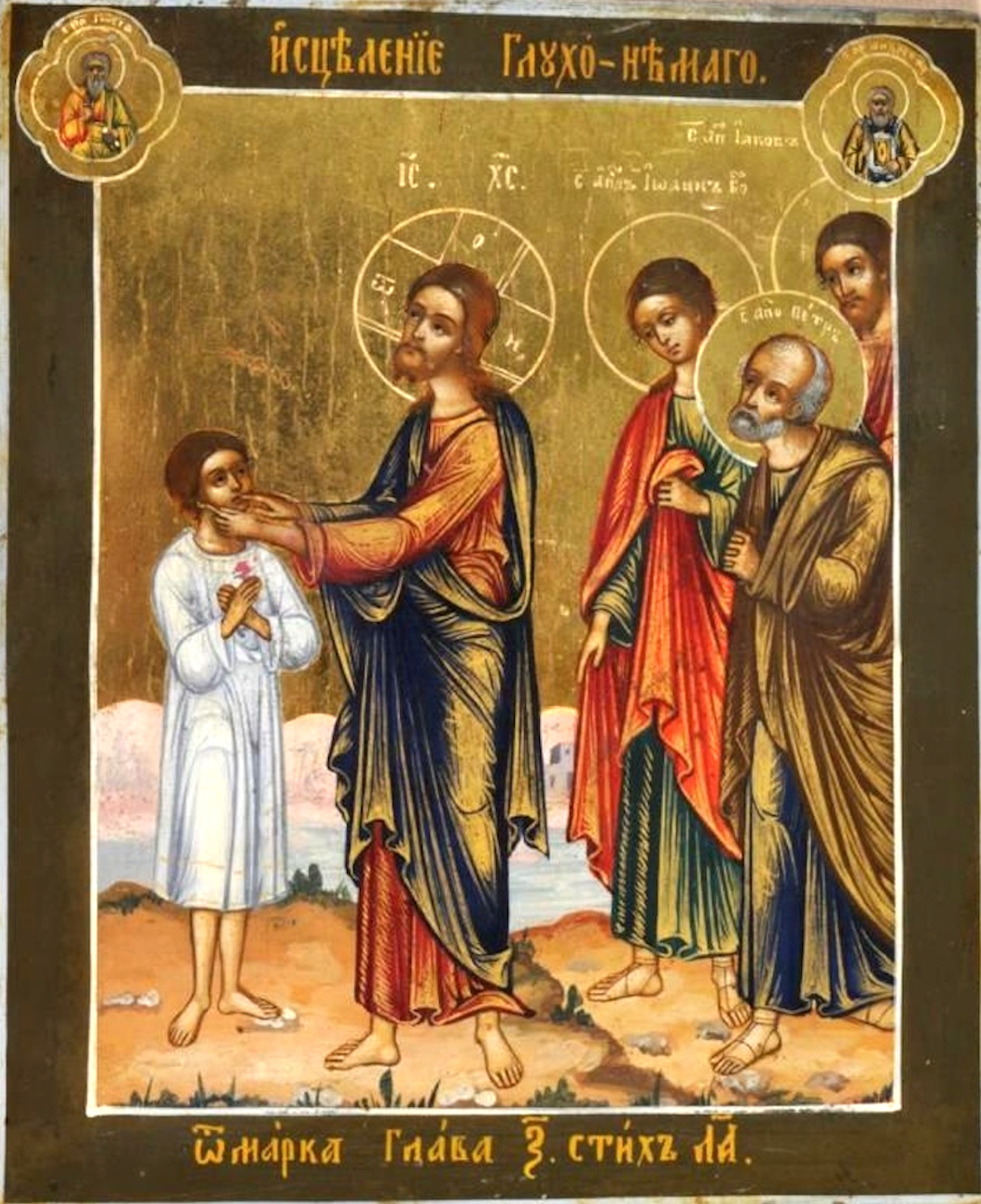
Russian, 1908
Translation of the Holy Gospel According to Mark (7:31-37)
At that time, Jesus going out to the coasts of Tyre, came by Sidon to the Sea of Galilee, through the midst of the coasts of Decapolis. And they bring to Him one deaf and dumb, and they besought Him that He would lay His hand upon him. And taking him from the multitude apart, He put His fingers into his ears, and spitting, He touched his tongue and looking up to heaven, He groaned and said to him: Ephpheta, that is, Be thou opened: and immediately his ears were opened, and the string of his tongue was loosed, and he spoke right. And He charged them that they should tell no man: but the more He charged them so much the more a great deal did they publish it; and so much the more did they wonder, saying: He hath done all things well; He hath made both the deaf to hear, and the dumb to speak.
A Message From St. Pope John Paul II, “Homily for the Jubilee of University Professors,” Sept. 10th, 2000
He has done all things well; he even makes the deaf hear and the dumb speak (Mark 7:37).
We are invited to share in the wonder and praise of those who witnessed the miracle which we have just heard recounted in the Gospel. Like many other episodes of healing, it testifies to the coming of the Kingdom of God in the person of Jesus. In Christ the messianic promises spoken by the prophet Isaiah are fulfilled: The ears of the deaf shall be unstopped … and the tongue of the dumb sing for joy (Isa 35:5-6). In him, the year of the Lord’s favour has begun for all humanity (cf. Luke 4:17-21).
…
Ephphatha, be opened! (Mark 7:34). The words spoken by Jesus at the healing of the deaf mute ring out once more for us today; they are stimulating words of great symbolic intensity which call us to open ourselves to listening and to bearing witness.
Does not the deaf mute mentioned in the Gospel bring to mind the situation of those who are unable to establish a communication which gives true meaning to life? In a certain way, he reminds us of those who shut themselves up in a presumed autonomy, which leaves them isolated from God and often from their neighbour as well. Jesus turns to this man to restore to him the capacity to open himself to the One who is Other and to others, in an attitude of trust and freely-given love. He offers him the extraordinary opportunity to meet God who is love and who allows himself to be known by those who love. He offers him salvation.
Yes, Christ opens man to a knowledge of both God and himself. He who is truth (cf. John 14:6) opens man to the truth, touching him from within and thus healing “from within” every human faculty.
[For educators], these words are an appeal to open your spirit, to the truth which sets free! At the same time, Christ’s words summon you to become this “Ephphatha” for countless hosts of young people, to become this word which opens the spirit to every aspect of truth in the different fields of learning. Seen in this light, your daily commitment becomes a following of Christ on the path of service to your brothers and sisters in the truth of love.
Christ is the one who has done all things well (Mark 7:37). He is the model to whom you must look unceasingly so that your academic activity becomes an effective service of the human longing for an ever fuller knowledge of truth.
‘Say to those who are of a fearful heart: `Be strong, fear not! Behold your God … He will come and save you‘ (Isa 35:4).
In these words of Isaiah your mission too [dear educators] is well delineated. Every day you are committed to proclaiming, defending and spreading the truth. Often this involves truths concerning the most diverse aspects of the cosmos and of history. The subject material will not always touch directly on the problem of the ultimate meaning of life and the relationship with God, as in the areas of philosophy and theology. However, this problem abides as the larger context of every thought. Even in research on areas of life which seem quite far from faith there is a hidden desire for truth and meaning which goes beyond the particular and the contingent.
When the human person is not spiritually “deaf and dumb” every area of thought, science and experience also brings a reflection of the Creator and gives rise to a desire for him, a desire often hidden and perhaps also repressed but which cannot be suppressed. This was well understood by Saint Augustine who exclaimed: You have made us for yourself, O Lord, and our hearts are restless until they rest in you (Confessions, I, 1 ).
As [educators] who have opened your hearts to Christ, your vocation is that of living and bearing witness in an effective way to this relationship between the individual branches of knowledge and that supreme “knowledge” which concerns God, and which in a sense coincides with him, with his Word made flesh and with the Spirit of truth given by him. Through your contribution, the [school] becomes the place of the “Ephphatha” where Christ – at work in you – continues to carry out the miracle of opening ears and lips, bringing about a new capacity for listening and a true communication.
…

[Schools] need people attentive to the word of the only Teacher; it needs qualified professionals and credible witnesses to Christ. This mission is certainly not easy, it requires constant commitment, it is nourished by prayer and study, and it is expressed in the normal events of everyday life.
…
Fixing our gaze on the mystery of the Incarnate Word (cf. Incarnationis Mysterium), man discovers himself (cf. Gaudium et Spes, 22). He also experiences an intimate joy which finds expression in the interior style itself of studying and teaching. Knowledge thus overcomes the limits which reduce it to a merely functional and pragmatic process, and so it recovers its dignity as research in the service of man in the whole truth about himself, illuminated and guided by the Gospel.
…
I entrust your journey to Mary, Sedes Sapientiae, whose image I entrust to you today, so that she may be welcomed as a teacher and a pilgrim in the [schools] of the world. Mary supported the Apostles with her prayer at the dawn of evangelization; may she also help you to invigorate the [school] world with a Christian spirit.