
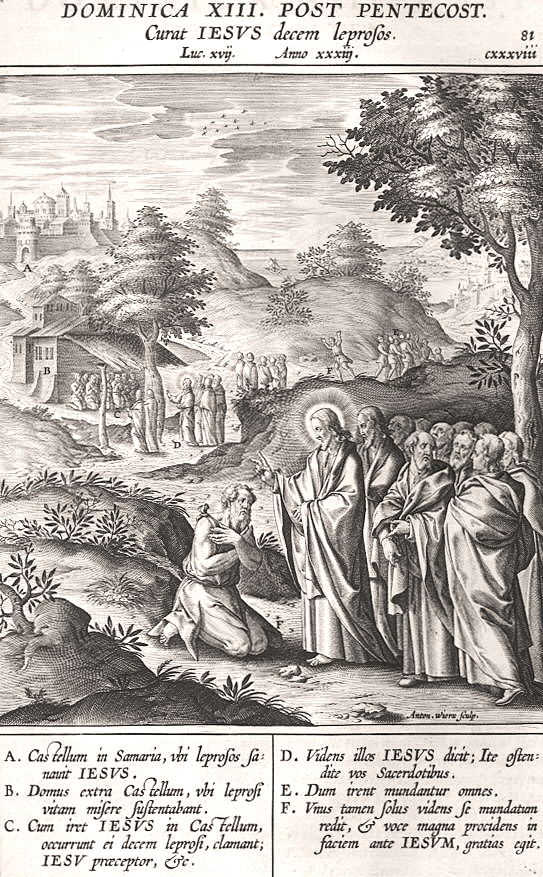
Antonius Wierix II,
Evangelicae Historiea Imagines, 1593
Translation of the Holy Gospel According to Luke (17:11-19)
At that time, as Jesus was going to Jerusalem, He passed through the midst of Samaria and Galilee: and as He entered into a certain town, there met Him ten men that were lepers, who stood afar off, and lifted up their voice, saying: Jesus, Master, have mercy on us. Whom when He saw, He said: Go, show yourselves to the priests. And it came to pass, that, as they went, they were made clean. And one of them, when he saw that he was made clean, went back, with a loud voice glorifying God: and he fell on his face before His feet, giving thanks: and this was a Samaritan. And Jesus answering said: Were not ten made clean? And where are the nine? There is no one found to return, and give glory to God, but this stranger. And He said to him: Arise, go thy way for thy faith hath made thee whole.
A Message from St. Augustine’s Quaestiones Evangeliorum.
(Luke 17:12-19)
BOOK 1: QUESTION 40. THE TEN LEPERS.
With regard to the ten lepers whom the Lord heals, we can say, Go and show yourself to the priests, and ask a great number of questions of genuine interest. I do not speak only of the significance attached to the number ten, and of this particular circumstance, that there was only one to give thanks: for these are free questions, and even those which are not in depth, delay little or no attention of readers; but what is most important to know is the motive for which he sent them to the priests, so that they might be healed by going there. One does not see any effect of bodily healing among all those who have sent him to priests other than lepers. Already it was to a leper, cured by his goodness, that he had said: Go and show yourself to the priest, and offer for you the sacrifice ordained by Moses, that it may serve them as a testimony. Then what spiritual healing can be supposed in those to whom he reproaches their ingratitude? For it is easy to see that a man may not be afflicted with bodily leprosy without having a good heart for it; but when one wants to deepen the meaning of this miracle, one wonders with emotion how one can say of an ungrateful person that he is cured.
Let’s see what leprosy itself is the figure. The Gospel does not say of those who have been delivered, that they are cured, but purified. Indeed, leprosy is a problem of color, not of the health or integrity of the senses or of the limbs. It is therefore permissible to see in the lepers the symbol of those men who, not having the knowledge of the true faith, openly profess the various contradictory teachings of error. For they do not veil even their incapacity, but they make all their efforts to produce error in the light of day and put at its service all the pomp of their speeches. Now, there is no false doctrine that contains some mixture of truth. The truths that appear in the discussion or conversation of a man, mixed without any order with the error, like spots on a body, therefore represent the leprosy, which covers and stains the body of the man of true colors and false colors. Now, the Church must avoid such men, so that, if possible, they may raise from the farthest they are a loud cry to Christ, like the ten lepers, who stopped far away from him, and raised up his voice, saying, Jesus, our teacher, have mercy on us. I do not know that anyone resorted to the Lord in demand of bodily health giving him the title of teacher. Therefore, I am inclined to think that leprosy is a sign of every false doctrine that a competent teacher manages to eliminate.
Among the faithful almost no one questions that the priesthood of the Jews was a figure of the future royal priesthood existing in the Church, with which all the members of the body of Christ, supreme and true prince of priests, are consecrated. In effect, at present he anoints everyone, something that at that time was reserved only for kings and priests. And what Peter, addressing to the Christian people, designates him as a royal priesthood (1 Pet 2:9) constitutes a declaration that both a name and another square to that people to whom that anointing corresponded. Thus, the Lord heals and corrects for himself, acting in the intimacy of conscience and intelligence, the other damages, as if it were the health of the members and the senses of the soul. On the other hand, the teaching of those who are to be initiated in the sacraments, and of those who are to be catechized by word or reading, have been properly entrusted to the Church. In this activity you can see the true and authentic color because it jumps to the eye and has external glare. In fact, it does not take place in inner thoughts but in manifest activities. What is entrusted to the Church is proved by Paul’s case. After having heard the voice of the Lord: Why do you persecute me? I am Jesus whom you are persecuting, (Acts 9:4-5) he was sent to Ananias so that with that priesthood established in the Church, he would receive the sacrament of teaching in the faith and approve his true color. (Cf. Acts 9:10-18) This does not mean that the Lord cannot do everything by himself, for who but he does these things also in the Church? But he does so that the assembly itself of the congregated faithful, approving and communicating reciprocally the teaching of the true faith in everything that is said with words or sealed by sacraments, present, so to speak, the appearance of an authentic color. A story also comes what the same Apostle says: Then, after fourteen years, I went back to Jerusalem with Barnabas, taking with me also Titus. I ascended moved by a revelation and I exposed the gospel that I proclaim among the Gentiles, exposing it separately to the most representative, lest it is running or has run in vain. And shortly after: And recognizing the grace that had been granted to me, saints Peter and John, who were considered as pillars, extended their hands in a sign of communion to me and to Barnabas. (Gal 2:1-2,9) The very gift of grace showed a single face of the doctrine, to the exclusion of all divergence. It is the same thing that, with a view to their salvation, he recommends to the Corinthians: I adjure you, brothers, by the name of our Lord Jesus Christ, that you all say the same. (1 Cor 1:10) Cornelius himself, when the angel informed him that his alms had been accepted and his prayers heard by God, receives the order to send (his own) to Peter with the aim of manifesting the unity of faith and sacraments. It is as if he had been told in person and to his people: Go and introduce yourself to the priests. In fact, on the way, they looked clean. Peter had already reached them, but since they had not yet received the sacrament of baptism, they had not approached the priests spiritually. In spite of everything, the infusion of the Holy Spirit and the astonishment produced by the fact of the tongues was already a declaration of its cleanliness. (Cf. Acts 10:44-46)
Given this reality, it is also easy to notice the possibility that someone, within the Church, embraces the whole and true doctrine, expresses everything according to the rule of the Catholic faith and distinguishes the creator from the creature, (Cf. Rom 1:25) and it manifests to have lacked as of leprosy, that is, of a variety of lies. However, it may be that he is ungrateful to the Lord God who cleansed him, since, swollen with pride, he does not prostrate himself to give thanks with pious humility, and he resembles those of whom the Apostle says that having known God, they did not glorify him as God nor gave him thanks. (Rom 1:21) When he says that they knew God, he shows that they were cleansed of leprosy, but then, afterwards, he accuses them of being ungrateful. Therefore, such individuals are stuck in the number nine, as imperfect people. If we add one to nine, a certain unity image is completed. It gives a number so complete that it does not advance the numbering if it does not start again from one. And this rule is maintained in all numbers to infinity. The nine, then, needs the one so that the whole is grouped into one as a unit and constitutes the ten; the one, however, does not need the remaining figures to maintain unity. For all this, just as the nine ungrateful and reprobate were excluded from the consortium of the unit, so the only one who is grateful was approved and praised, symbolizing the one Church. And as those nine were Jews they were made to see that, because of their pride, they had lost the kingdom of heaven which is where unity is maintained at its highest level. This other one, on the other hand, was a Samaritan, a term that translates as “guardian”, attributing the gift received to his giver, and singing in a certain way the words of the psalm: I will keep my strength with you. (Psa 18:10) He submitted to the King by his gratitude, and by his humble devotion he preserved the privilege of unity.