
Translation From the Holy Gospel According to Matthew (22:1-14)

Selby Donnison, 1963
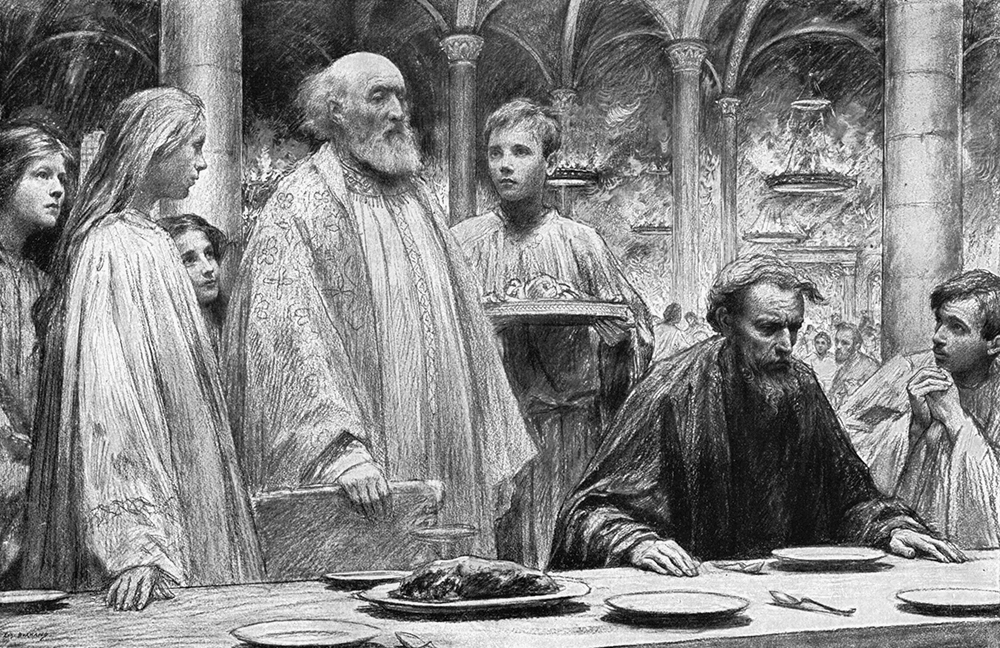
At that time, Jesus spoke to the chief priests and the Pharisees in parables, saying: The kingdom of Heaven is likened to a king, who made a marriage for his son; and he sent his servants, to call them that were invited to the marriage, and they would not come. Again he sent other servants, saying: Tell them that were invited: Behold, I have prepared my dinner; my oxen and fatlings are killed, and all things are ready: come ye to the marriage. But they neglected and went their way, one to his farm, and another to his merchandise; and the rest laid their hands on his servants, and having treated them abusively, put them to death. But when the king heard of it, he was angry and sending his armies, he destroyed those murderers, and burnt their city. Then he saith to his servants: The marriage indeed is ready, but they that were invited were not worthy, Go ye therefore into the highways, and as many as you shall find, call to the marriage. And his servants going forth into the ways, gathered together all that they found, both bad and good and the marriage was filled with guests. And the king went in to see the guests, and he saw there a man who had not on a wedding garment: and he saith to him: Friend, how came thou in hither, not having on a wedding garment? But he was silent. Then the king said to the waiters: Bind his hands and feet, and cast him into the exterior darkness: there shall be weeping and gnashing of teeth. For many are called, but few are chosen.
A Message From Pope Benedict XVI’s “Homily for Mass,” Oct. 9th, 2011.
This Sunday’s liturgy presents a parable to us that speaks of a wedding banquet to which many were invited. The Book of Isaiah, prepares the ground for this theme, for it speaks about the banquet of God. It is an image — the banquet — often used in the Scriptures to indicate the joy in communion and in the abundance of the Lord’s gifts, and it gives some idea of the celebration of God with humanity as Isaiah describes: On this mountain the Lord of hosts will make for all peoples a feast of fat things, a feast of wine on the lees, of fat things full of marrow, of wine… well refined (Isa 25:6). The Prophet adds that God’s intention is to put an end to sadness and shame; he wants all people to live happily in love of him and in mutual communion. Therefore, his plan is to eliminate death forever, to wipe away the tears from all faces, to take away once and for all the dishonourable condition of his people (cf. Isa 25:7-8). All this awakens deep gratitude and hope: Lo, this is our God; we have waited for him, that he might save us. This is the Lord; we have waited for him; let us be glad and rejoice in his salvation (Isa 25:9).
In the Gospel Jesus speaks to us of the answer that is given to the invitation of God — represented by a king — to take part in this marriage feast (cf. Matt 22:1-14). Many guests were invited but something unexpected happens: they refuse to take part in the celebration, they have other things to do; indeed, some of them show contempt for the invitation. God is generous to us, he offers us his friendship, his gifts, his joy, but often we do not welcome his words, we show greater interest in other things and put our own material concerns, our own interests, first. The king’s invitation even meets with hostile and aggressive reactions. Yet this does not impede his generosity. He is not discouraged and sends his servants out to invite many other people. The refusal of those invited first causes the invitation to be extended to everyone, even the poorest, the abandoned and disinherited. The servants gather together those they find and the wedding hall is filled: the king’s goodness knows no bounds and all are given the possibility of answering his call. However, there was one condition in order to attend this wedding feast: that the wedding garment be worn. And, on entering the hall, the king notices that someone has not wished to wear it and for this reason bars him from the banquet.

I would like to reflect for a moment on this point with a question: why did this man accept the king’s invitation, enter the banquet hall, find the door opened to him but not put on the wedding garment? What is this wedding garment? [There is] a beautiful commentary on this parable by St Gregory the Great. He explains that the guest had accepted God’s invitation to take part in his banquet, that in a certain way he had faith which opened the door of the banquet hall to him, but he lacked something essential: the wedding garment, which is charity or love. And St Gregory adds: Therefore each one of you in the Church who has faith in God has already taken part in the wedding feast, but cannot claim to wear the wedding garment unless he jealously guards the grace of love (“Homily 38,” 9; PL 76, 1287). And this garment is woven symbolically on two looms of wood, one above and one below: love of God and love of neighbour (cf. ibid., 10: PL 76, 1288). We are all invited to be the Lord’s guests, to enter his banquet with faith, but we must put on and take care of the wedding garment: charity, to live in the profound love of God and neighbour.