

Rembrant, ca. 1657
Translation From the Holy Gospel According to Matthew (24:15-35)
At that time, Jesus said to His disciples: When you shall see the abomination of desolation which was spoken of by Daniel the prophet, standing in the holy place (he that reads, let him understand:) then they that are in Judea, let them flee to the mountains and he that is on the housetop, let him not come down to take anything out of his house and he that is in the field, let him not go back to take his coat. And woe to them that are with child and that give suck, in those days. But pray that your flight be not in the winter, or on the sabbath: for there shall be then great tribulation, such as hath not been found from the beginning of the world until now, neither shall be: and unless those days had been shortened, no flesh should be saved; but for the sake of the elect, those days shall be shortened. Then if any man shall say to you: Lo, here is Christ, or there; do not believe him: for there shall arise false Christs, and false prophets, and shall show great signs and wonders, insomuch as to deceive (if possible) even the elect. Behold I have told it to you beforehand. If therefore they shall say to you: Behold, he is in the desert, go ye not out. Behold He is in the closets, believe it not. For as lightning cometh out of the east, and appeareth even into the west, so shall also the coming of the Son of Man be: Wheresoever the body shall be, there shall the eagles also be gathered together. And immediately after the tribulation of those days, the sun shall be darkened, and the moon shall not give her light, and the stars shall fall from the heaven, and the powers of heaven shall be moved and then shall appear the sign of the Son of Man in heaven, and then shall all the tribes of the earth mourn; and they shall see the Son of Man coming in the clouds of heaven with much power and majesty. And He shall send His angels with a trumpet and a loud voice, and they shall gather together His elect from the four winds, from the farthest parts of the heavens to the utmost bounds of them. And from the fig tree learn a parable: when the branch thereof is now tender, and the leaves come forth, you know that summer is nigh. So you also, when you shall see all these things, know ye that ìt is nigh at the doors. Amen I say to you that this generation shall not pass till all these things be done. Heaven and earth shall pass away, but My words shall not pass away.
A Message From St. Paul VI’s Evangeli Nutiandi
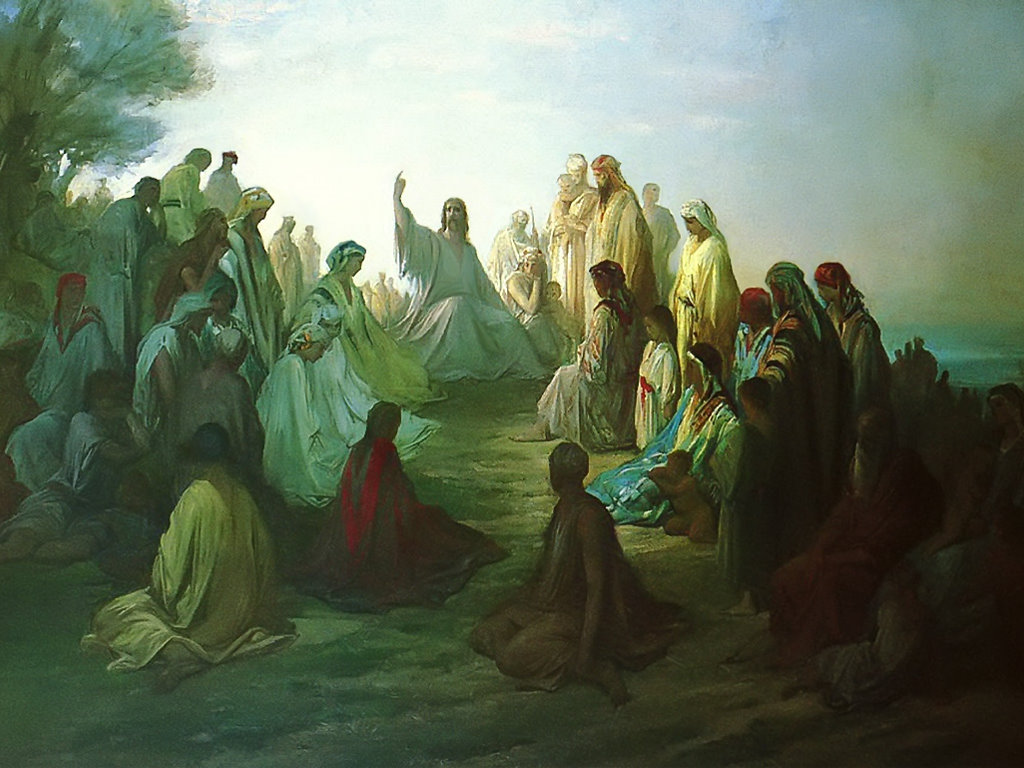
Gustave Dore, 1868
[The preaching] of the Gospel message is not an optional contribution for the Church. It is the duty incumbent on her by the command of the Lord Jesus, so that people can believe and be saved. This message is indeed necessary. It is unique. It cannot be replaced. It does not permit either indifference, syncretism or accommodation. It is a question of people’s salvation. It is the beauty of the Revelation that it represents. It brings with it a wisdom that is not of this world. It is able to stir up by itself faith – faith that rests on the power of God.[11] It is truth. It merits having the apostle consecrate to it all his time and all his energies, and to sacrifice for it, if necessary, his own life.
The witness that the Lord gives of Himself and that Saint Luke gathered together in his Gospel – “I must proclaim the Good News of the kingdom of God”[12] – without doubt has enormous consequences, for it sums up the whole mission of Jesus: “That is what I was sent to do.”[13] These words take on their full significance if one links them with the previous verses, in which Christ has just applied to Himself the words of the prophet Isaiah: “The Spirit of the Lord has been given to me, for he has anointed me. He has sent me to bring the good news to the poor.”[14]
Going from town to town, preaching to the poorest – and frequently the most receptive – the joyful news of the fulfillment of the promises and of the Covenant offered by God is the mission for which Jesus declares that He is sent by the Father. And all the aspects of His mystery – the Incarnation itself, His miracles, His teaching, the gathering together of the disciples, the sending out of the Twelve, the cross and the resurrection, the permanence of His presence in the midst of His own – were components of His evangelizing activity.
… Jesus Himself, the Good News of God,[15] was the very first and the greatest evangelizer; He was so through and through: to perfection and to the point of the sacrifice of His earthly life. To evangelize: what meaning did this imperative have for Christ? It is certainly not easy to express in a complete synthesis the meaning, the content and the modes of evangelization as Jesus conceived it and put it into practice. In any case the attempt to make such a synthesis will never end. Let it suffice for us to recall a few essential aspects.
As an evangelizer, Christ first of all proclaims a kingdom, the kingdom of God; and this is so important that, by comparison, everything else becomes “the rest,” which is “given in addition.”[16] Only the kingdom therefore is absolute and it makes everything else relative. The Lord will delight in describing in many ways the happiness of belonging to this kingdom (a paradoxical happiness which is made up of things that the world rejects),[17] the demands of the kingdom and its Magna Charta,[18] the heralds of the kingdom,[19] its mysteries,[20] its children,[21] the vigilance and fidelity demanded of whoever awaits its definitive coming.[22]
As the kernel and center of His Good News, Christ proclaims salvation, this great gift of God which is liberation from everything that oppresses man but which is above all liberation from sin and the Evil One, in the joy of knowing God and being known by Him, of seeing Him, and of being given over to Him. All of this is begun during the life of Christ and definitively accomplished by His death and resurrection. But it must be patiently carried on during the course of history, in order to be realized fully on the day of the final coming of Christ, whose date is known to no one except the Father.[23]
This kingdom and this salvation, which are the key words of Jesus Christ’s evangelization, are available to every human being as grace and mercy, and yet at the same time each individual must gain them by force – they belong to the violent, says the Lord,[24] through toil and suffering, through a life lived according to the Gospel, through abnegation and the cross, through the spirit of the beatitudes. But above all each individual gains them through a total interior renewal which the Gospel calls metanoia; it is a radical conversion, a profound change of mind and heart.[25]
Christ accomplished this proclamation of the kingdom of God through the untiring preaching of a word which, it will be said, has no equal elsewhere: “Here is a teaching that is new, and with authority behind it.”[26] “And he won the approval of all, and they were astonished by the gracious words that came from his lips.[27] There has never been anybody who has spoken like him.”[28] His words reveal the secret of God, His plan and His promise, and thereby change the heart of man and his destiny.
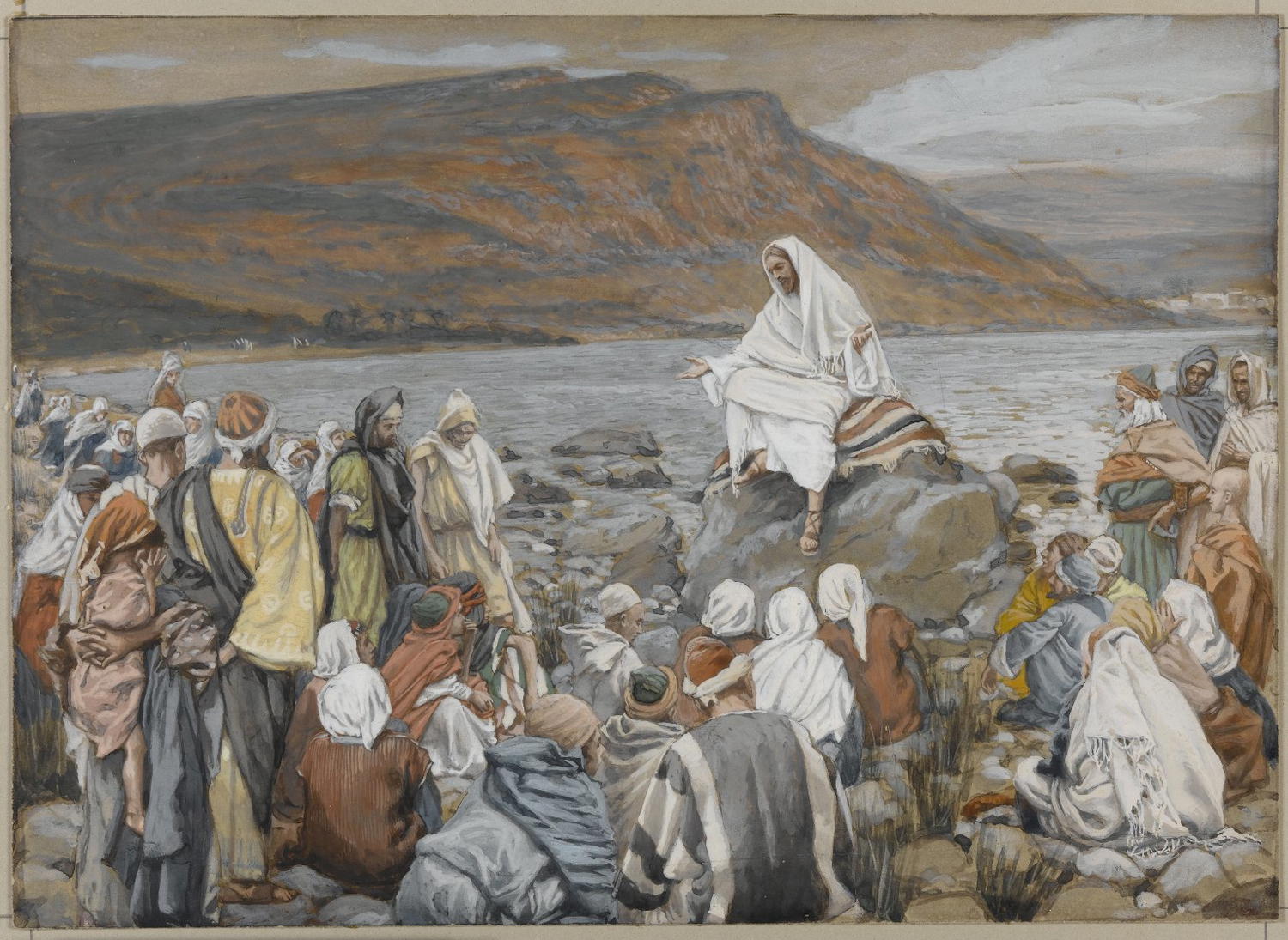
James Tissot, 1886-96
But Christ also carries out this proclamation by innumerable signs, which amaze the crowds and at the same time draw them to Him in order to see Him, listen to Him and allow themselves to be transformed by Him: the sick are cured, water is changed into wine, bread is multiplied, the dead come back to life. And among all these signs there is the one to which He attaches great importance: the humble and the poor are evangelized, become His disciples and gather together “in His name” in the great community of those who believe in Him. For this Jesus who declared, “I must preach the Good News of the Kingdom of God”[29] is the same Jesus of whom John the Evangelist said that He had come and was to die “to gather together in unity the scattered children of God.”[30] Thus He accomplishes His revelation, completing it and confirming it by the entire revelation that He makes of Himself, by words and deeds, by signs and miracles, and more especially by His death, by His resurrection and by the sending of the Spirit of Truth.[31]
11. Cf. 1 Cor 2:5.
12. Lk 4:43.
13. Ibid.
14. Lk 4:18; cf. Is 61:1.
15. Cf. Mk 1:1; Rom 1:1-3.
16. Cf. Mt 6:33.
17. Cf. Mt 5:3-12.
18. Cf. Mt 5-7.
19. Cf. Mt 10.
20. Cf. Mt 13.
21. Mt 18.
22. Cf. Mt 24-25.
23. Cf. Mt. 24:36; Acts 1:7; 1 Thess 5:1-2.
24. Cf. Mt 11:12; Lk 16:16.
25. Cf. Mt 4:17.
26. Mk 1:27.
27. Lk 4:22.
28. Jn 7:46.
29. Lk 4:43.
30. Jn 11:52.
31. Cf. Second Vatican Ecumenical Council, Dogmatic Constitution on Divine Revelation Dei Verbum, 4: AAS 58 (1966), pp. 818-819.32. 1 Pt 2:9.