
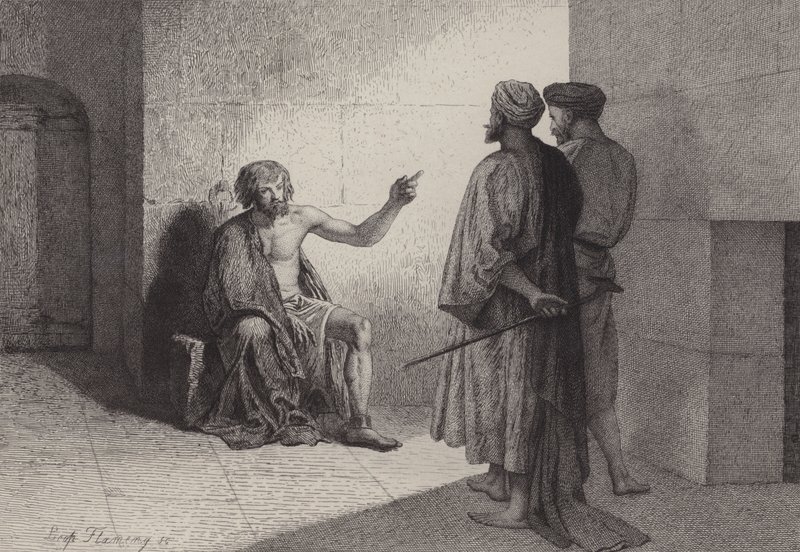
after Albert Robida (engraving), 1873
Translation of the Holy Gospel According to Matthew (11:2-10)
At that time, when John had heard in prison the works of Christ, sending two of his disciples, he said to Him: Art thou He that art to come, or look we for another? And Jesus, making answer, said to them: Go and relate to John what you have heard and seen. The blind see, the lame walk, the lepers are cleansed, the deaf hear, the dead rise again, the poor have the gospel preached to them: and blessed is he that shall not be scandalized in Me. And when they went their way, Jesus began to say to the multitudes concerning John: What went you out into the desert to see? A reed shaken with the wind? But what went you out to see? A man clothed in soft garments? Behold they that are clothed in soft garments are in the houses of kings. But what went you out to see? A prophet? Yea I tell you, and more than a prophet. For this is he of whom it is written: Behold, I send my Angel before Thy face, who shall prepare Thy way before Thee.
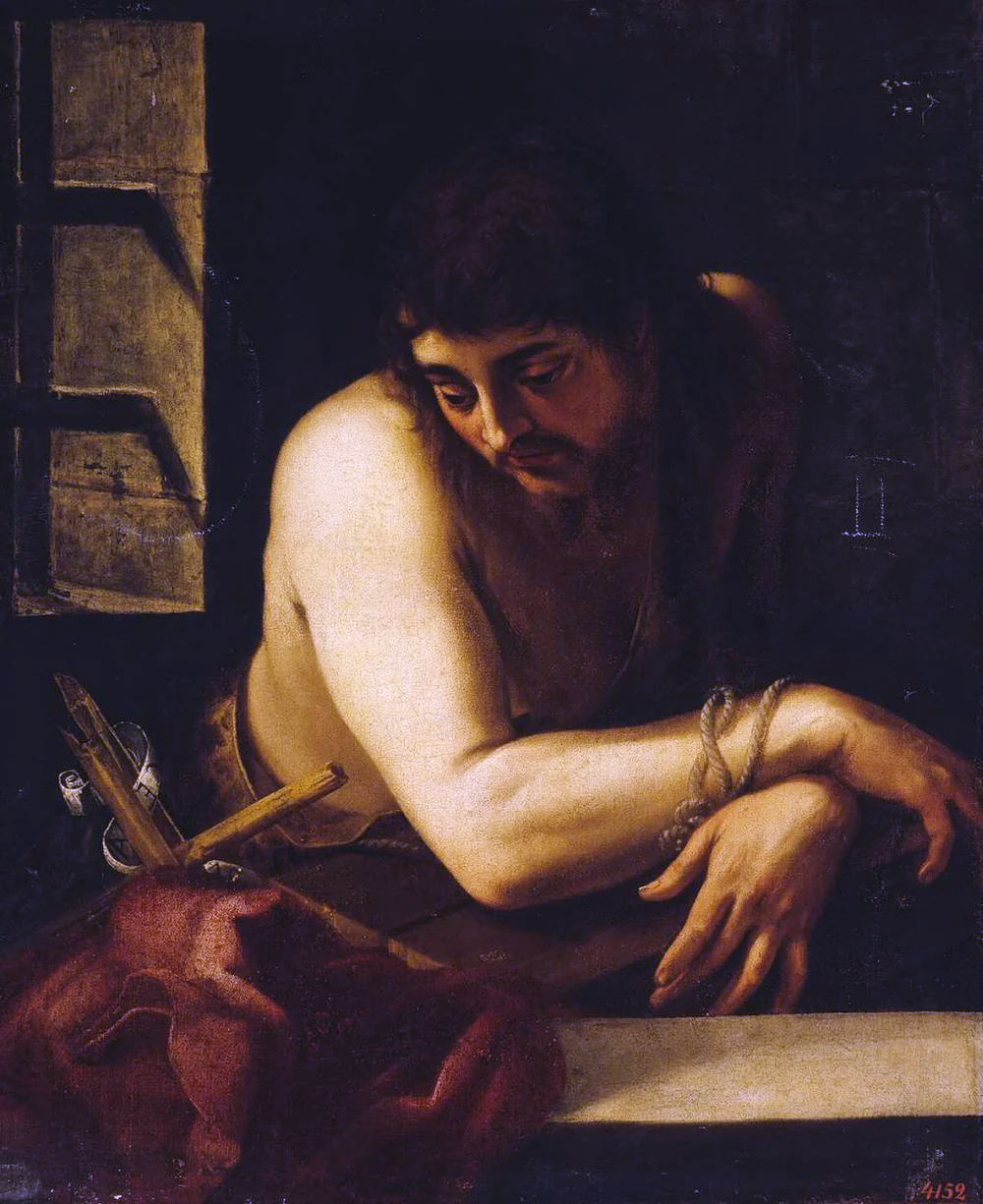
Juan Fernández De Navarrete, cir. 1605
A Message from St. Jerome’s Commentary on the Gospel of Matthew
But when John heard in prison of the works of Christ, he sent two of his disciples to say to him: “Are you he who is to come, or do we wait for another?” (11.2–3) He asks, but not as one who is ignorant of the answer. For he had pointed him out to others who did not know about him when he said: “Behold the Lamb of God, behold him who takes away the sins of the world.”1 Also, he had heard the voice of the Father, thundering: “This is my beloved Son in whom I am well pleased.”2 Rather, it is just as when the Savior asks where Lazarus has been laid. He did this so that those who pointed out the location of the tomb would at least be thus prepared for faith and see the dead man rising.3 Thus, when John was about to be killed by Herod, he sends his disciples to Christ, so that on this occasion, when they see the signs and miracles, they may believe in him and, with their teacher asking, learn for themselves. An earlier question also demonstrated, however, that the disciples of John were puffed up against the Lord. They had caustic feelings toward him that sprang from resentment and envy. The evangelist reports: “Then the disciples of John approached him, saying: ‘Why do we and the Pharisees often fast, but your disciples do not fast?’”4 And in another passage it says: “Teacher, the one for whom you offered testimony at the Jordan, behold, his disciples are baptizing, and more are coming to him.”5 It is as though they had said: This is a rarity, the crowd is flocking to him.
11.3. Are you he who is to come, or do we wait for another? It does not say: are you he who has come, but: “are you he who is to come?” The meaning is: Command me, since I am about to descend to the lower world, whether I should announce you even in the lower world, whom I announced in the upper world.6 Or does it not befit the Son of God that he should taste death?7 Are you going to send another to carry out these mysteries?8
11.4–5. Jesus responded and said to them: “Go, report back to John what things you have heard and seen: the blind see, the lame walk, the lepers are cleansed, the deaf hear, the dead rise.” 9 Through his disciples John had asked: “Are you he who is to come or do we wait for another?” Christ points out the signs, not as a means of responding to the things which he had been asked, but as a stumbling block to the messengers. Go, he says, and tell John the signs which you see, the blind seeing, the lame walking, etc., and what is not less than these: the poor are being evangelized.10 This refers either to the poor in spirit,11 or at least to the poor in respect to wealth. Thus there is to be no distinction between the noble and the ignoble, between the rich and the needy, in the proclamation of the Gospel. These things prove the rigor of the teacher and they prove the truth of the preacher, since with him everyone is equal who can be saved. But what he says
11.6. “And blessed is he who is not scandalized in me,” is an attack on the messengers, as will be demonstrated in what follows.
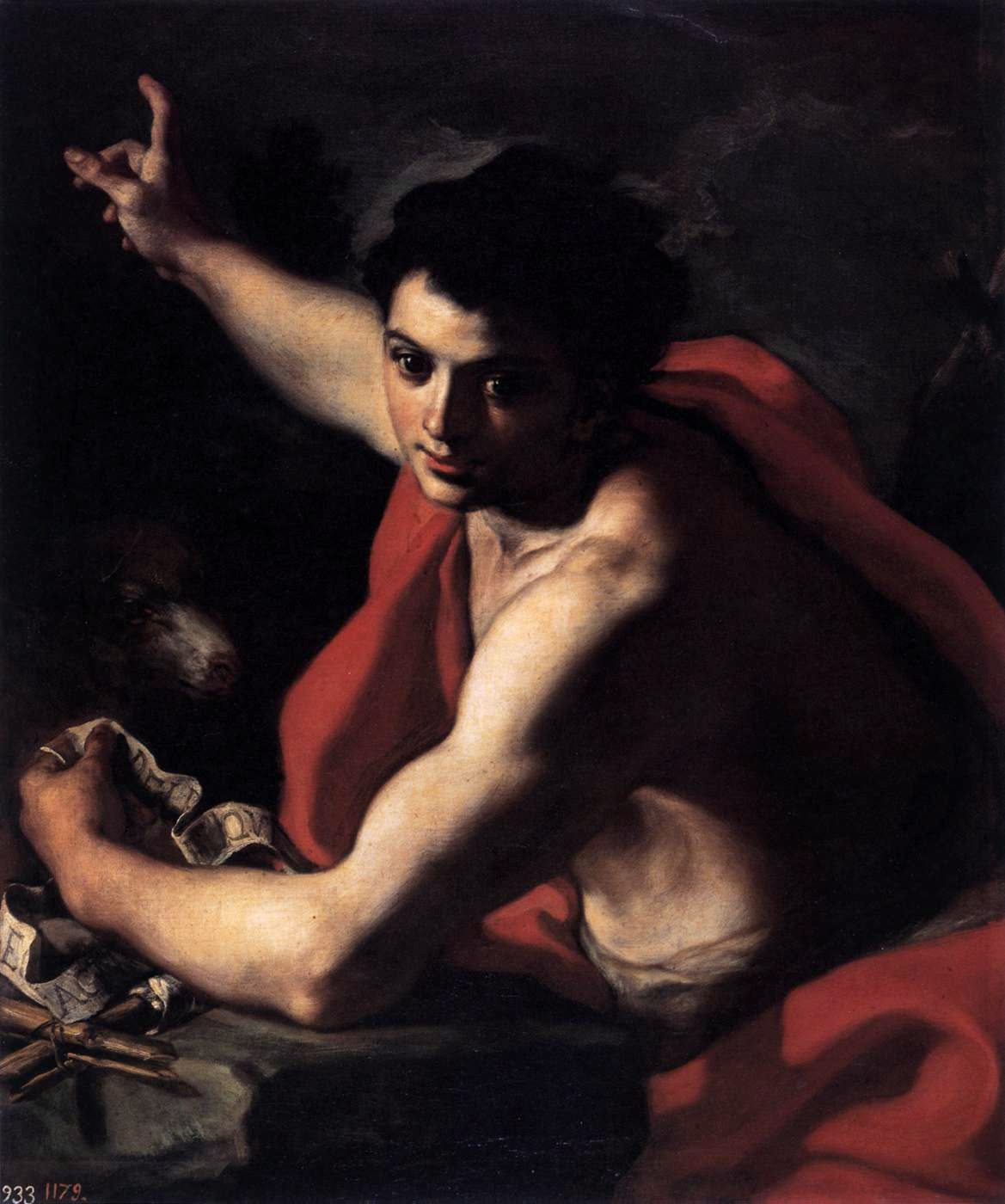
Francesco Solimena, 1725-30
11.7–8. Then as they went away, Jesus began to speak to the crowds about John: “Why did you go out into the desert? To see a reed shaken by the wind? But why did you go out? To see a man dressed in fine clothes?” etc. If the earlier judgment, that is, his words: “Blessed is he who is not scandalized in me,”12 had been brought forth against John, as many think, how is it that now John is preached with such great praises? Rather, it was because the crowd standing around was not aware of the mystery of [John’s] question. They thought that John was in doubt about the Christ, whom he himself had pointed out. Therefore, in order that they might understand that John had asked not for himself but for his disciples, he says: “Why did you go out into the desert?” Surely it was not to see a man who is borne about by every wind13 like a reed, and that wavers with a fickleness of mind concerning the one whom he had previously predicted? Or perhaps you think that John is compelled by the goads of envy against me and that his preaching is a pursuit of empty fame, so that he seeks a profit from it? Why should he desire riches? That he might have abundant feasts? But his food is locusts and wild honey.14 Or why should he desire to be clothed in fine clothing? Camel’s hair is his covering.15 Food and clothing of that sort are received for lodging in a prison, and the proclamation of the truth has such a habitation. But those who are flatterers and pursue profit and seek wealth and abound in pleasures and wear fine clothing, are in kings’ homes. From this he shows that a rigid life and austere preaching ought to avoid the courts of rulers and turn away from the palaces of luxurious men.
11.9. “But why did you go out? To see a prophet? Yes, I tell you, and more than a prophet.” John is greater than the other prophets in that the one whom they had predicted as coming, he pointed out with his finger as having come, when he said: “Behold the Lamb of God, behold him who takes away the sins of the world.”16 And because in addition to the privilege of being his prophet there also came to the Baptist the reward of baptizing his own Lord, he then adds an [increase] of merits, producing the testimony from Malachi in which even the angel17 is predicted.18 Now here we should not think that John is called an “angel” as one who participates in their nature, but by the dignity of his office, namely, that of messenger. For he brought the message that the Lord was coming.
- John 1.29.
- Matt 3.17.
- cf. John 11.34.
- Matt 9.14.
- John 3.26.
- n.b. J. P. O’Connell, The Eschatology of Saint Jerome, 134.
- cf. Heb 2.9.
- cf. Origen, fragm. 220; Jerome, Ep. 121.1; D. Scheerin, “St. John the Baptist in the Lower World,” VC 30 (1976): 1–22.
- cf. Isa 29.18; 35.5.
- 11.5; cf. Isa 61.1
- cf. Mt 5.3.
- Matt 11.6.
- cf. Eph 4.14.
- cf. Matt 3.4.
- cf. Matt 3.4.
- John 1.29.
- cf. Homily 16 on Ps 83 (84), in FOTC 48, 125; Against the
Luciferians 7; Against Jovinian 2.27. - cf. Mal 3.1.