
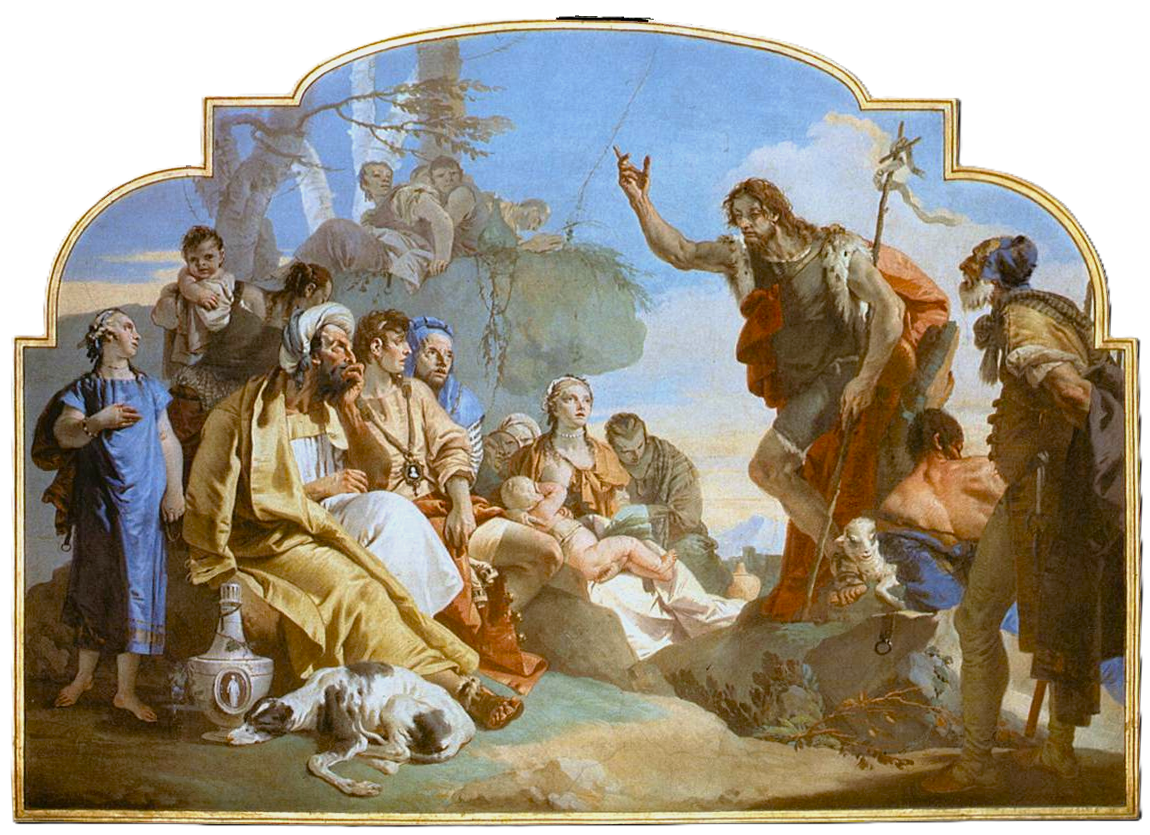
Giovanni Battista Tiepolo, 1732-3
Translation From the Holy Gospel According to John (1:19-28)
At that time the Jews sent from Jerusalem priests and levites to John, to ask him: Who art thou? And he confessed: I am not the Christ. And they asked him: What then? Art thou Elias? And he said: I am not. Art thou the Prophet? And he answered: No. They said therefore unto him: Who art thou, that we may give an answer to them that sent us? He said: I am the voice of one crying in the wilderness, Make straight the way of the Lord, as said the Prophet Isaias. And they that were sent were of the Pharisees. And they asked him, and said to him: Why then dost thou baptize, if thou be not Christ, nor Elias, nor the Prophet? John answered them, saying: I baptize with water: but there hath stood one in the midst of you, whom you know not. The same is He that shall come after me, who is preferred before me: the latchet of whose shoe I am not worthy to loose. These things were done in Bethania, beyond the Jordan, where John was baptizing.
A Message from St. John Paul II “Homily for Gaudéte Sunday,” Dec. 15, 1996.
“Gaudete in Domino semper. Iterum dico: Gaudete! … Dominus prope”. Rejoice in the Lord always; again I will say, Rejoice…. The Lord is at hand (Phi 4:4-5). It is from these words taken from St Paul’s letter to the Philippians, that this Sunday takes the liturgical name “Gaudete”. Today the liturgy urges us to rejoice because the birth of the Lord is approaching.
In his Letter to the Thessalonians, the Apostle exhorts us thus: Rejoice always, pray constantly, give thanks in all circumstances…. May the God of peace himself sanctify you wholly; and may your spirit and soul and body be kept sound and blameless at the coming of our Lord Jesus Christ (1 The 5:16-31).
This is a typical Advent exhortation. Advent is the liturgical season that prepares us for the Lord’s birth, but it is also the time of expectation for the definitive return of Christ for the last judgement, and St Paul refers, in the first place, to this second coming. The very fact that the conclusion of the liturgical year coincides with the beginning of Advent suggests that “the beginning of the time of salvation” is in some way linked to the “end of time”. This exhortation typical of Advent always applies: “The Lord is at hand!”.
In today’s liturgy the prospect of Christ’s coming at Christmas, so near now, seems to prevail. The echo of joy at the Messiah’s birth resounds in the Magnificat, the canticle that wells up in Mary during her visit to the elderly wife of Zechariah. Elizabeth greets Mary with the words: And why is this granted me, that the mother of my Lord should come to me? For behold, when the voice of your greeting came to my ears, the babe in my womb leaped for joy. And blessed is she who believed that there would be a fulfilment of what was spoken to her from the Lord” (Luke 1:43-45). Advanced in age and by now beyond all hope of possible motherhood, Elizabeth had realized that the extraordinary grace granted her was closely linked to the divine plan of salvation. The son who was to be born of her had been foreseen by God as the Precursor called to prepare the way for Christ (cf. Luke 1:76) And Mary replies with the words of the Magnificat, repeated in the responsorial psalm today: My soul magnifies the Lord, and my spirit rejoices in God my Saviour, for he has regarded the low estate of his handmaiden…. He who is mighty has done great things for me, and holy is his name (Luke 1:46-49).
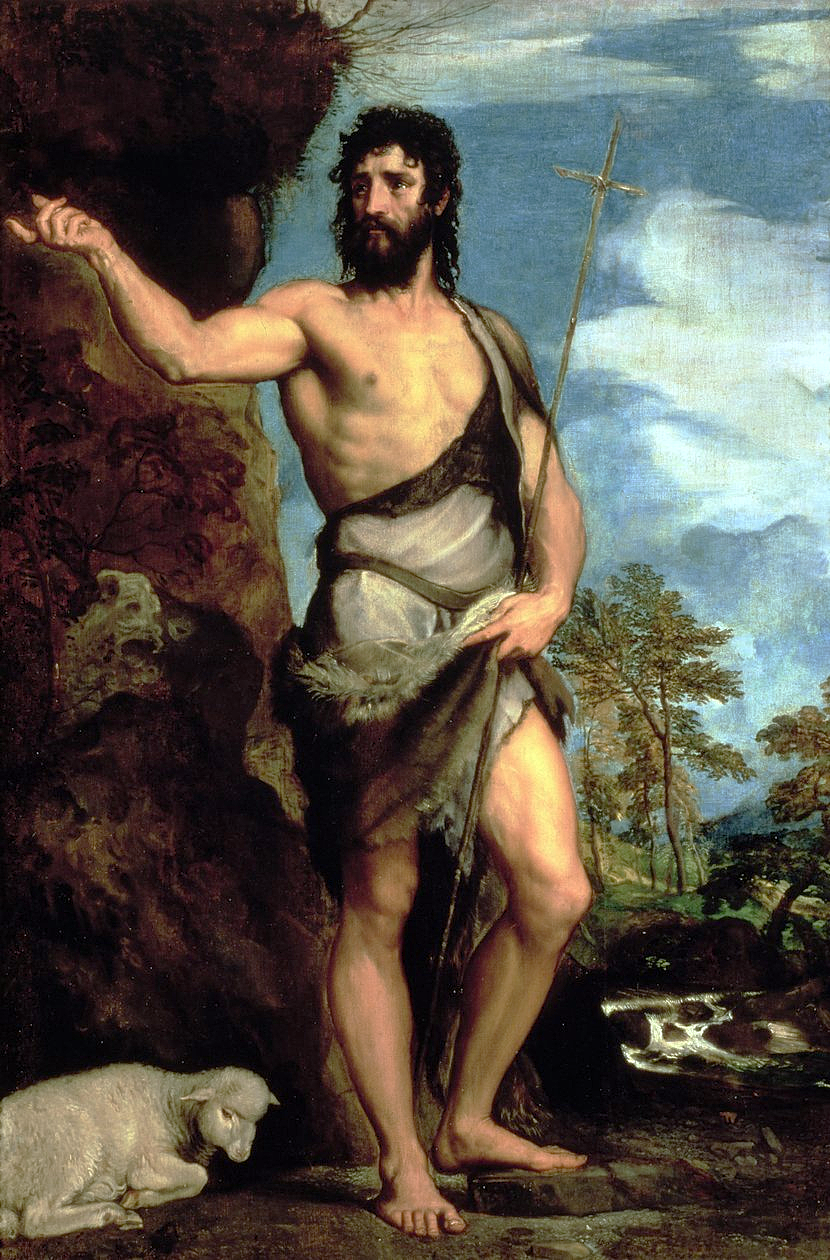
John the Baptist is one of the most significant biblical figures we meet during this important season of the liturgical year. In the fourth Gospel we read: There was a man sent from God, whose name was John. He came for testimony, to bear witness to the light, that all might believe through him. He was not the light, but came to bear witness to the light (John 1:6-8). To the question “Who are you?”, John the Baptist responds: “I am not the Christ”, nor Elijah, nor any other of the prophets (cf. John 1:19-20). And faced with the insistence of those sent from Jerusalem, he says: I am the voice of one crying in the wilderness, ‘Make straight the way of the Lord’ (John 1:23).
With this quote from Isaiah, in a certain sense he reveals his identity and clarifies his special role in the history of salvation. And when the representatives of the Sanhedrin ask him why he is baptizing, although he is neither the Messiah, nor Elijah, nor any other prophet, he answers: I baptize with water; but among you stands one whom you do not know, even he who comes after me, the thong of whose sandal I am not worthy to untie (John 1:26-27).
John the Baptist’s witness re-echoes in the Advent verse: “The Lord is at hand!”. The different perspectives of the night of Bethlehem and the baptism in the Jordan converge in the same truth: we must shake off our inertia and prepare the way of the Lord who comes.
…
My hope is that the Good News of Christ will enter every home and help families to rediscover that only in Christ can man find salvation. In him it is possible to find the interior peace, hope and strength necessary to face life’s various situations each day, even those most onerous and difficult. In the letter accompanying the Gospel, I recalled that Jesus is not a figure of the past. He is the Word of God who even today continues to shed light on man’s path; his actions are the expression of the Father’s love for every human being.
The spirit of the Lord God is upon me, because the Lord has anointed me; he has sent me to bring glad tidings to the lowly, to heal the broken-hearted, to proclaim liberty to the captives and release to the prisoners, to announce a year of favour from the Lord (Iss 61:1-2).
In the synagogue of Nazareth, at the moment of beginning his public ministry, Christ will apply these words of the prophet Isaiah to himself. Today he repeats them for us during this liturgical assembly, and in repeating them he invites us to rejoice again with the words of Isaiah: I rejoice heartily in the Lord, in my God is the joy of my soul; for he has clothed me with a robe of salvation, and wrapped me in a mantle of justice (Isa 61:10).
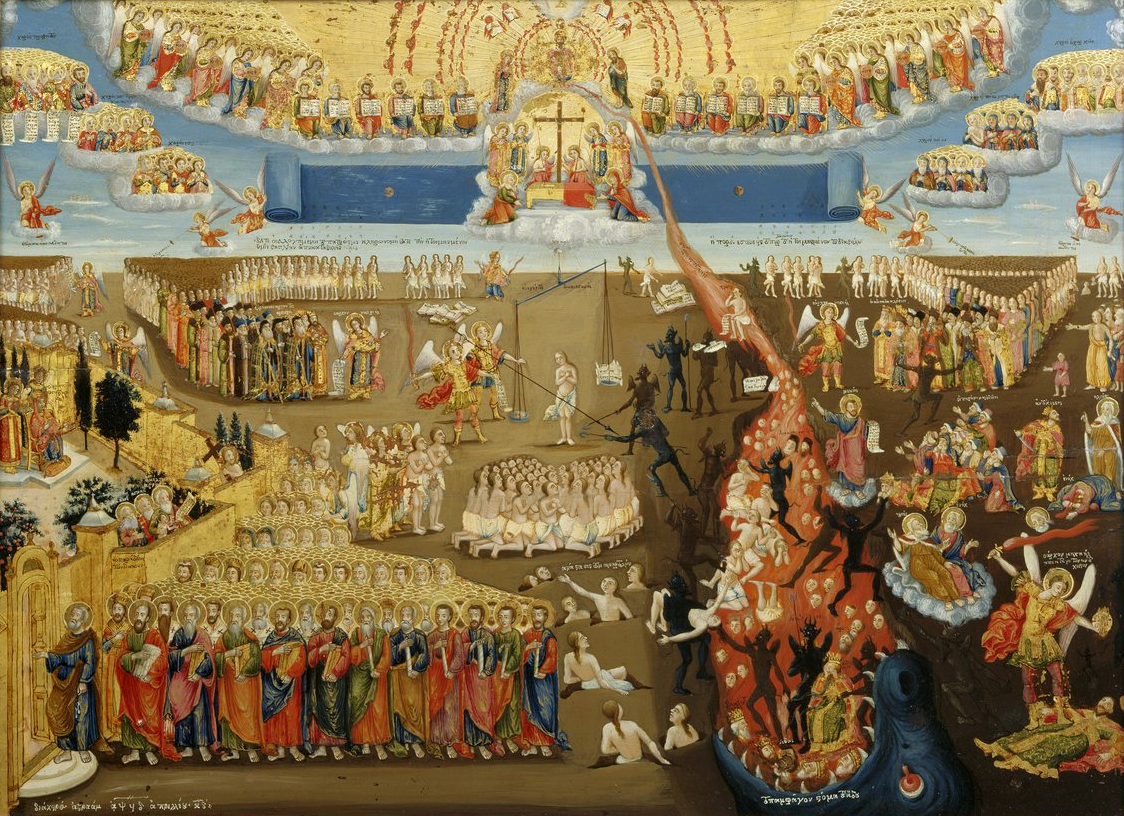
Abraham Abraham, 1794
The prophet’s joyful proclamation is echoed in what St Paul writes in the passage from his Letter to the Thessalonians we have just heard. Isaiah affirms: I rejoice heartily in the Lord (Isa 61:10), and Paul exhorts: Rejoice! The Lord is at hand! (cf. Phi 4:4-5; 1 The 5:16).
The Lord Jesus is at hand at every moment of our life. He is at hand if we consider him in the perspective of Christmas, but he is also at hand if we look at him on the banks of the Jordan when he officially receives his messianic mission from the Father; lastly, he is at hand in the perspective of his return at the end of time.
Christ is at hand! He comes by virtue of the Holy Spirit to announce the Good News; he comes to cure and to set free, to proclaim a time of grace and salvation, in order to begin, already on the night of Bethlehem, the work of the world’s redemption.
Let us therefore rejoice and exult! The Lord is at hand; he is coming to save us.