
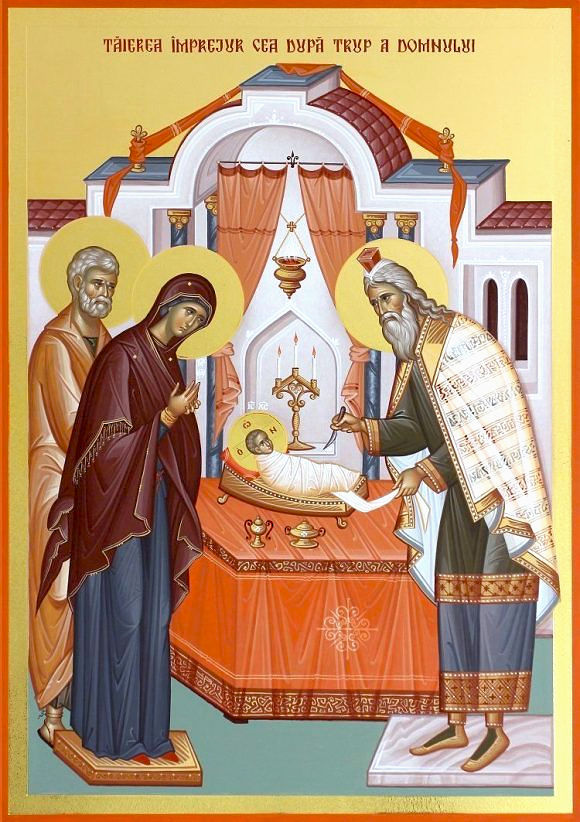
Translation of the Gospel According to Luke (2:21)
At that time, after eight days were accomplished, that the child should be circumcised; His Name was called Jesus, which was called by the Angel before He was conceived in the womb.
Messages from St. Anthony of Padua’s The Festival Sermons, “The Circumcision of the Lord.”
At that time: After eight days were completed, etc. (Luke 2:21)
In this Gospel two things are noted: Christ’s circumcision and the calling of his name.
Christ’s circumcision: After eight days were completed, that the child should be circumcised. Note that in this first clause we are taught, anagogically, how every just person will be circumcised from all corruption in the general resurrection. But “because you have heard a circumcised word about the circumcised Word, let us speak in a circumcised way about his circumcision.”1
“Christ was circumcised in the body alone, because he had nothing in the mind that might be circumcised. For, he did no sin, neither was guile found in his mouth (1 Peter 2:22). But neither did he contract sin, for, as Isaiah says: He ascended upon a light cloud (Isa 19:1), that is, he assumed flesh free from sin.2 “Coming into his own, because his own would not receive him (cf. John 1:11) he had to be circumcised, lest the Jews should take occasion against him and say, ‘You are uncircumcised, you should perish from your people, because as Genesis says,
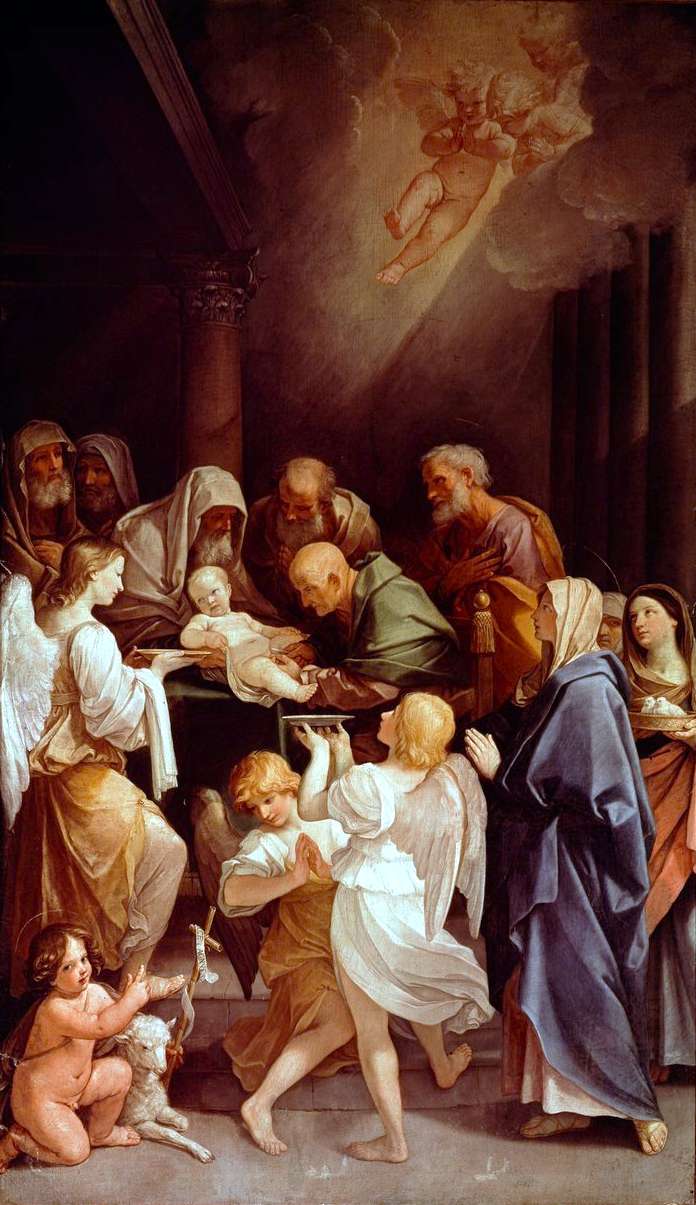
The male, whose flesh of his foreskin shall not be circumcised, shall be destroyed out of his people. (Gen 17:14)
You are a transgressor of the Law, we will not hear you against the Law.’”3
He was circumcised, then, for at least three reasons: to fulfil the law- “The mystery of circumcision had to be observed until the sacrament of Baptism should be substituted;”4 to take away any occasion for the Jews to calumniate him; and “to teach us the circumcision of the heart. Of this, Romans says:
The circumcision of the heart is in the spirit, not in the letter; whose praise is not of men, but of God. (Rom 2:29)”5
After eight days were completed. Let us see what these three mean, the eighth day, the child and his circumcision. Our life revolves in seven days, after which comes the eighth day of the resurrection. Ecclesiastes 11 says of this:
Give a portion to seven, and also to eight: for thou knowest not what evil shall be on the earth. (Eccl 11:2)
That is as if to say, Give the seven days of your life a share of good works, for which you will receive a reward in the eighth day of the resurrection. In that day there will be such great evil upon earth (that is, on earthly folk who love the earth), that it not known to any man.
Then the floor will be cleansed and the wheat separated from the straw (cf. Matt 3:12; Luke 3:17), and the sheep will be separated from the goats (cf. Matt 25:32). The sweeping of the floor is the giving of the final Judgement; the wheat means the just who are to be stored in the heavenly barn. So Job 5 says:
Thou shalt enter into the grave in abundance, as a heap of wheat is brought in its season. (Job 5:26)
The grave is eternal life, in which the just are hidden from the troubling of the demons, as a person is hidden in the grave from the sight of men, when they enter it in the abundance of their good works. The straw, meaning the proud who are light and unstable, will be burned with fire, as Job 21 says:
They shall be as chaff before the face of the wind, and as ashes which the whirlwind scattereth. (Job 21:18)
The lambs or sheep, that is, the humble and innocent, will be set at Christ’s right hand, as Isaiah 40 says:
He shall feed his flock like a shepherd. He shall gather the lambs with his arm and shall take them up in his bosom; and he himself shall carry them that are with young. (Isa 40:11)
Note that in these four words, ‘feed’, ‘gather’, ‘take up’ and ‘carry’, we may discern the four gifts of the body (clarity, immortality, agility and subtlety) which the just will have in the eighth day of the resurrection. He will ‘feed’ by clarity; as in Ecclesiastes 11:
The light is sweet: and it is delightful for the eyes to see the sun. (Ecc 11:7) Regarding this he says:
The just shall shine out like the sun in the kingdom of God (cf. Matt 13:43)
If the eye which is still corruptible is so delighted by the deceitful brightness of the wretched body, how great do you think that delight will be in the true splendour of the glorified body? He will ‘gather’ by immortality, for death scatters and immortality gathers together. He will ‘take up’ by agility; what is agile is easily lifted. He will ‘carry’ by subtlety; that which is subtle is easily carried.
The goats, however, (that is, the lustful) will be hung by the heels on the pikes of hell. The Lord curses the ‘fat cows’ (cf. Amo 4:1), the proud and lustful prelates of the Church, in Amos 4:
The days shall come upon you, when they (the demons,) shall lift you up on pikes and what shall remain of you in boiling pots. And you shall go out at the breaches one over against the other: and you shall be cast forth into Hermon, (Amo 4:2-3),
meaning ‘anathema’, because being anathematized and cursed by the Church Triumphant, they will go into eternal punishment.
All this, namely glory and punishment, will be given to each in the eighth day of the resurrection, according to what each has done in the seven days of this life. Genesis 29 says of this:
Jacob served seven years for Rachel; and they seemed but a few days, because of the greatness of his love. (Gen 29:20)
She was well favoured, and of a beautiful countenance (Gen 29:17). A little later, it says that:
After the week was past, he married Rachel. (Gen 29:28)
He refers to the same in chapter 31:
Day and night was I parched with heat, and with frost; and sleep departed from my eyes. (Gen 31:40)
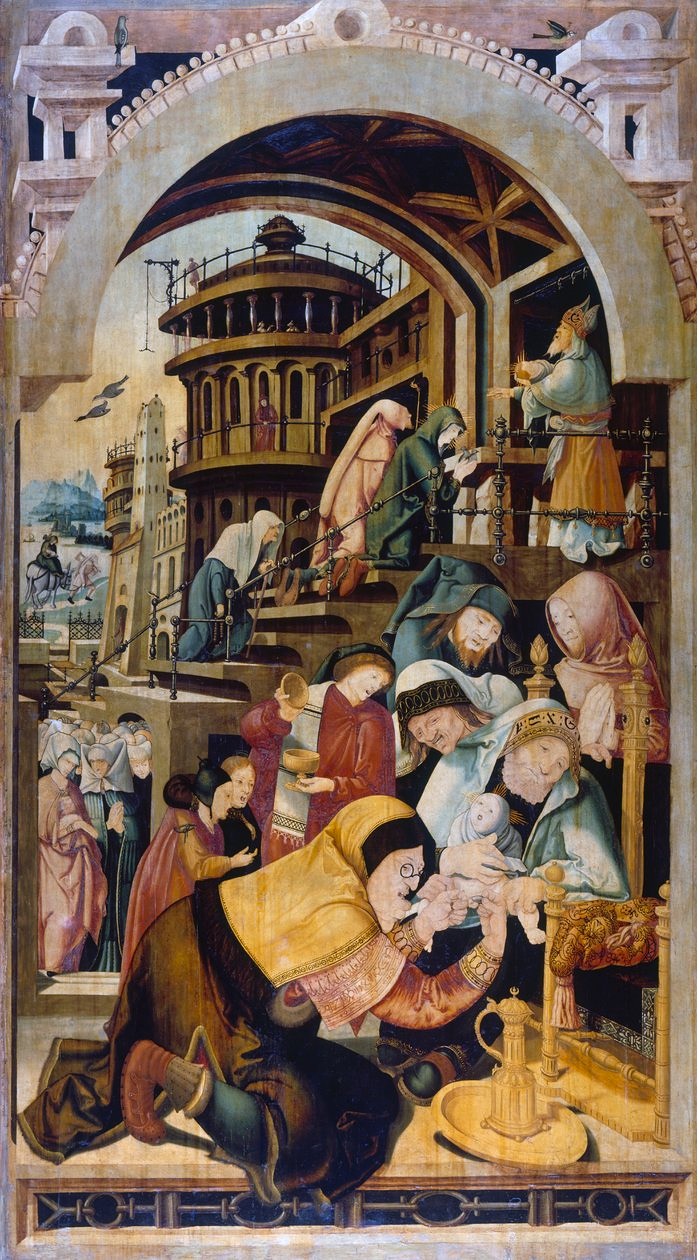
Jerg Ratgeb, cir 1515-19
O love of beauty! O beauty of love! O glory of the resurrection, how much you enable man to bear, so as to attain to you nuptials! The just man serves the whole septenary of his life in lowliness of body and humility of mind. He is parched in the day, when prosperity burns with the heat of vainglory; and in the night, when adversity assails with the frost of diabolical temptation. Thus, all sleep and rest flee away, for there are ‘combats within, fears without’ (cf. 2 Cor 7:5). He fears the world, he fights against himself; and yet amid such evils the days seem few, so great is his love. “Nothing is hard for a lover.”6 O Jacob, I pray you, be patient, bear all humbly, for when the week of this present misery is past, you will attain the long-desired wedding of the glorious resurrection, in which you will be circumcised from all toil and slavery to corruption.
So it is said: After eight days were completed, that the child should be circumcised.
It says ‘the child’, not ‘an old man’. Who this child is, see in the “Sermon for the Nativity.”7 In that resurrection, every elect soul shall be circumcised, for, as Isidore8 says, “He will rise to glory without any vice, or any deformity.” All weakness, slowness, corruption and need will be far away, and anything else that does not befit that kingdom of the Highest King, wherein ‘the children of the resurrection and of the promise shall be equal to the angels of God’ (cf. Luke 20:36). Then there will be true immortality. “The first state of man was the possibility of not dying; because of sin, his punishment was the impossibility of not dying. The third state, in bliss, will be the impossibility of dying.”9 “Then free will shall be full. It was given to the first man to be able not to sin; but how much more blessed it will be, to be unable to sin!”10 O desirable eighth day, which circumcises all evil from the child!
1 cf. INNOCENT III, “Sermon 4, On the circumcision of the Lord”; PL 217.465
2 ibid.
3 ibid.
4 ibid.
5 ibid
6 CICERO, Oratio X,33
7 See , Festival Sermon on the Nativity, 11-14
8 ISIDORE, Sententiae 1,26,1-2; PL 83.594
9 cf. P.LOMBARD, Sententiae, II, dist 19,4
10 cf. ibid. dist 25,3
11 cf. BERNARD, In Cantica sermo 15,6; PL 183.847
12 ROMAN BREVIARY, “Office of the Dead,” Resp. 3 at Mattins
13 INNOCENT III, Sermons on the Saints 4, “On the Circumcision of the Lord”; PL 217.4667
14 In Latin, J is a vowel, the same as I.
15 Athanasian Creed
16 INNOCENT III, loc. cit.
17 INNOCENT III, loc. cit.; PL 217.470
18 P.COMESTOR, Historia scholastica, liber Exodi, 10; PL 198.1147
19 RICHARD OF ST VICTOR, Mystical notes on the Psalms, Ps 121; PL 196.365-6