
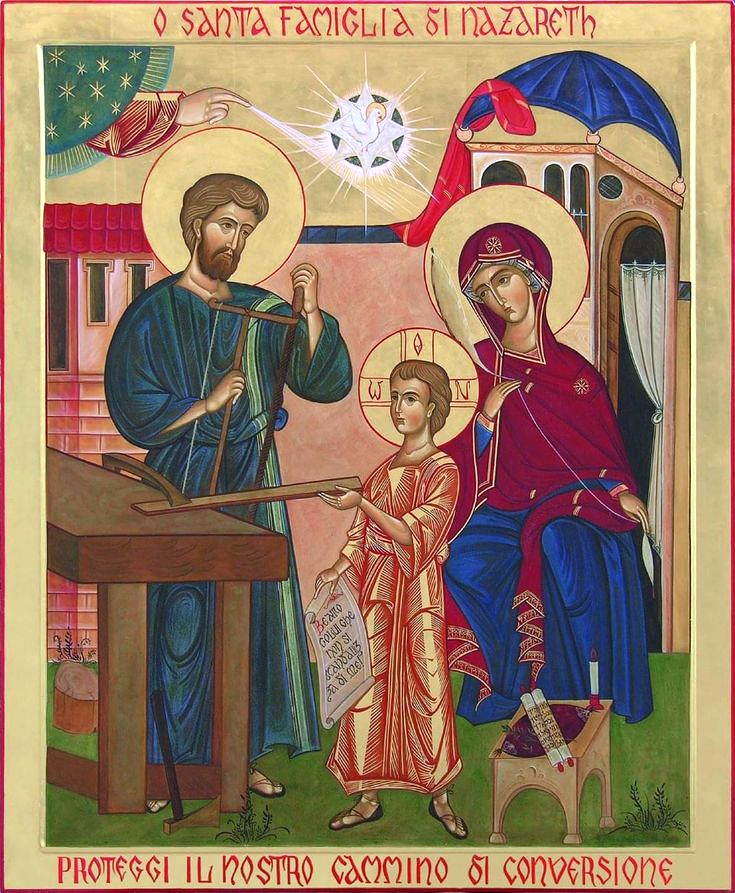
Translation From the Holy Gospel According to Luke (2:42-52)
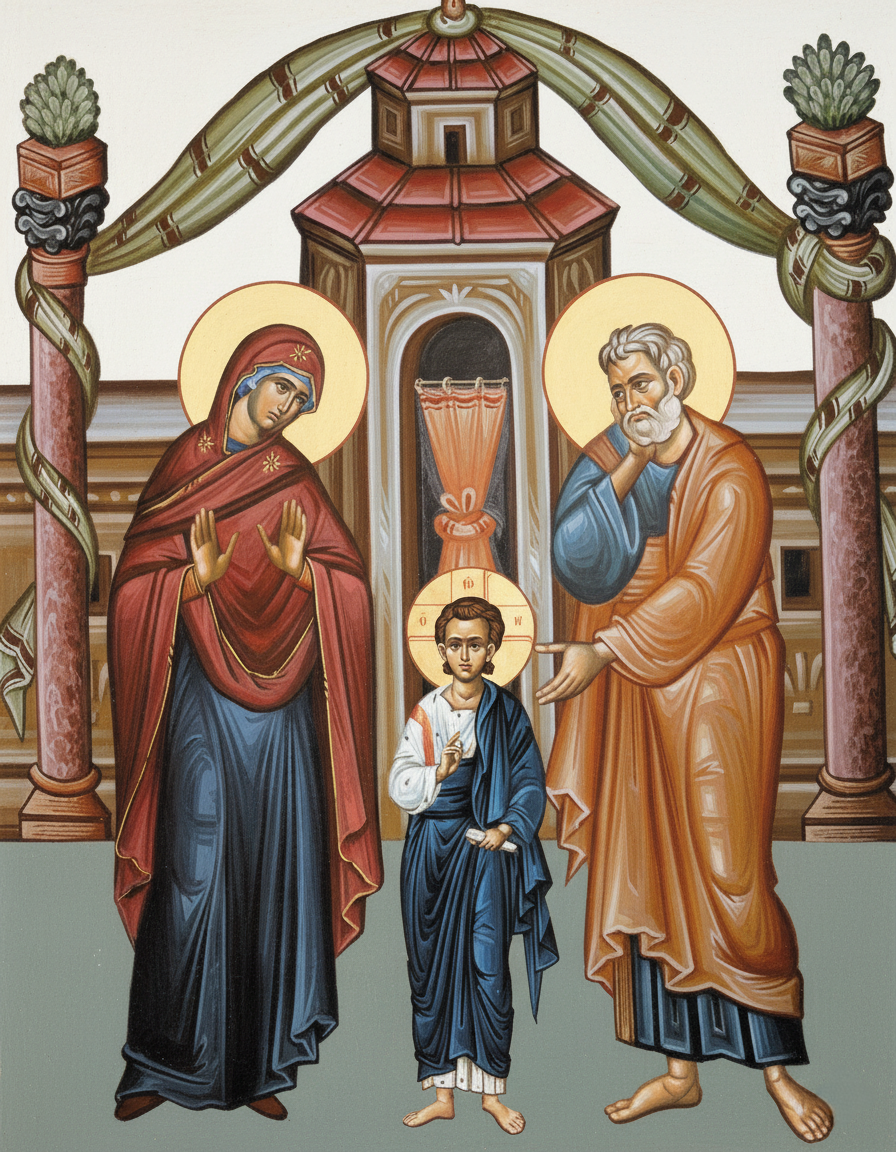
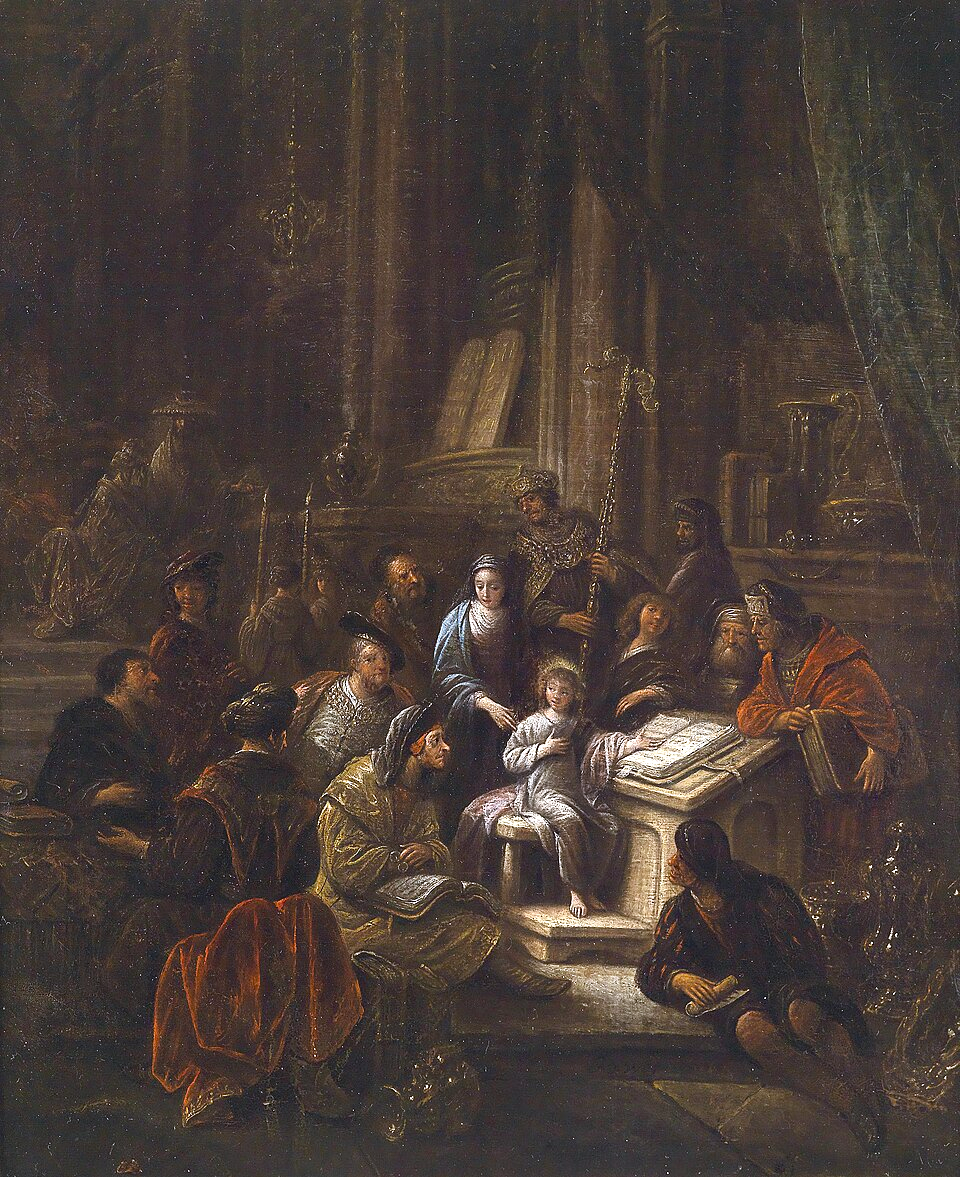
When Jesus was twelve years old, they going up into Jerusalem according to the custom of the feast, and having fulfilled the days, when they returned, the Child Jesus remained in Jerusalem, and His parents knew it not. And thinking that He was in the company, they came a day’s journey, and sought Him among their kinsfolk and acquaintances. And not finding Him, they returned into Jerusalem, seeking Him. And it came to pass that after three days they found Him in the Temple, sitting in the midst of the doctors, hearing them and asking them questions. And all that heard Him were astonished at His wisdom and His answers. And seeing Him they wondered. And His Mother said to Him: Son, why hast Thou done so to us? Behold Thy father and I have sought Thee sorrowing. And He said to them: how is it that you sought Me? Did you not know that I must be about My Father’s business? And they understood not the word that He spoke unto them. And he went down with them and came to Nazareth, and was subject to them. And His Mother kept all these words in her heart. And Jesus advanced in wisdom and age and grace with God and men.
A Message from St. Augustine’s On Marriage and Concupiscence
Book I
Chapter 11 [X.]—The Sacrament of Marriage; Marriage Indissoluble; The World’s Law About Divorce Different from the Gospel’s.
It is certainly not fecundity only, the fruit of which consists of offspring, nor chastity only, whose bond is fidelity, but also a certain sacramental bond31 in marriage which is recommended to believers in wedlock. Accordingly it is enjoined by the apostle: Husbands, love your wives, even as Christ also loved the Church.32 Of this bond the substance33 undoubtedly is this, that the man and the woman who are joined together in matrimony should remain inseparable as long as they live; and that it should be unlawful for one consort to be parted from the other, except for the cause of fornication.34 For this is preserved in the case of Christ and the Church; so that, as a living one with a living one, there is no divorce, no separation for ever. And so complete is the observance of this bond in the city of our God, in His holy mountain35 —that is to say, in the Church of Christ—by all married believers, who are undoubtedly members of Christ, that, although women marry, and men take wives, for the purpose of procreating children, it is never permitted one to put away even an unfruitful wife for the sake of having another to bear children. And whosoever does this is held to be guilty of adultery by the law of the Gospel; though not by this world’s rule, which allows a divorce between the parties, without even the allegation of guilt, and the contraction of other nuptial engagements,—a concession which, the Lord tells us, even the holy Moses extended to the people of Israel, because of the hardness of their hearts.36 The same condemnation applies to the woman, if she is married to another man. So enduring, indeed, are the rights of marriage between those who have contracted them, as long as they both live, that even they are looked on as man and wife still, who have separated from one another, rather than they between whom a new connection has been formed. For by this new connection they would not be guilty of adultery, if the previous matrimonial relation did not still continue. If the husband die, with whom a true marriage was made, a true marriage is now possible by a connection which would before have been adultery. Thus between the conjugal pair, as long as they live, the nuptial bond has a permanent obligation, and can be cancelled neither by separation nor by union with another. But this permanence avails, in such cases, only for injury from the sin, not for a bond of the covenant. In like manner the soul of an apostate, which renounces as it were its marriage union with Christ, does not, even though it has cast its faith away, lose the sacrament of its faith, which it received in the laver of regeneration. It would undoubtedly be given back to him if he were to return, although he lost it on his departure from Christ. He retains, however, the sacrament after his apostasy, to the aggravation of his punishment, not for meriting the reward.
Chapter 12 [XI.]—Marriage Does Not Cancel a Mutual Vow of Continence; There Was True Wedlock Between Mary and Joseph; In What Way Joseph Was the Father of Christ.
But God forbid that the nuptial bond should be regarded as broken between those who have by mutual consent agreed to observe a perpetual abstinence from the use of carnal concupiscence. Nay, it will be only a firmer one, whereby they have exchanged pledges together, which will have to be kept by an especial endearment and concord,—not by the voluptuous links of bodies, but by the voluntary affections of souls. For it was not deceitfully that the angel said to Joseph: Fear not to take unto thee Mary thy wife.37 She is called his wife because of her first troth of betrothal, although he had had no carnal knowledge of her, nor was destined to have. The designation of wife was neither destroyed nor made untrue, where there never had been, nor was meant to be, any carnal connection. That virgin wife was rather a holier and more wonderful joy to her husband because of her very pregnancy without man, with disparity as to the child that was born, without disparity in the faith they cherished. And because of this conjugal fidelity they are both deservedly called “parents”38 of Christ (not only she as His mother, but he as His father, as being her husband), both having been such in mind and purpose, though not in the flesh. But while the one was His father in purpose only, and the other His mother in the flesh also, they were both of them, for all that, only the parents of His humility, not of His sublimity; of His weakness, not of His divinity. For the Gospel does not lie, in which one reads, Both His father and His mother marvelled at those things which were spoken about Him;39 and in another passage, Now His parents went to Jerusalem every year;40 and again a little afterwards, His mother said unto Him, Son, why hast Thou thus dealt with us? Behold, Thy father and I have sought Thee sorrowing.41 In order, however, that He might show them that He had a Father besides them, who begat Him without a mother, He said to them in answer: How is it that ye sought me? Wist ye not that I must be about my Father’s business?42 Furthermore, lest He should be thought to have repudiated them as His parents by what He had just said, the evangelist at once added: And they understood not the saying which He spake unto them; and He went down with them, and came to Nazareth, and was subject unto them.43 Subject to whom but His parents? And who was the subject but Jesus Christ, who, being in the form of God, thought it not robbery to be equal with God?44 And wherefore subject to them,who were far beneath the form of God, except that He emptied Himself, and took upon Him the form of a servant,45 —the form in which His parents lived? Now, since she bore Him without his engendering, they could not surely have both been His parents, of that form of a servant, if they had not been conjugally united, though without carnal connection. Accordingly the genealogical series (although both parents of Christ are mentioned together in the succession)46 had to be extended, as it is in fact,47 down rather to Joseph’s name, that no wrong might be done, in the case of this marriage, to the male, and indeed the stronger sex, while at the same time there was nothing detrimental to truth, since Joseph, no less than Mary, was of the seed of David,48 of whom it was foretold that Christ should come.
Chapter 13.—In the Marriage of Mary and Joseph There Were All the Blessings of the Wedded State; All that is Born of Concubinage is Sinful Flesh.
124 The entire good, therefore, of the nuptial institution was effected in the case of these parents of Christ: there was offspring, there was faithfulness, there was the bond.49 As offspring, we recognise the Lord Jesus Himself; the fidelity, in that there was no adultery; the bond,50 because there was no divorce. [XII.] Only there was no nuptial cohabitation; because He who was to be without sin, and was sent not in sinful flesh, but in the likeness of sinful flesh,51 could not possibly have been made in sinful flesh itself without that shameful lust of the flesh which comes from sin, and without which He willed to be born, in order that He might teach us, that every one who is born of sexual intercourse is in fact sinful flesh, since that alone which was not born of such intercourse was not sinful flesh. Nevertheless conjugal intercourse is not in itself sin, when it is had with the intention of producing children; because the mind’s good-will leads the ensuing bodily pleasure, instead of following its lead; and the human choice is not distracted by the yoke of sin pressing upon it, inasmuch as the blow of the sin is rightly brought back to the purposes of procreation. This blow has a certain prurient activity which plays the king in the foul indulgences of adultery, and fornication, and lasciviousness, and uncleanness; whilst in the indispensable duties of the marriage state, it exhibits the docility of the slave. In the one case it is condemned as the shameless effrontery of so violent a master; in the other, it gets modest praise as the honest service of so submissive an attendant. This lust, then, is not in itself the good of the nuptial institution; but it is obscenity in sinful men, a necessity in procreant parents, the fire of lascivious indulgences, the shame of nuptial pleasures. Wherefore, then, may not persons remain man and wife when they cease by mutual consent from cohabitation; seeing that Joseph and Mary continued such, though they never even began to cohabit?
31 Quoddam sacramentum.
32 Eph 5:25.
33 Res sacramenti.
34 Matt 5:32.
35 Psa 48:2.
36 Matt 19:8.
37 Matt 1:20.
38 ibid. 2:41.
39 ibid. 2:33, the Vulgate as well as the best Greek texts, instead of the “And Joseph and His mother marvelled,” etc., of the common text.
40 ibid. 2:41.
41 ibid. 2:48.
42 ibid. 2:49.
43 ibid. 2:50-51.
44 Phl 2:6.
45 Phl 2:7.
46 Matt 1:16.
47 Compare Luke 3:23 with Matt 1:16.
48 Luke 1:27.
49 Sacramentum.
50 ibid.
51 Rom 8:3