

Translation of the Holy Gospel According to Luke (11:14-28)
At that time Jesus was casting out a devil, and the same was dumb. And when He had cast out the devil, the dumb spoke, and the multitudes were in admiration at it. But some of them said: He casteth out devils by Beelzebub, the prince of devils. And others, tempting, asked of Him a sign from Heaven. But He, seeing their thoughts, said to them: Every kingdom divided against itself shall be brought to desolation, and house upon house shall fall. And if Satan also be divided against himself, how shall this kingdom stand? Because you say that through Beelzebub I cast out devils. Now if I cast out devils by Beelzebub, by whom do your children cast them out? Therefore, they shall be your judges. But if I by the finger of God cast out devils: doubtless the kingdom of God is come upon you. When a strong man armed keepeth his court, those things are in peace which he possesseth. But if a stronger than he come upon him and overcome him, he will take away all his armor wherein he trusted, and will distribute his spoils. He that is not with Me is against Me: and he that gathereth not with Me scattereth. When the unclean spirit is gone out of a man, he walketh through places without water, seeking rest: and not finding, he saith: I will return into my house whence I came out. And when he is come, he findeth it swept and garnished. Then he goeth and taketh with him seven other spirits more wicked than himself, and entering in they dwell there. And the last state of that man becomes worse than the first. And it came to pass, as He spoke these things, a certain woman from the crowd, lifting up her voice, said to Him: Blessed is the womb that bore Thee, and the paps that gave Thee suck. But He said: Yea, rather, blessed are they who hear the word of God, and keep it.
A Message From St. John Chrysostom’s Homilies on John, XXI.
John 2:4. Woman, what have I to do with thee? Mine hour is not yet come.
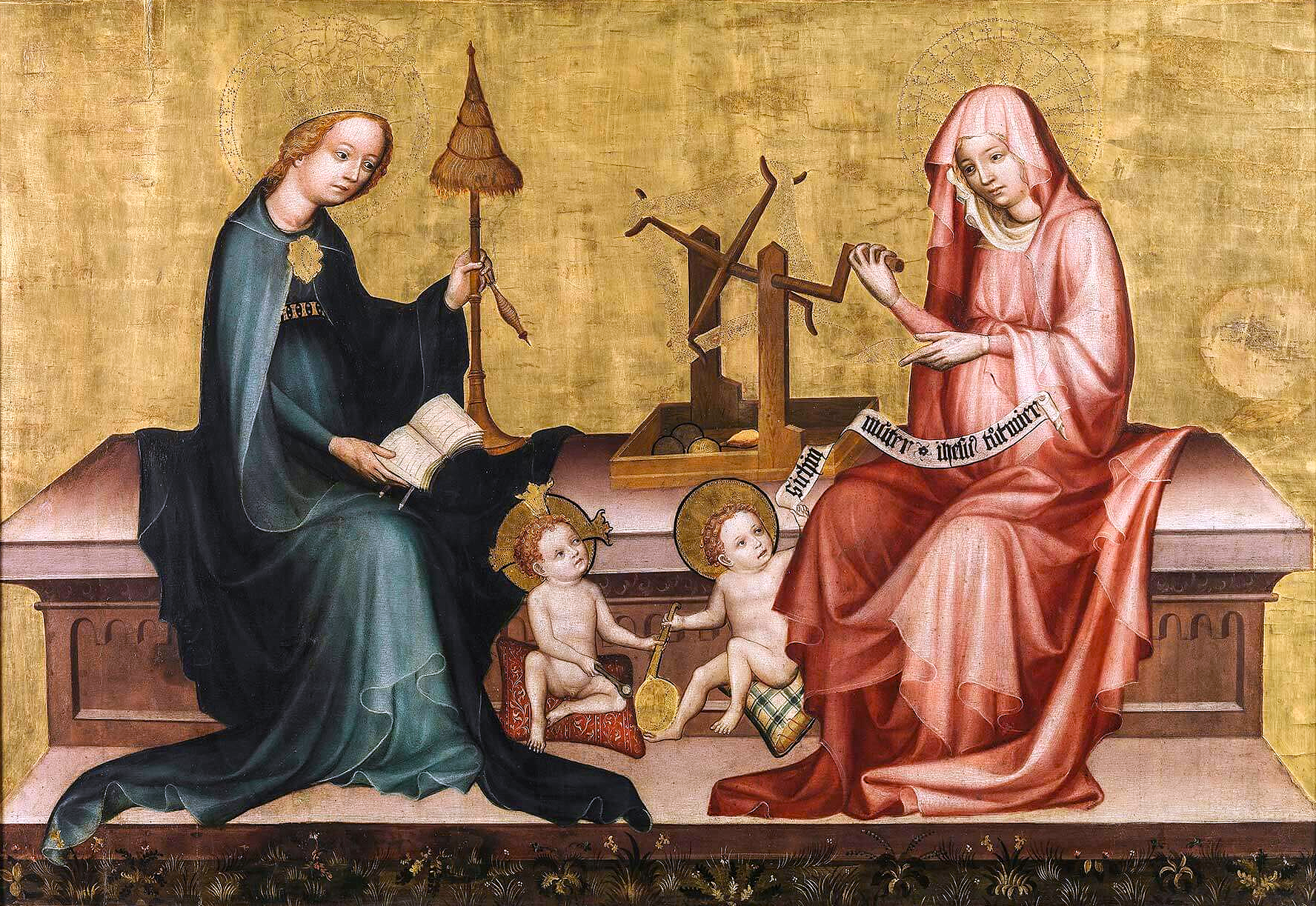
Altar of St Mary, Nuremberg, c. 1400/1410
To prove that He greatly respected His mother, hear Luke relate how He was subject to His parents (Luke 2:51), and John declare how He had forethought for her at the very season of the Crucifixion. For where parents cause no impediment or hindrance in things belonging to God, it is our bounden duty to give way to them, and there is great danger in not doing so; but when they require anything unseasonably, and cause hindrance in any spiritual matter, it is unsafe to obey. And therefore He answered thus in this place, and again elsewhere, Who is My mother, and who are My brethren? (Matt 12:48), because they did not yet think rightly of Him; and she, because she had borne Him, claimed, according to the custom of other mothers, to direct Him in all things, when she ought to have reverenced and worshiped Him. This then was the reason why He answered as He did on that occasion. For consider what a thing it was, that when all the people high and low were standing round Him, when the multitude was intent on hearing Him, and His doctrine had begun to be set forth, she should come into the midst and take Him away from the work of exhortation, and converse with Him apart, and not even endure to come within, but draw Him outside merely to herself. This is why He said, Who is My mother and My brethren? Not to insult her who had borne Him, (away with the thought!) but to procure her the greatest benefit, and not to let her think meanly of Him. For if He cared for others, and used every means to implant in them a becoming opinion of Himself, much more would He do so in the case of His mother. And since it was probable that if these words had been addressed to her by her Son, she would not readily have chosen even then to be convinced, but would in all cases have claimed the superiority as being His mother, therefore He replied as He did to them who spake to Him; otherwise He could not have led up her thoughts from His present lowliness to His future exaltation, had she expected that she should always be honored by Him as by a son, and not that He should come as her Master.
It was then from this motive that He said in this place, Woman, what have I to do with thee? and also for another reason not less pressing. What was that? It was, that His miracles might not be suspected. The request ought to have come from those who needed, not from His mother. And why so? Because what is done at the request of one’s friends, great though it be, often causes offense to the spectators; but when they make the request who have the need, the miracle is free from suspicion, the praise unmixed, the benefit great. So if some excellent physician should enter a house where there were many sick, and be spoken to by none of the patients or their relations, but be directed only by his own mother, he would be suspected and disliked by the sufferers, nor would any of the patients or their attendants deem him able to exhibit anything great or remarkable. And so this was a reason why He rebuked her on that occasion, saying, Woman, what have I to do with thee? instructing her for the future not to do the like; because, though He was careful to honor His mother, yet He cared much more for the salvation of her soul, and for the doing good to the many, for which He took upon Him the flesh.
These then were the words, not of one speaking rudely to his mother, but belonging to a wise dispensation, which brought her into a right frame of mind, and provided that the miracles should be attended with that honor which was meet. And setting other things aside, this very appearance which these words have of having been spoken chidingly, is amply enough to show that He held her in high honor, for by His displeasure He showed that He reverenced her greatly; in what manner, we will say in the next discourse. Think of this then, and when you hear a certain woman saying, Blessed is the womb that bare Thee, and the paps which Thou hast sucked,” and Him answering, “rather blessed are they that do the will of my Father (Luke 11:27), suppose that those other words also were said with the same intention. For the answer was not that of one rejecting his mother, but of One who would show that her having borne Him would have nothing availed her, had she not been very good and faithful. Now if, setting aside the excellence of her soul, it profited Mary nothing that the Christ was born of her, much less will it be able to avail us to have a father or a brother, or a child of virtuous and noble disposition, if we ourselves be far removed from his virtue. A brother, saith David, doth not redeem shall man redeem? (Psa 49:7 LXX). We must place our hopes of salvation in nothing else, but only in our own righteous deeds (done) after a the grace of God. For if this by itself could have availed, it would have availed the Jews, (for Christ was their kinsman according to the flesh,) it would have availed the town in which He was born, it would have availed His brethren. But as long as His brethren cared not for themselves, the honor of their kindred availed them nothing, but they were condemned with the rest of the world, and then only were approved, when they shone by their own virtue; and the city fell, and was burnt, having gained nothing from this; and His kinsmen according to the flesh were slaughtered and perished very miserably, having gained nothing towards being saved from their relationship to Him, because they had not the defense of virtue. The Apostles, on the contrary, appeared greater than any, because they followed the true and excellent way of gaining relationship with Him, that by obedience. And from this we learn that we have always need of faith, and a life shining and bright, since this alone will have power to save us. For though His relations were for a long time everywhere held in honor, being called the Lord’s kinsmen, yet now we do not even know their names, while the lives and names of the Apostles are everywhere celebrated.
Let us then not be proud of nobleness of birth according to the flesh, but though we have ten thousand famous ancestors, let us use diligence ourselves to go beyond their excellences, knowing that we shall gain nothing from the diligence of others to help us in the judgment that is to come; nay, this will be the more grievous condemnation, that though born of righteous parents and having an example at home, we do not, even thus, imitate our teachers. And this I say now, because I see many heathens, when we lead them to the faith and exhort them to become Christians, flying to their kinsmen and ancestors and house, and saying, “All my relations and friends and companions are faithful Christians.” What is that to thee, thou wretched and miserable? This very thing will be especially thy ruin, that thou didst not respect the number of those around thee, and run to the truth. Others again who are believers but live a careless life, when exhorted to virtue make the very same defense, and say, “my father and my grandfather and my great-grandfather were very pious and good men.” But this will assuredly most condemn thee, that being descended from such men, thou hast acted unworthily of the root from whence thou art sprung. For hear what the Prophet says to the Jews, Israel served for a wife, and for a wife he kept (sheep) (Hos 12:12); and again Christ, Your father Abraham rejoiced to see My day, and he saw it, and was glad. (John 8:56). And everywhere they bring forward to them the righteous acts of their fathers, not only to praise them, but also to make the charge against their descendants more heavy. Knowing then this, let us use every means that we may be saved by our own works, lest having deceived ourselves by vain trusting on others, we learn that we have been deceived when the knowledge of it will profit us nothing. In the grave, saith David, who shall give thee thanks? (Psa 6:5). Let us then repent here, that we may obtain the everlasting goods, which may God grant we all do, through the grace and lovingkindness of our Lord Jesus Christ, with whom to the Father and the Holy Ghost be glory, for ever and ever. Amen.