
Translation of the Holy Gospel According to John (6:1-15)

Antonio Muñoz Degrain, 1909
At that time, Jesus went over the Sea of Galilee which is that of Tiberias; and a great multitude followed Him, because they saw the miracles which He did on them that were diseased. Jesus therefore went up into a mountain, and there He sat with His disciples. Now the pasch, the festival day of the Jews, was near at hand. When Jesus therefore had lifted up His eyes, and seen that a very great multitude cometh to Him, He said to Philip, Whence shall we buy bread that these may eat? And this He said to try him; for He Himself knew what He would do. Philip answered Him, Two hundred penny-worth of bread is not sufficient for them, that every one may take a little. One of His disciples, Andrew, the brother of Simon Peter, saith to Him, There is a boy here that hath five barley loaves and two fishes; but what are these among so many? Then Jesus said: Make the men sit down. Now there was much grass in the place. The men therefore sat down, in number about five thousand. And Jesus took the loaves; and when He had given thanks, He distributed to them that were set down. In like manner also of the fishes, as much as they would. And when they were filled, He said to His disciples, Gather up the fragments that remain, lest they be lost. They gathered up therefore, and filled twelve baskets with the fragments of the five barley loaves, which remained over and above to them that had eaten. Now those men, when they had seen what a miracle Jesus had done, said, This is of a truth the prophet that is to come into the world. Jesus therefore, when He knew that they would come to take Him by force and make Him king, fled again into the mountain Himself alone.
From St. Augustine’s Homilies On The Gospel of John: Tract XXV

V.D. Polenov, 1909
When that miracle was wrought, in which Jesus fed the five thousand with five loaves, and the multitudes marveled and said that He was a great prophet that came into the world, then follows this: When Jesus therefore knew that they came to seize Him, and to make Him king, He escaped again unto the mountain alone (John 6:15). It is therefore given to be understood that the Lord, when He sat on the mountain with His disciples, and saw the multitudes coming to Him, had descended from the mountain, and fed the multitudes on its lower parts. For how can it be that He should escape thither again, if He had not before descended from the mountain? There is something meant by the Lord’s descending from on high to feed the multitudes. He fed them, and ascended.
But why did He ascend after He knew that they wished to seize Him and make Him a king? How then; was He not a king, that He was afraid to be made a king? He was certainly not such a king as would be made by men, but such as would bestow a kingdom on men. May it not be that Jesus, whose deeds are words, does here, too, signify something to us? Therefore in this, that they wished to seize Him and make Him a king, and that for this He escapes to the mountain alone, is this action in His case silent; does it speak nothing, does it mean nothing? Or was this seizing of Him perhaps an intention to anticipate the time of His kingdom? For He had come now, not to reign immediately, as He is to reign in the sense in which we pray, Thy kingdom come. He ever reigns, indeed, with the Father, in that He is the Son of God, the Word of God, the Word by which all things were made. But the prophets foretold His kingdom according to that wherein He is Christ made man, and has made His faithful ones Christians. There will consequently be a kingdom of Christians, which at present is being gathered together, being prepared and purchased by the blood of Christ. His kingdom will at length be made manifest, when the glory of His saints shall be revealed, after the judgment is executed by Him, which judgment He Himself has said above is that which the Son of man shall execute. Of which kingdom also the apostle has said: When He shall have delivered up the kingdom to God, even the Father (1 Cor 15:24) In reference to which also Himself says: “Come, ye blessed of my Father, receive the kingdom which is prepared for you from the beginning of the world (Matt 25:34). But the disciples and the multitudes that believed on Him thought that He had thus come immediately to reign; hence, they wished to seize Him and to make Him a king; they wished to anticipate the time which He hid with Himself, to make it known in due time, and in due time to declare it in the end of the world.
That ye may know that they wished to make Him a king,-that is, to anticipate, and at once to have manifest the kingdom of Christ, whom it behoved first to be judged and then to judge,-when He was crucified, and they who hoped in Him had lost hope of His resurrection, having risen from the dead, He found two of them despairingly conversing together, and, with groaning, talking with one another of what had been done; and appearing to them as a stranger, while their eyes were held that He should not be recognized by them, He mixed with them as they held discourse: but they, narrating to Him the matter of their conversation, said that He was a prophet, mighty in deeds and in words, that had been slain by the chief priests; And we, say they, did hope that it was He that should have redeemed Israel (Luke 24:13-21), Rightly you hoped: a true thing you hoped for: in Him is the redemption of Israel. But why are ye in haste? Ye wish to seize it. The following, too, shows us that this was their feeling, that, when the disciples inquired of Him concerning the end, they said to Him, Wilt Thou at this time be made manifest, and when will be the kingdom of Israel (Acts 1:6-7)? For they longed for it now, they wished it now; that is, they wished to seize Him, and to make Him king. But saith He to the disciples (for He had yet to ascend alone), It is not for you to know the times or seasons which the Father hath put in His own power: but ye shall receive virtue from on high, the Holy Spirit coming upon you, and ye shall be witnesses to me in Jerusalem, and in all Judea and Samaria, and unto the ends of the earth (ibid. 1:7-8). You wish that I should manifest the kingdom now; let me first gather what I may manifest; you love elevation, and you shall obtain elevation, but follow me through humility. Thus it was also foretold of Him, And the gathering of the peoples will surround Thee, and for this cause return Thou on high (Psa 7:8); that is, that the gatherings of the peoples may surround Thee, that Thou mayest gather many together, return Thou on high. Thus He did; He fed men, and ascended.
But why is it said, He escaped? For He could not be held against His will, nor seized against His will, since He could not be recognized against His will. But that you may know that this was done mystically, not of necessity, but of express purpose, you will presently see in the following: that He appeared to the same multitudes that sought Him, said many things in speaking with them, and discoursed much about the bread of heaven; when discoursing about bread, was He not with the same people from whom He had escaped test He should be held of them? Then, could He not have so acted at that time that He should not be seized by them, just as afterwards when He was speaking with them? Something, therefore, was meant by His escaping. What means, He escaped? His loftiness could not be understood. For of anything which thou hast not understood thou sayest, “It has escaped me.” Wherefore, He escaped again unto the mountain alone,-the first-begotten from the dead, ascending above all heavens, and interceding for us (cf. Col 1:18; Rom 8:34).
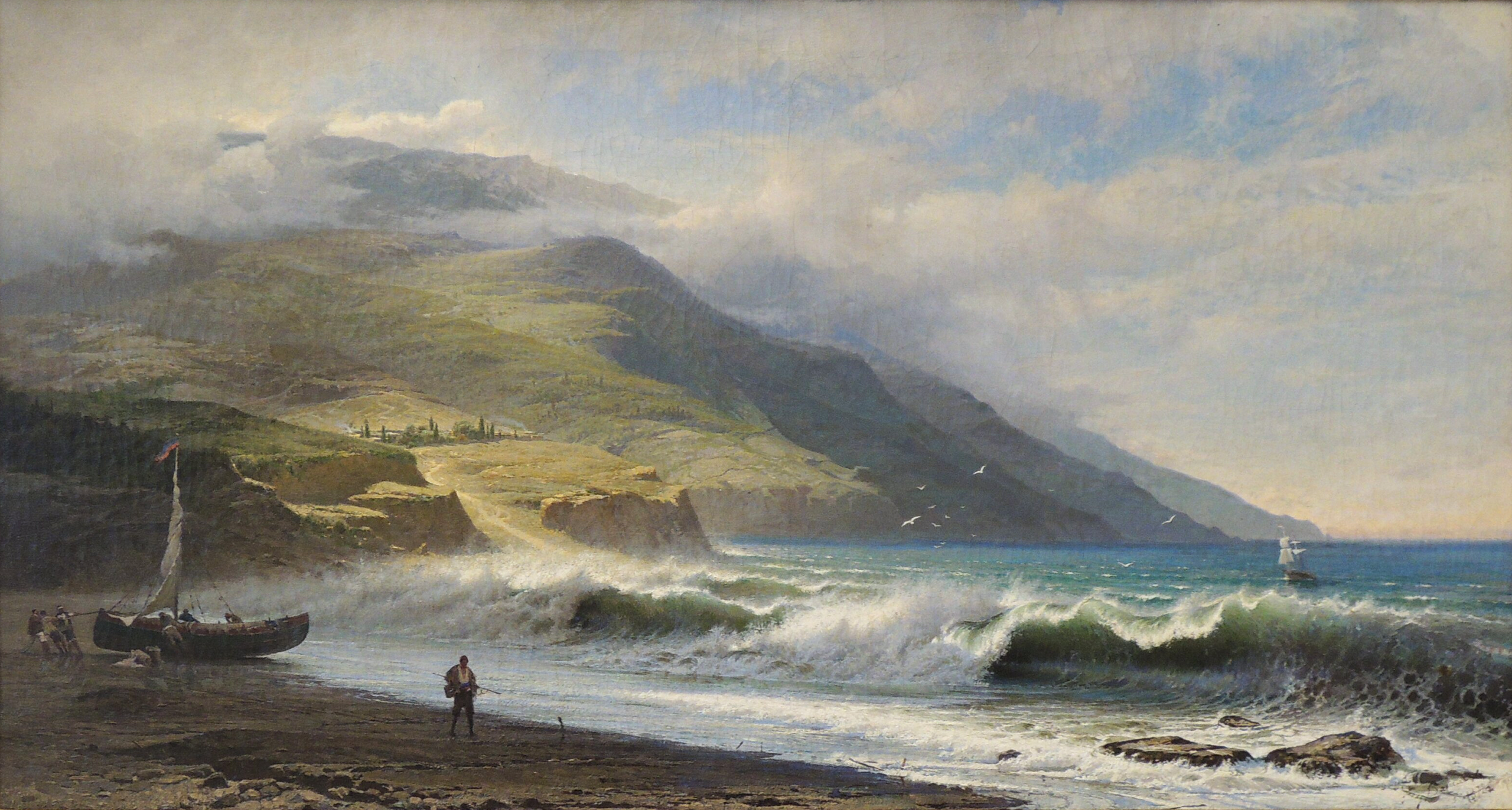
F.A. Vasiliev, 1872
Meanwhile, He, the one great High Priest being above (He who has entered into that within the veil, the people standing without; for Him that priest under the old law, who did this once a year, did signify): He then being above, what were the disciples enduring in the ship? For that ship prefigured the Church while He is on high. For if we do not, in the first place, understand this thing which that ship suffered respecting the Church, those incidents were not significant, but simply transient; but if we see the real meaning of those signs expressed in the Church, it is manifest that the actions of Christ are a kind of speeches. But when it was late, saith he,His disciples went down to the sea; and when they had entered into a ship, they came over the sea to Capernaum (John 6:16-17a). He declared that as finished quickly, which was done afterwards,-They came over the sea to Capernaum. He returns to explain how they came; that they passed over by sailing across the lake. And whilst they were sailing to that place to which he has already said they had come, he explains by recapitulation what befell them. “It was now dark, and Jesus had not come to them (ibid., 6:17b). Rightly he said “dark,” for the light had not come to them It was now dark, and Jesus had not come to them. As the end of the world approaches, errors increase, terrors multiply, iniquity increases, infidelity increases; the light, in short, which, by the Evangelist John himself, is fully and clearly shown to be charity, so much so that he says, Whoso hateth his brother is in darkness (1 John 2:11); that light, I say, is very often extinguished; this darkness of enmity between brethren increases, daily increases, and Jesus is not yet come. How does it appear to increase? Because iniquity will abound, and the love of many will begin to wax cold (Matt 24:12). Darkness increases, and Jesus is not yet come. Darkness increasing, love waxing cold, iniquity abounding,-these are the waves that agitate the ship; the storms arid the winds are the clamors of revilers. Thence love waxes cold; thence the waves do swell, and the ship is tossed.