
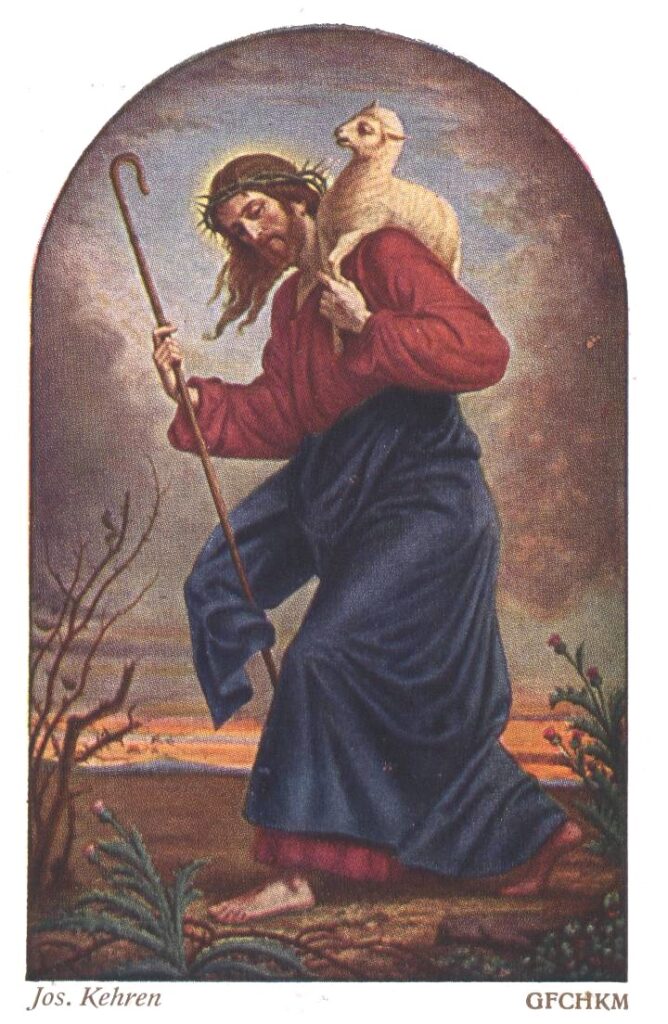
Translation of the Gospel According to John (John 10:11-16)
At that time Jesus said to the Pharisees: I am the good Shepherd. The good Shepherd giveth his life for his sheep. But the hireling, and he that is not the shepherd, whose own the sheep are not, seeth the wolf coming and leaveth the sheep and flieth: and the wolf catcheth and scattereth the sheep: and the hireling flieth, because he is a hireling, and he hath no care for the sheep. I am the good Shepherd: and I know Mine, and Mine know Me, as the Father knoweth Me, and I know the Father: and I lay down My life for My sheep. And other sheep I have that are not of this fold: them also I must bring, and they shall hear My voice, and there shall be one fold and one shepherd.
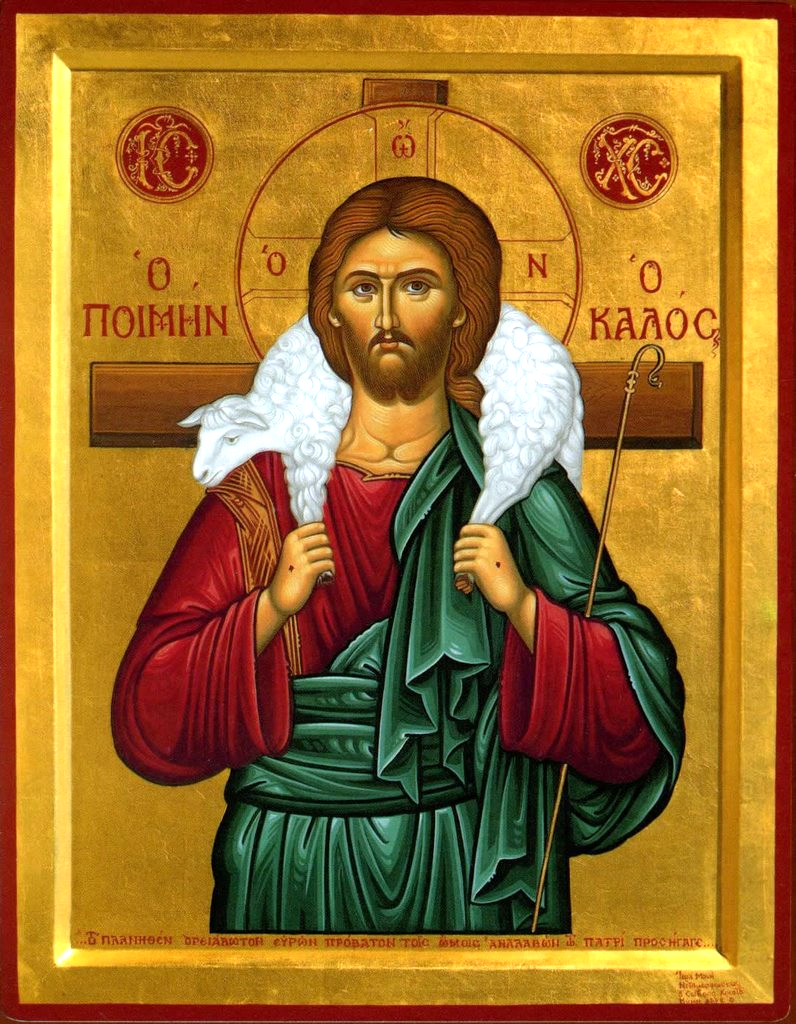
Byzantine, Modern
A Message From St. Pope Leo the Great’s Sermon LXIII (On the Passion XII).
…
We should in all things be renewed in His image Who, remaining in the form of God, deigned to “take the form” of sinful flesh (cf. Phi 2:6-7)? For all our weaknesses, which come from sin, He took on Him without sharing in sin, so that He felt the sensation of hunger and thirst and sleep and fatigue, and grief and weeping, and suffered the fiercest pangs up to the extremity of death, because no one could be loosed from the snares of death, unless He in Whom alone all men’s nature was guileless allowed Himself to be slain by the hands of wicked men. And hence our Saviour the Son of God provided for all that believe in Him both a mystery and an example, that they might apprehend the one by being born again, and follow the other by imitation. For the blessed Apostle Peter teaches this, saying, Christ suffered for us, leaving you an example that ye should follow His steps. Who did no sin, neither was guile found in His mouth. Who when He was reviled, reviled not: when He suffered, threatened not, but gave Himself up to His unjust judge. Who Himself bare our sins in His body on the tree, that being dead to sins, we may live to righteousness (1 Peter 2:21-24, Vul.).
As therefore there is no believer, dearly-beloved, to whom the gifts of grace are denied, so there is no one who is not a debtor in the matter of Christian discipline; because, although the severity of the mystic Law is done away, yet the benefits of its voluntary observance have increased, as the evangelist John says, Because the Law was given through Moses, but grace and truth came through Jesus Christ (John 1:17). For all things that, according to the Law, went before, whether in the circumcision of the flesh, or in the multitude of victims, or in the keeping of the Sabbath, testified of Christ, and foretold the grace of Christ. And He is the end of the Law (Rom 10:4), not by annulling, but by fulfilling its meanings. For although He is at once the Author of the old and of the new, yet He changed the symbolic rites connected with the promises, because He accomplished the promises and put an end to the announcement by the coming of the Announced. But in the matter of moral precepts, no decrees of the earlier Testament are rejected, but many of them are amplified by the Gospel teaching: so that the things which give salvation are more perfect and clearer than those which promise a Saviour.
All therefore that the Son of God did and taught for the world’s reconciliation, we not only know as a matter of past history, but appreciate in the power of its present effect. It is He Who, born of the Virgin Mother by the Holy Ghost, fertilizes His unpolluted Church with the same blessed Spirit, that the birth of Baptism an innumerable multitude of sons may be born to God, of Whom it is said, who were born not of blood, nor of the will of the flesh, nor of the will of man, but of God (John 1:13). It is He, in Whom the seed of Abraham is blessed by the adoption of the whole world (cf. Gen 22:18), and the patriarch becomes the father of nations by the birth. through faith not flesh, of the sons of promise. It is He Who, without excluding any nation, makes one flock of holy sheep from every nation under heaven, and daily fulfils what He promised, saying, Other sheep also I have which are not of this fold; them also I must bring, and they shall hear My: voice, and there shall be one flock and one shepherd (John 10:16). For though to the blessed Peter first and foremost He says, Feed My sheep (John 21:17); yet the one Lord directs the charge of all the shepherds, and feeds those that come to the rock with such glad and well-watered pastures, that countless sheep are nourished by the richness of His love, and hesitate not to perish for the Shepherd’s sake, even as the good Shepherd Himself was content to lay down His life for His sheep. It is He whose sufferings are shared not only by the martyrs’ glorious courage, but also in the very act of regeneration by the faith of all the new-born. For the renunciation of the devil and belief in God, the passing from the old state into newness of life, the casting off of the earthly image, and the putting on of the heavenly form—all this is a sort of dying and rising again, whereby he that is received by Christ and receives Christ is not the same after as he was before he came to the font, for the body of the regenerate becomes the flesh of the Crucified.
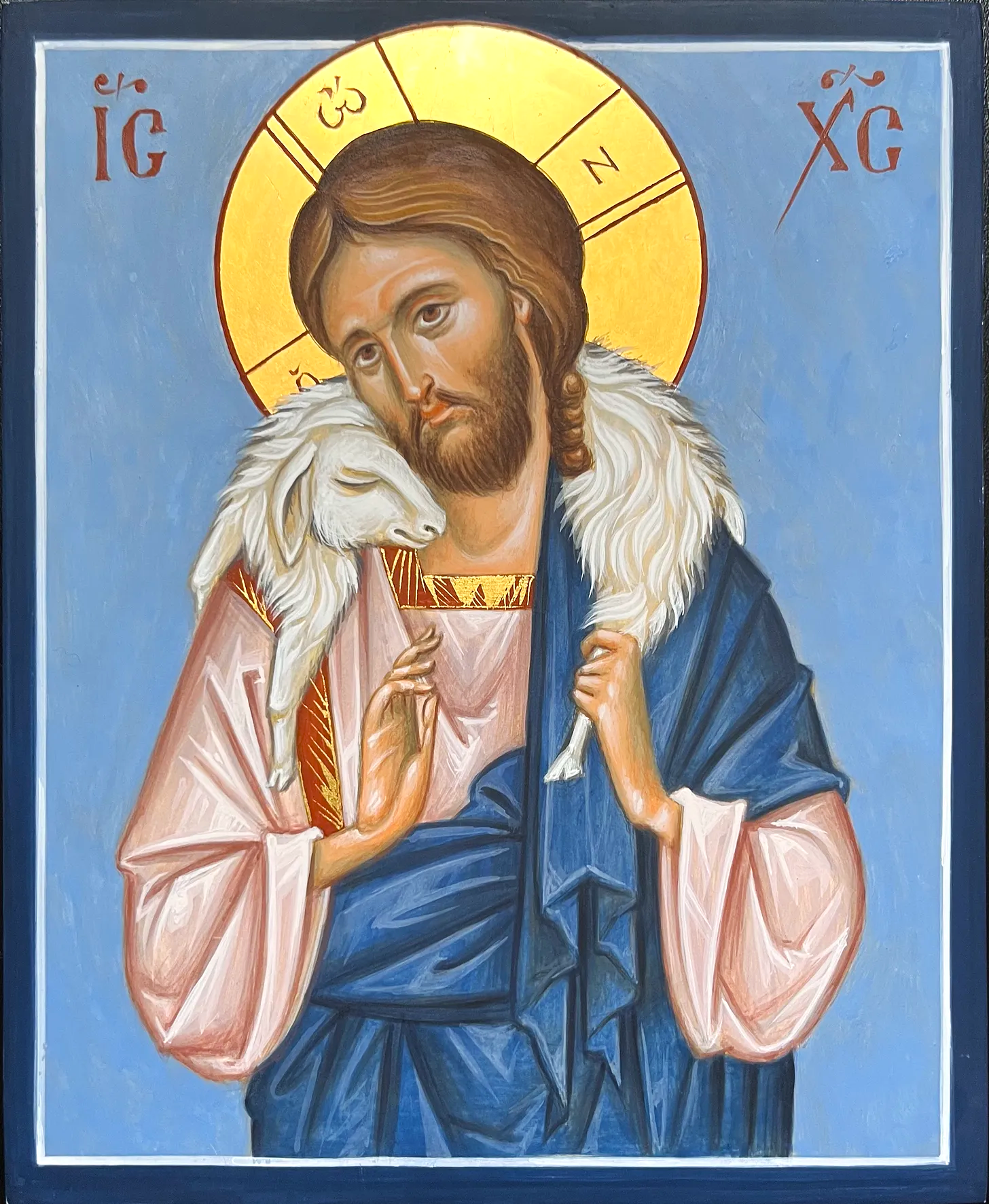
Justin Venn, Modern
This change, dearly-beloved, is the handiwork of the Most High (cf. Psa 77:10 (LXX); 1 Cor 17:6)., Who “worketh all things in all,” so that by the good manner of life observed in each one of the faithful, we know Him to be the Author of all just works, and give thanks to God’s mercy, Who so adorns the whole body of the Church with countless gracious gifts, that through the many rays of the one Light the same brightness is everywhere diffused, and that which is well done by any Christian whatsoever cannot but be part the glory of Christ. This is that true which justifies and enlightens every man. This it is that rescues from the power of darkness and transfers us into the Kingdom of the Son of God. This it is that by newness of life exalts the desires of the mind and quenches the lusts of the flesh. This it is whereby the Lord’s Passover is duly kept “With the unleavened bread of sincerity and truth” by the casting away of the old leaven of wickedness (1 Co 5:8) and the inebriating and feeding of the new creature with the very Lord. For naught else is brought about by the partaking of the and Blood of Christ than that we pass into that which we then take, and both in spirit and in body carry everywhere Him, in and with Whom we were dead, buried, and rose again, as the Apostle says, For ye are dead, and your life is hid with Christ in God. For when Christ, your life, shall appear, then shall ye also appear with Him in glory (Col 3:3-4). Who with the Father [lives and reigns in the unity of the Holy Ghost. Amen.]