
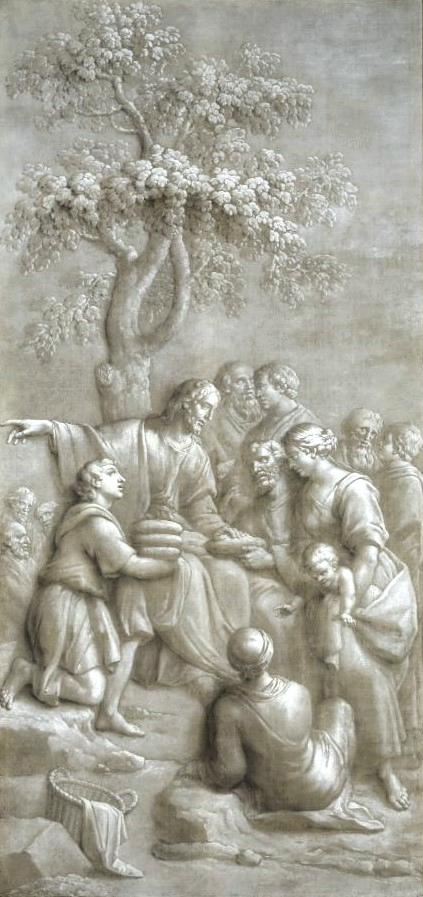
Petrus Norbertus van Reysschoot, 1773-92
Translation of the Holy Gospel According to Mark (8:1-9)
At that time, when there was a great multitude with Jesus, and they had nothing to eat, calling His disciples together, He saith to them: I have compassion on the multitude, for behold they have now been with Me three days, and have nothing to eat and if I shall send them away fasting to their home, they will faint in the way: for some of them came from afar off. And His disciples answered Him: From whence can any one fill them here with bread in the wilderness? And he asked them: How many loaves have ye? Who said: Seven. And He commanded the people to sit down on the ground. And taking the seven loaves, giving thanks, He broke and gave to His disciples to set before the people. And they had a few little fishes, and He blessed them, and commanded them to be set before them. And they did eat, and were filled: and they took up that which was left of the fragments, seven baskets: and they that had eaten, were about four thousand: and He sent them away.
A Message From St. Pope John XXIII’s Mater et Magistra (emphasis added)
Mother and Teacher of all nations — such is the Catholic Church in the mind of her Founder, Jesus Christ; to hold the world in an embrace of love, that men, in every age, should find in her their own completeness in a higher order of living, and their ultimate salvation. She is “the pillar and ground of the truth.”[1] To her was entrusted by her holy Founder the twofold task of giving life to her children and of teaching them and guiding them — both as individuals and as nations — with maternal care. Great is their dignity, a dignity which she has always guarded most zealously and held in the highest esteem.
Christianity is the meeting-point of earth and heaven. It lays claim to the whole man, body and soul, intellect and will, inducing him to raise his mind above the changing conditions of this earthly existence and reach upwards for the eternal life of heaven, where one day he will find his unfailing happiness and peace.
Hence, though the Church’s first care must be for souls, how she can sanctify them and make them share in the gifts of heaven, she concerns herself too with the exigencies of man’s daily life, with his livelihood and education, and his general, temporal welfare and prosperity.
In all this she is but giving effect to those principles which Christ Himself established in the Church He founded. When He said “I am the way, and the truth, and the life,”[2] “I am the light of the world,”[3] it was doubtless man’s eternal salvation that was uppermost in His mind, but He showed His concern for the material welfare of His people when, seeing the hungry crowd of His followers, He was moved to exclaim: “I have compassion on the multitude.”[4] And these were no empty words of our divine Redeemer. Time and again He proved them by His actions, as when He miraculously multiplied bread to alleviate the hunger of the crowds.
Bread it was for the body, but it was intended also to foreshadow that other bread, that heavenly food of the soul, which He was to give them on “the night before He suffered.”
Small wonder, then, that the Catholic Church, in imitation of Christ and in fulfillment of His commandment, relies not merely upon her teaching to hold aloft the torch of charity, but also upon her own widespread example. This has been her course now for nigh on two thousand years, from the early ministrations of her deacons right down to the present time. It is a charity which combines the precepts and practice of mutual love. It holds fast to the twofold aspect of Christ’s command to give, and summarizes the whole of the Church’s social teaching and activity.
An outstanding instance of this social teaching and action carried on by the Church throughout the ages is undoubtedly that magnificent encyclical on the christianizing of the conditions of the working classes, Rerum Novarum, published seventy years ago by Our Predecessor, Leo XIII.[5]
…
Leo XIII spoke in a time of social and economic upheaval, of heightening tensions and actual revolt. Against this dark background, the brilliance of his teaching stands out in clear relief.
As is well known, the outlook that prevailed on economic matters was for the most part a purely naturalistic one, which denied any correlation between economics and morality. Personal gain was considered the only valid motive for economic activity. In business the main operative principle was that of free and unrestricted competition. Interest on capital, prices — whether of goods or of services — profits and wages, were to be determined by the purely mechanical application of the laws of the market place. Every precaution was to be taken to prevent the civil authority from intervening in any way in economic matters. The status of trade unions varied in different countries. They were either forbidden, tolerated, or recognized as having private legal personality only.
In an economic world of this character, it was the might of the strongest which not only arrogated to itself the force of law, but also dominated the ordinary business relationships between individuals, and thereby undermined the whole economic structure.
Enormous riches accumulated in the hands of a few, while large numbers of workingmen found themselves in conditions of ever-increasing hardship. Wages were insufficient even to the point of reaching starvation level, and working conditions were often of such a nature as to be injurious alike to health, morality and religious faith. Especially inhuman were the working conditions to which women and children were sometimes subjected. There was also the constant specter of unemployment and the progressive disruption of family life.
The natural consequence of all this was a spirit of indignation and open protest on the part of the workingman, and a widespread tendency to subscribe to extremist theories far worse in their effects than the evils they purported to remedy.
It was at such a time and under pressure of such circumstances as these that Leo XIII wrote his social encyclical, Rerum Novarum, based on the needs of human nature itself and animated by the principles and spirit of the Gospel. His message, not unnaturally, aroused opposition in some quarters, but was received by the majority of people with the greatest admiration and enthusiasm.
It was not, of course, the first occasion on which the Apostolic See had come out strongly in defense of the earthly interests of the poor; indeed, Leo himself had made other pronouncements which in a sense had prepared the way for his encyclical. But here for the first time was a complete synthesis of social principles, formulated with such historical insight as to be of permanent value to Christendom. It is rightly regarded as a compendium of Catholic social and economic teaching.
In this Leo XIII showed his complete mastery of the situation. There were those who presumed to accuse the Church of taking no interest in social matters other than to preach resignation to the poor and generosity to the rich, but Leo XIII had no hesitation in proclaiming and defending the legitimate rights of the workers. As he said at the beginning of his exposition of the principles and precepts of the Church in social matters: “We approach the subject with confidence, and in the exercise of the rights which manifestly appertain to Us, for no practical solution of this question will be found apart from the counsel of religion and of the Church.”[6]
You know well enough, Venerable Brethren, the basic economic and social principles for the reconstruction of human society enunciated so clearly and authoritatively by this great Pope.
They concern first of all the question of work, which must be regarded not merely as a commodity, but as a specifically human activity. In the majority of cases a man’s work is his sole means of livelihood. Its remuneration, therefore, cannot be made to depend on the state of the market. It must be determined by the laws of justice and equity. Any other procedure would be a clear violation of justice, even supposing the contract of work to have been freely entered into by both parties.
Secondly, private ownership of property, including that of productive goods, is a natural right which the State cannot suppress. But it naturally entails a social obligation as well. It is a right which must be exercised not only for one’s own personal benefit but also for the benefit of others.
As for the State, its whole raison d’etre is the realization of the common good in the temporal order. It cannot, therefore, hold aloof from economic matters. On the contrary, it must do all in its power to promote the production of a sufficient supply of material goods, “the use of which is necessary for the practice of virtue.”[7] It has also the duty to protect the rights of all its people, and particularly of its weaker members, the workers, women and children. It can never be right for the State to shirk its obligation of working actively for the betterment of the condition of the workingman.
It is furthermore the duty of the State to ensure that terms of employment are regulated in accordance with justice and equity, and to safeguard the human dignity of workers by making sure that they are not required to work in an environment which may prove harmful to their material and spiritual interests. It was for this reason that the Leonine encyclical enunciated those general principles of rightness and equity which have been assimilated into the social legislation of many a modern State, and which, as Pope Pius XI declared in the encyclical Quadragesimo Anno,[8] have made no small contribution to the rise and development of that new branch of jurisprudence called labor law.
Pope Leo XIII also defended the worker’s natural right to enter into association with his fellows. Such associations may consist either of workers alone or of workers and employers, and should be structured in a way best calculated to safeguard the workers’ legitimate professional interest. And it is the natural right of the workers to work without hindrance, freely, and on their own initiative within these associations for the achievement of these ends.
Finally, both workers and employers should regulate their mutual relations in accordance with the principle of human solidarity and Christian brotherhood. Unrestricted competition in the liberal sense, and the Marxist creed of class warfare, are clearly contrary to Christian teaching and the nature of man.
These, Venerable Brethren, are the basic principles upon which a genuine social and economic order must be built.
…
Forty years after the appearance of this magnificent summary of Christian social principles, Our Predecessor, Pius XI, published his own encyclical, Quadragesimo Anno.[10]
In it the Supreme Pontiff confirmed the right and duty of the Catholic Church to work for an equitable solution of the many pressing problems weighing upon human society and calling for a joint effort by all the people. He reiterated the principles of the Leonine encyclical and stressed those directives which were applicable to modern conditions. In addition, he took the opportunity not only to clarify certain points of this teaching which had given rise to difficulties even in the minds of Catholics, but also to reformulate Christian social thought in the light of changed conditions.
The difficulties referred to principally concerned the Catholic’s attitude to private property, the wage system, and moderate Socialism.
With regard to private property, Our Predecessor reaffirmed its origin in natural law, and enlarged upon its social aspect and the obligations of ownership.
As for the wage system, while rejecting the view that it is unjust of its very nature, he condemned the inhuman and unjust way in which is it so often implemented, and specified the terms and conditions to be observed if justice and equity are not to be violated.
In this connection, as Our Predecessor clearly points out, it is advisable in the present circumstances that the wage-contract be somewhat modified by applying to it elements taken from the contract of partnership, so that “wage-earners and other employees participate in the ownership or the management, or in some way share in the profits.”[11]
Of special doctrinal and practical importance is his affirmation that “if the social and individual character of work be overlooked, it can be neither justly valued nor equitably recompensed.”[12] In determining wages, therefore, justice demands that account be taken not only of the needs of the individual workers and their families, but also of the financial state of the business concern for which they work and of “the economic welfare of the whole people.”[13]
Pope Pius XI further emphasized the fundamental opposition between Communism and Christianity, and made it clear that no Catholic could subscribe even to moderate Socialism. The reason is that Socialism is founded on a doctrine of human society which is bounded by time and takes no account of any objective other than that of material well-being. Since, therefore, it proposes a form of social organization which aims solely at production, it places too severe a restraint on human liberty, at the same time flouting the true notion of social authority.
Pius XI was not unaware of the fact that in the forty years that had supervened since the publication of the Leonine encyclical the historical scene had altered considerably. It was clear, for example, that unregulated competition had succumbed to its own inherent tendencies to the point of practically destroying itself. It had given rise to a great accumulation of wealth, and, in the process, concentrated a despotic economic power in the hands of a few “who for the most part are not the owners, but only the trustees and directors of invested funds, which they administer at their own good pleasure.”[14]
Hence, as the Pope remarked so discerningly, “economic domination has taken the place of the open market. Unbridled ambition for domination has succeeded the desire for gain; the whole economic regime has become hard, cruel and relentless in frightful measure.”[15] As a consequence, even the public authority was becoming the tool of plutocracy, which was thus gaining a stranglehold on the entire world.
Pius XI saw the re-establishment of the economic world within the framework of the moral order and the subordination of individual and group interests to the interest of the common good as the principal remedies for these evils. This, he taught, necessitated an orderly reconstruction of society, with the establishment of economic and vocational bodies which would be autonomous and independent of the State. Public authority should resume its duty of promoting the common good of all. Finally, there should be co-operation on a world scale for the economic welfare of all nations.
Thus Pius XI’s teaching in this encyclical can be summed up under two heads. First he taught what the supreme criterion in economic matters ought not to be. It must not be the special interests of individuals or groups, nor unregulated competition, economic despotism, national prestige or imperialism, nor any other aim of this sort.
On the contrary, all forms of economic enterprise must be governed by the principles of social justice and charity.
The second point which We consider basic in the encyclical is his teaching that man’s aim must be to achieve in social justice a national and international juridical order, with its network of public and private institutions, in which all economic activity can be conducted not merely for private gain but also in the interests of the common good.
For all that he did to render more precise the Christian definition of social rights and duties, no small recognition is due to Our late Predecessor, Pius XII. On Pentecost Sunday, June 1st, 1941, he broadcast his message “to call to the attention of the Catholic world a memory worthy of being written in letters of gold on the Church’s Calendar: the fiftieth anniversary of the publication of the epoch-making social encyclical of Leo XIII, Rerum Novarum,”[16] and “to render to Almighty God from the bottom of Our heart, Our humble thanks for the gift, which . . . He bestowed on the Church in that encyclical of His vicar on earth, and to praise Him for the life-giving breath of the Spirit which through it, in ever-growing measure from that time on, has blown on all mankind.”[17]
In that broadcast message the great Pontiff claimed for the Church “the indisputable competence” to “decide whether the bases of a given social system are in accord with the unchangeable order which God our Creator and Redeemer has shown us through the Natural Law and Revelation.”[18] He confirmed the perennial validity and inexhaustible worth of the teaching of Rerum Novarum, and took occasion “to give some further directive moral principles on three fundamental values of social and economic life. These three fundamental values, which are closely connected one with the other, mutually complementary and dependent, are: the use of material goods, work, and the family.”[19]
Concerning the use of material goods, Our Predecessor declared that the right of every man to use these for his own sustenance is prior to every other economic right, even that of private property. The right to the private possession of material goods is admittedly a natural one; nevertheless, in the objective order established by God, the right to property cannot stand in the way of the axiomatic principle that “the goods which were created by God for all men should flow to all alike, according to the principles of justice and charity.”[20]**
On the subject of work, Pius XII repeated the teaching of the Leonine encyclical, maintaining that a man’s work is at once his duty and his right. It is for individuals, therefore, to regulate their mutual relations where their work is concerned. If they cannot do so, or will not do so, then, and only then, does “it fall back on the State to intervene in the division and distribution of work, and this must be according to the form and measure that the common good properly understood demands.”[21]
In dealing with the family the Supreme Pontiff affirmed that the private ownership of material goods has a great part to play in promoting the welfare of family life. It “secures for the father of a family the healthy liberty he needs in order to fulfill the duties assigned him by the Creator regarding the physical, spiritual and religious welfare of the family.”[22] It is in this that the right of families to migrate is rooted. And so Our Predecessor, in speaking of migration, admonished both parties involved, namely the country of departure and the country receiving the newcomers, to seek always “to eliminate as far as possible all obstacles to the birth and growth of real confidence”[23] between the nations. In this way both will contribute to, and share in, the increased welfare of man and the progress of culture.
- 1. cf. 1 Tim. 3:15.
- 2. John 14:6.
- 3. John 8:12.
- 4. Mark 8:2.
- 5. Acta Leonis XIII, XI, 1891, pp. 97-144.
- 6. ibid. p. 107.
- 7. St. Thomas, De regimine principum, I, 15.
- 8. cf. AAS 23 (1931) 185.
- 10. ibid. pp. 177-228.
- 11. cf. ibid. p. 199.
- 12. cf. ibid. p. 200.
- 13. cf. ibid. p. 201.
- 14. cf. ibid. p. 210 et seq.
- 15. cf. ibid. p. 211.
- 16. cf. AAS 33 (1941) 196.
- 17. cf. ibid. p. 197.
- 18. cf. ibid. p. 196.
- 19. cf. ibid. p. 198 et seq.
- 20. cf. ibid., p. 199.
- 21. cf. ibid. p. 201.
- 22. cf. ibid. p. 202.
- 23. cf. ibid. p. 203.
** NB The intent here is not equal distribution of goods, i.e., taking cows from a rich farmer until everyone has a cow, but rather that the farmer has an obligation to provide the production of his cows to those he can, according to a just price and according to charity. It also has the intent of a farmer not allowing his field to be fallow during times of need, or preventing access to needed water that happens to be on his land; both of which occurred historically. ~PPP