
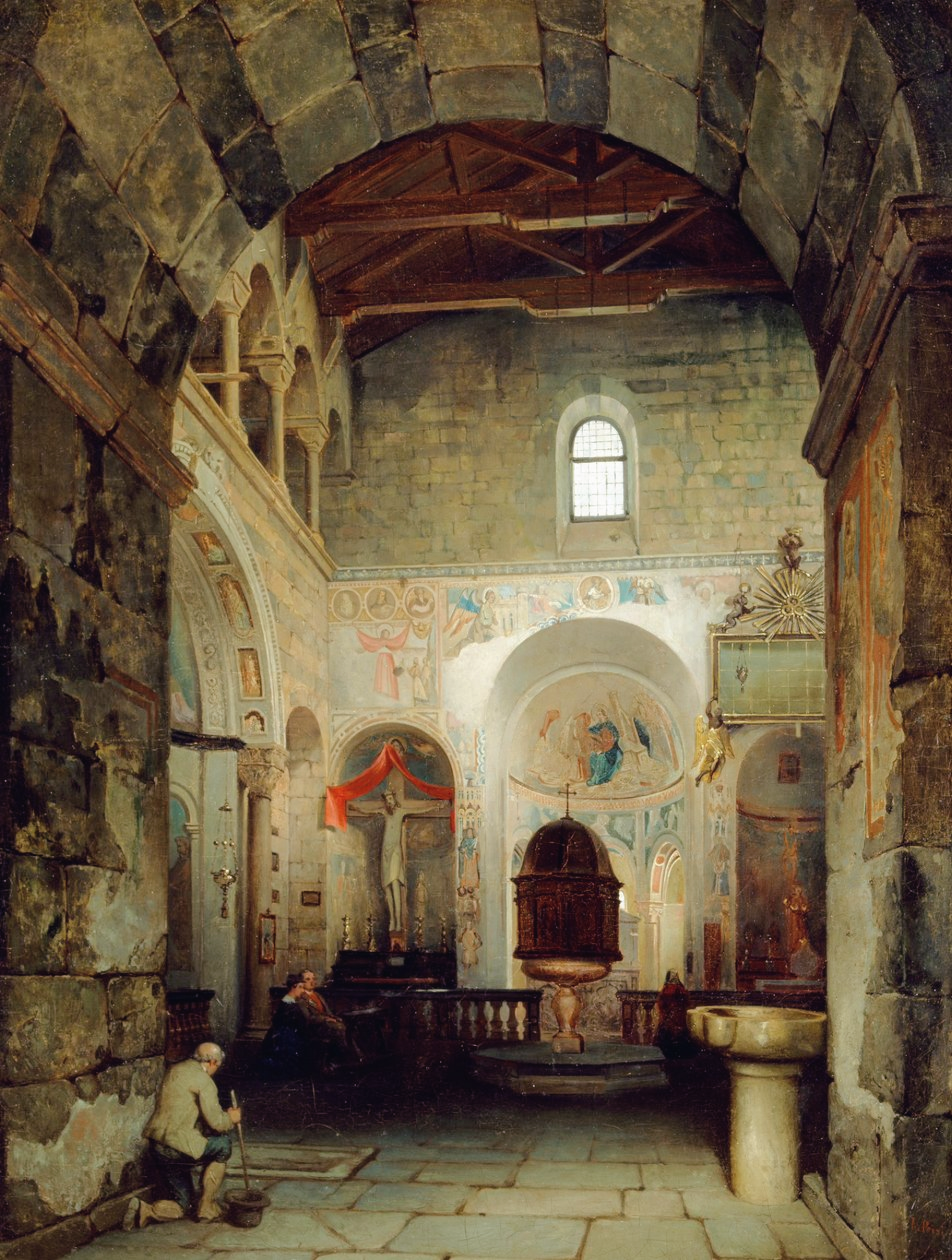
Luigi Bisi, 1857
Translation of the Epistle for the Sixth Sunday after Pentecost (Rom 6:3-11)
Brethren: All we who have been baptized into Christ Jesus have been baptized into His death. For we were buried with Him by means of Baptism into death, in order that, just as Christ has arisen from the dead through the glory of the Father, so we also may walk in newness of life. For if we have been united with Him in the likeness of His death, we shall be so in the likeness of His resurrection also. For we know that our old self has been crucified with Him, in order that the body of sin may be destroyed, that we may no longer be slaves to sin; for he who is dead is acquitted of sin. But if we have died with Christ, we believe that we shall also live together with Christ; for we know that Christ, having risen from the dead, dies now no more, death shall no longer have dominion over Him. For the death that He died, He died to sin once for all, but the life that He lives, He lives unto God. Thus do you consider yourselves also as dead to sin, but alive to God in Christ Jesus our Lord.
Continuation of the Holy Gospel According to Saint Mark (8:1-9)
At that time, when there was a great multitude with Jesus, and had nothing to eat, calling His disciples together, He saith to them: I have compassion on the multitude, for behold they have now been with Me three days, and having nothing to eat; and if I shall send them away fasting to their home, they will faint in the way: for some of them came from afar off. And His disciples answered Him: From whence can any one fill them here with bread in the wilderness? And He asked them: How many loaves have ye? who said: Seven. And He commanded the people to sit down on the ground. And taking the seven loaves, giving thanks, He broke and gave to His disciples to set before the people. And they had a few little fishes, and He blessed them, and commanded them to be set before them. And they did eat, and were filled; and they took up that which was left of the fragments, seven baskets: and they that had eaten were about four thousand: and He sent them away
The Saving Words of the Gospel
Thus do you consider yourselves also as dead to sin, but alive to God in Christ Jesus our Lord.
In the Name of the Father, and the Son, and the Holy Ghost. Amen.
Transcription of Audio
In today’s Epistle, we have a foundational text for the Sacrament of Baptism, one of several, and it helps us to understand what happens in the moment of baptism by revisiting those effects that it has on our soul, and if we are truly to be dead to sin – if that’s what it means to be alive in Christ – what we know, from our own experience, that since baptism, that’s not necessarily a done deal. Rather, this is a lifelong project.
And to better be dead to sin and alive in Christ, let’s revisit some of those effects of Baptism so we can renew our appreciation for an inestimable gift that Our Lord has given us, because, in the moment of baptism, we were made adoptive children in Christ.
And as a result, another effect of baptism is that it makes us inheritors of God’s Kingdom. And because adoptive brothers of Christ, we’re made co-heirs with Him. If you think of the father in the “Parable of the Prodigal Son,” when he tells the older son, “All that is mine is yours,” and God wants to share His all with us. Everything in His Kingdom then becomes our inheritance.
Another effect of Baptism is supernatural life is bestowed upon us. By nature, none of us could live in outer space. By nature, none of us could live underwater. By nature, none of us could survive Heaven for an instant. Yet, the infusion of divine life into our souls adequate us for Heaven, and so, we receive an elevation of our nature which allows us to experience Heaven without destruction.
Another effect is that grace makes us pleasing to God. Every parent knows what it means to love their children and not be pleased by one, or two of them, or all of them, at some point, but grace is what makes us pleasing to God, and Thomas Aquinas calls it gratia gratum faciens, the grace that makes us pleasing to God. In the soul in grace, God sees His own reflection. He sees one who is, in a certain sense, like Him, made like Him, because, through grace, we participate in His nature.
Grace also makes it possible for us to supernaturally merit. Outside of grace, we could do nothing pleasing to God. Outside of grace, we can merit nothing for eternal life. And in grace, because of another effect of grace, we have what are called infused supernatural virtues; we can execute acts that materially look like anybody else’s act of virtue. Yet, because one is in a state of grace, and, this is another condition for it to be meritorious and supernatural in God’s eyes, we not only have to be in a state of grace, we also have to have a supernatural intention. This is the importance of a Morning Offering when we offer God all of our thoughts, our words, our actions, because during the course of the day, we sometimes forget to give a particular intention to certain actions. Well, that Morning Offering of offering Him our thoughts, or words, or actions of the day, then covers that.
Grace as well unites us in an intimate way to God. What does this mean? Well, St. Augustine says that God is closer to us than we are to ourselves. He dwells in us, and that’s what brings us to another effect of baptismal grace, which is that it makes us… makes our bodies temples of God. Just as Our Lord is truly present in the tabernacle here on the altar, the Blessed Trinity makes of us living tabernacles; places where He dwells. This should radically alter how we see ourselves. This should also radically alter how we see others as temples of God or at least potential temples of God made to be God’s dwelling place.
This infused supernatural life then gives us not only infused supernatural virtues but also the gifts of the Holy Spirit. And corresponding with those gifts brings about the Fruits of the Holy Spirit, which are put in motion. And all of this is gratuitously given. And all of this is also squandered through one mortal sin.
And so, we have a choice. This is literally a fight to the death. Do I want eternal life? Do I want something less than that? Ultimately, we get what we want. If I truly want eternal life, I’m going to avail myself of all of the means. We’re not Protestants who believe that we were saved in a moment, and now we’re just awaiting Heaven. No, this is a much more profound doctrine because Heaven has already begun in our souls, through grace. It’s not something that comes later. It’s a relationship that begins in baptism.
And so, our being saved is not something that happens in an instant. Being saved is something that begins in an instant in baptism, but the process perdures throughout our earthly life until the separation of body and soul. And so, being dead to sin is not the fruit of one choice. It’s the fruit of many choices. There should be an unbroken chain of choices. Augustine tells us in the City of God that two loves built two cities. The love of self, even to the contempt of God, built the City of Babylon, that is, of the world in immorality. The love of God, even to the contempt of self, built the City of God.
At the root of this Babylon, this interior Babylon, this tendency that we have to satisfy ourselves over choosing the will of God is in an ordinate self-love. Some saints speak about hatred of self. They’re not talking about hatred of our essence. They’re not talking about hatred of our body. They’re not talking about hatred of anything about us. They’re talking about a hatred of a nothing about us. Because sin is a nothing. Evil doesn’t have a substance. Evil doesn’t – it’s a lack of a good that ought to be there.
And so, what does Thomas Aquinas tell us? He says that we ought to even love our bodies with the charity of the Father. It doesn’t mean we see them as ends; we don’t see them as evil, we don’t see them as toys, we see them as temples that are there for His purpose. The same with our intellect, the same with our will. And so, how do we continue along this process of dying to self in order to give ourselves to God; dying to self in order to receive Him and His Kingdom and all that He has?
Well, it helps us also to understand the nature of a sin. The nature of a sin is not to choose evil. The nature of a sin is to choose a good that is not in accordance with God’s will. So, every choice, no matter which we make, is a subjective good. It’s not objective in every case, and that’s the problem. So, what I deem as good, I do. What I deem as good may, or may not, be in line with God’s will. That’s where we want to join our subjective good with our objective good. So, that which we call good is truly good. That which we strive for, what we think about, what we say, what we do is truly good. So, how do we assure this habitual state?
Well, we have to spend a lot of time with Him, who is the only good. Every day, mental prayer; every day. If we’re not doing mental prayer every day, we’re denying Our Lord, and we’re denying ourselves great intimacy, graces that only come through mental prayer. And mental prayer is the common denominator of all the saints. That’s what they all had in common. Not all of them were Virgins, not all of them were Confessors, not all of them were Martyrs, but they all spent time every day in prayer, mental prayer.
You know, there are nine degrees of prayer. The first is called vocal prayers, the devotions that we’ve all learned. And some people never graduate from first grade. We’re called to mental prayers, the second degree. It’s like the gateway, the gateway to virtue and greater prayer, because our life of virtue will never surpass the degree of prayer that we’ve achieved, and our prayer is freed up by our virtue.
And so, virtue and prayer are something like the two rails that carry the carriage of our spiritual organism; one doesn’t go ahead of the other. If I’m frequently confessing the same things, usually that’s because my interior life is poor; it’s mediocre. If I’m going to Adoration frequently and doing it well… we can go to Adoration and be thinking about other things. We can go to Adoration and fill our minds with all sorts of words or all sorts of reading. They’re not bad things, but we’re denying ourselves great intimacy with Our Lord if we’re cluttering our interior with noise and words. If we’re not doing mental prayer every day, we ought not be surprised that we confess the same things over and over. And some people begin mental prayer and quit because it’s frankly difficult at the start. We’ve habituated our intellects, our memories, our imaginations to lesser things. And now, to try and grasp higher things is not so easy because these lesser things that we’ve given ourselves to, they make a claim on us, but pay attention to the nature of your distractions.
Often they reveal disordered attachments. Often they reveal somebody I haven’t forgiven properly, or I need to forgive again, my interior, or they reveal anxieties, which are simply a lack of trust in Our Lord. So, they’re revelatory in a certain sense, God’s mercy that shows these distractions to us. So, take note of them but don’t pursue them during prayer. You’ve got better things to do than go over your distractions. But take note because something is being revealed there, and then get back to the heart of Christ in your prayer.
Some people don’t continue in their mental prayer because, as the fourth part of the Catechism says, prayer is a struggle. It’s a fight. But we have to learn to love the fight. We have to learn to love the cross. When we love the cross and we join penance to our interior life, our fasting, regular fasting, little penances throughout the day, small things, it’s not the great things that are going to make us holy. It’s the constancy in moderation. That’s where holiness is achieved. Constancy and moderation. The devil is in the extremes, and the extremes include little, okay?
So, that’s where the devil is in very little interior life, very little penance, or too much. That’s called super-erogation, where I do too much and I get tired and I just give up everything, or I just dial it back because then, all of a sudden, I am the victim of my own sensuality. I’m doing it when I feel like but where there’s constancy and moderation, progress comes, and we’ll be surprised that our prayer life becomes less discursive, becomes less cluttered with words and images, and becomes something that’s more; we move to the next stage of prayer, which is affective prayer.
Our Lord has purified our intellect and now He’s going to work on our hearts. And as He makes a claim on our heart, that’s not the time to read, or think too much, or speak too much. That’s the time to love and be loved. And then after a while, an affective prayer of one perseveres and virtue in prayer, Our Lord may move us to the prayer of simplicity, which is as high as you can go in the ordinary order of prayer.
After that, the five subsequent degrees of prayer those are what are called extraordinary graces of infused contemplation. And that’s something that Our Lord does to whom He wants, and when He wants. We can do nothing to attain them, but we certainly can prepare the terrain if Our Lord has in store those graces through our prayer and our penance.
And so, this dying to self is not a negative thing. It’s eminently positive because it’s living fully in Christ. This dying to self, dying to sin, is actually clearing space in one’s heart, one’s mind, one’s imagination, and memory for Christ, who wants to make a claim on it all. And that is the glory of man being truly alive.
In the Name of the Father, and of the Son, the Holy Ghost. Amen.
~Fr. Ermatinger