
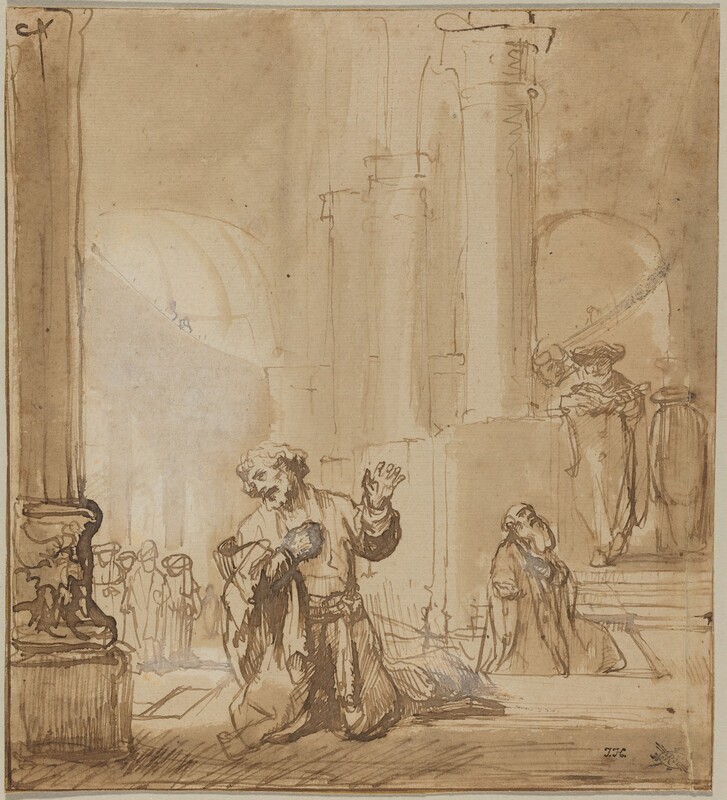
and the Pharisee,
Rembrandt, c. 1650 1655
Translation of the Epistle for the Tenth Sunday After Pentecost (1 Cor 12:2-11)
Brethren, You know that, when you were heathens, you went to dumb idols, according as you were led, Wherefore I give you to understand, that no man, speaking by the Spirit of God, saith Anathema to Jesus and no man can say, The Lord Jesus, but by the Holy Ghost. Now there are diversities of graces, but the same Spirit; and there are diversities of ministries, but the same Lord; and there are diversities of operations, but the same God, who workth all in all. And the manifestation of the Spirit is given to every man unto profit. To one indeed, by the Spirit, is given the word of wisdom; and to another, the word of knowledge, according to the same Spirit; to another faith in the same Spirit; to another, the grace of healing in one Spirit; to another, the working of miracles; to another, prophecy; to another, the discerning of spirits; to another, divers kinds of tongues; to another, interpretation of speeches. But all these things one and the same Spirit works, dividing to every one according as He will.
Continuation of the Holy Gospel According to Saint Luke (Luke 18:9-14)
At that time, Jesus spoke this parable to some who trusted in themselves as just and despised others. Two men went up into the temple to pray: the one was a Pharisee, and the other a Publican. The Pharisee standing, prayed thus with himself: O God, I give Thee thanks that I am not as the rest of men, extortioners, unjust, adulterers; as also is this Publican. I fast twice in the week; I give tithes of all that I possess. And the Publican standing afar off would not so much as lift up his eyes towards heaven, but struck his breast saying: O God, be merciful to me a sinner. I say to you, this man went down to his house justified rather than the other: because every one that exalts himself shall be humbled, and he that humbles himself shall be exalted.
In the Name of the Father, the Son, the Holy Ghost. Amen.
Transcription of Sermon
In the Name of the Father, and the Son, the Holy Ghost. Amen.
Our Lord presents to us these two models, one of prayer and the other of self-absorption. It says, that he prayed with himself, which is exactly the right translation. So, he wasn’t praying to God. It’s says, stans, haec apud se orábat. So, he prayed with himself, or to himself. So, Our Lord is almost making a caricature of this man, seemingly. And then the man goes on to talk about how wonderful he is and reminds God, as if God didn’t know, all of the wonderful things that he does. And he’s quite satisfied with himself. And it seems almost like a caricature, except it’s not, because there are many ways in which one can oráre apu se, one can pray with oneself without really addressing oneself to God.
Some people are consumed with anxiety and pray about their anxiety, or the thing that worries them, rather than praying to God. You know, Francis DeSales says that after sin, the greatest evil that can befall us is anxiety. It can become something of an idol because it consumes us, whereas we’re supposed to be consumed with Our Lord. We can’t be consumed by two absolutes.
Some people make almost demands and threats to God. If you don’t give me this, you know, I will threaten you with a faith crisis.
Some people get discouraged because in their prayer, they experience much dryness. Now there are multiple reasons for dryness, but there’s no reason for discouragement. Dryness, says John of the Cross, can come about because of our infidelity to grace. Dryness can come about because God is testing us. Dryness can come about because the devil is testing us. But it’s never a reason for discouragement.
Discouragement is usually a symptom of a certain hidden vanity. There are those who don’t feel consolations and, therefore, get frustrated, and almost angry with God, yet we have to remember that God can’t be felt. Consolations are creatures. We don’t use God to get something less than God, such as a consolation. John of the Cross has very little compassion for those people, and he calls them spiritual adulterers, those who would manipulate God in order to get a good feeling.
Some people cultivate disordered attachments. You know, think of how much time is spent looking at a screen all day, and how much, and compare it to the amount of time spent in prayer, in the study of the Faith. See which one wins out.
What happens sometimes in prayer, even when one is sincere and goes to pray, all of a sudden, distractions come. That’s not a problem. They’re often very revelatory of where we’ve misplaced our affections. Those things that we allow to consume our heart will come bubbling to the surface because Our Lord, in His mercy, is showing us where we’ve presented some obstacles to union.
Other people are incapable of prayer because they haven’t forgiven someone. How do we expect to have deep union with Our Lord if we don’t forgive others or one person? In fact, we condition God’s mercy towards us in the Our Father. We ask Him to forgive us just as we forgive others. So, we’re conditioning His mercy towards us. We ought to think about what we’re saying.
Now, Our Lord then points to the publican, and Augustine says beautifully, he said, Because he didn’t dare to look up, God looked down on him and received him. And so, this humility of heart is what wins over the heart of Our Lord. Saint Augustine says elsewhere, at the moment he’s talking about the man beating the breast, says, At the moment when the confiteor was intoned, you beat your breasts. What does it mean to beat the breast but to confess what is concealed in it by a visible blow; to chastise a hidden sin. Why else did you do this except because you heard the words “confiteor tibi Pater;” I confess to you, Father. And further on, he says, Therefore, our accusation of ourselves in our confession is praising God already. In other words, when we come to Him with humility and accuse ourselves, He accepts that as something of an oblation.
So, when we symbolically strike our breasts in the Confiteor, we’re doing multiple things. We’re preparing ourselves for union with God. So, this beating of the breast is symbolic of a self-imposed punishment. I’m also pointing to the source of my own ills, which is in my heart. Augustine is pretty clear to say that sin doesn’t come really from the mind. It comes from the heart, where we attach our heart to things that it ought not be attached to. And as a result of being forgiven, we use the word “absolve” comes absolute prayer. What is absolute? Absolvere → absolutus, right? It’s the same word in Latin. It means to be untethered; to be freed up; unrestrained. So, when we’ve been absolved, what happens?
Our Lord unties the burden that we’ve imposed upon ourselves. When we’ve been absolved, we’re ready for what’s called an absolute. In other words, an untethered relationship with Him. It’s not bound up with things, not bound up with ourselves, but we’re freed up to have a relationship with Him that is filial.
Now, the Catechism of the Catholic Church says to overcome these aforementioned obstacles in prayer, it says we must battle to gain three things: humility, trust, and perseverance. (CCC 2728). Notice how this really encompasses the entire relationship, because when we’re humble like the publican, we win Our Lord’s Heart over. We come in with a broken heart, which wins His Heart. When we trust, we grant Him all sorts of permissions to work on us. And when we persevere, then there is constancy in our relationship with Him, and these are really the three elements that the Church presents to us for a healthy prayer life.
In the Name of the Father, and of the Son, the Holy Ghost. Amen.
~Fr. Ermatinger