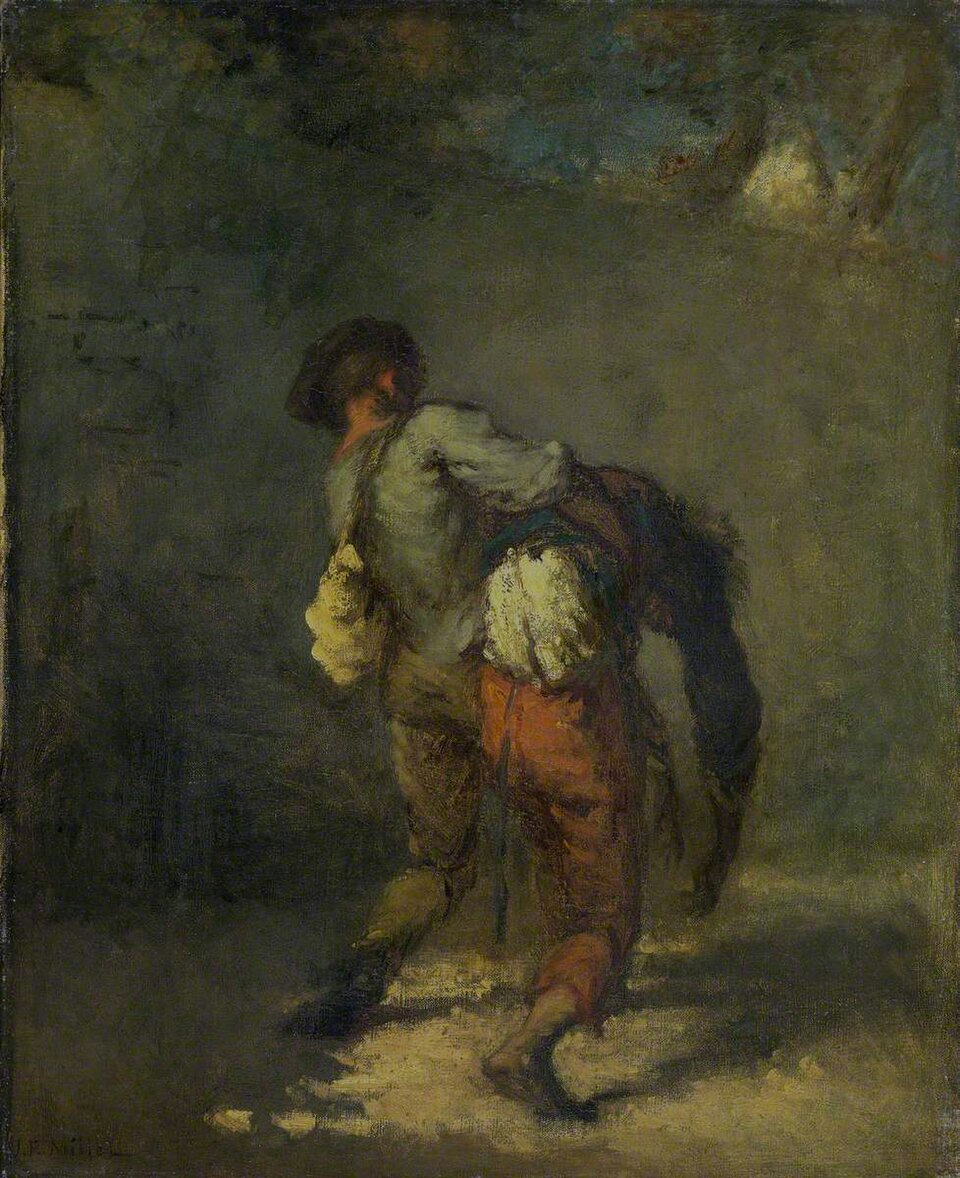
Jean-François Millet, 1846
Translation of the Epistle for the 12th Sunday After Pentecost (2 Cor 3:4-9)
Brethren, Such confidence we have through Christ towards God. Not that we are sufficient to think anything of ourselves, as of ourselves: but our sufficiency is from God. Who also hath made us fit ministers of the new testament, not in the letter, but in the spirit: for the letter kills, but the spirit quickens. Now if the ministration of death, engraven with letters upon stones, was glorious, so that the children of Israel could not steadfastly behold the face of Moses, for the glory of his countenance which is made void: how shall not the ministration of the spirit be rather in glory? For if the ministration of condemnation be glory, much more the ministration of justice abounds in glory.
Translation of the Holy Gospel According to St. Luke (10:23-37)
At that time, Jesus said to His disciples: Blessed are the eyes that see the things which you see. For I say to you, that many prophets and kings have desired to see the things that you see, and have not seen them; and to hear the things that you hear, and have not heard them. And behold a certain lawyer stood up, tempting Him, and saying: Master, what must I do to possess eternal life? But He said to him: What is written in the law? how do you read it? He answering, said: Thou shalt love the Lord thy God with thy whole heart, with thy whole soul, and with all thy strength, and with all thy mind, and thy neighbor as thyself, And He said to him: Thou hast answered rightly: this do, and thou shalt live. But he, willing to justify himself, said to Jesus: And who is my neighbor? And Jesus answering, said: A certain man went down from Jerusalem to Jericho, and fell among robbers, who also stripped him, and having wounded him, went away, leaving him half dead. And it chanced that a certain priest went down the same way, and seeing him, passed by. In like manner also a Levite, when he was near the place and saw him, passed by. But a certain Samaritan being on his journey, came near him, and seeing him, was moved with compassion, and going up to him, bound up his wounds, pouring in oil and wine, and setting him upon his own beast, brought him to an inn, and took care of him. And the next day he took out two pence and gave to the host, and said. Take care of him, and whatsoever thou shalt spend over and above, I, at my return, will repay thee. Which of these three, in thine opinion, was neighbor to him that fell among robbers? But he said: He that showed mercy to him. And Jesus said to him: Go and do thou in like manner.
The Saving Words of the Gospel.
In the Name of the Father, and of the Son, and of the Holy Spirit. Amen.
Transcription of Sermon
n the Name of the Father, and the Son, and the Holy Ghost. Amen.
We have the famous parable, proper to Luke, of the Good Samaritan. You can find the best commentaries on this online, if you are interested, in St. Ambrose’s Commentary on St. Luke, St. Augustine, and St. Jerome. Those are probably the best patristic commentaries on this parable. I recommend you read them because you’re not going to hear anything about the Samaritan today. I’m going to focus on this commandment of Our Lord, which is ratified by Him: Love God with all your heart, mind, strength, and soul.
Most people use the word love for many different things, so obviously it’s a rather equivocal term, and often misunderstood and misused. Many will mistakenly associate love, or distill love down to mere emotions, but Our Lord says it’s much more than that. And so, what does it mean to love God with all one’s heart?
The heart is the will. In scriptural anthropology, the heart is the seat of the human person where all choices are made. Now we can’t love God without knowing Him, and so, it’s not enough to will it. When Our Lord says you have to love Him with all of your soul, when Our Lord says this is a true commandment to love Him with our soul, the soul here refers, as St. Thomas Aquinas, to the passions. We know from Catholic theology that our passions are disordered. There is a certain disorder in that they’re blind, and given free rein, they become blinding. And so, what do we do? We have to, thanks to the life of grace, we have to take those first movements of passions and transform them or allow Our Lord to transform them into virtues through channeling our passions towards Our Lord. But we can’t do that if we don’t know Him.
And then loving Him with all of our strength, regards those exterior things that make up our life, our labors, our duties. And so, when all of that is consecrated to God, this is the importance of a morning offering, when we give Our Lord everything we’re going to do today, and then, our work then, all of a sudden, has a supernatural character, because we’ve given it to Him. But we can’t do that if we don’t know Him.
So, this is all going to come down to loving him with our whole mind. And this is something of a foreign concept to many. How do we love God with all of our mind? Well, we can ask ourselves, what do I think about throughout the day? Some people have their minds filled with soap operas and game shows, and that’s their choice. Other people with, perhaps, past injustices, and haven’t forgiven someone who has done them wrong, and they allow this to consume them. Other people are addicted to their phones, and they don’t know exactly what their mind is going to be filled with today. It’s whatever YouTube or the podcast at hand serves up. Or we can fill our minds with Our Lord. How do we do that? We have to make a choice.
Even though, as Thomas Aquinas says, our mind has infinite capacity, our time is limited, our energy is limited, and so, we have to be rather judicious in ‘what do I think about?’ What do I read? What do I look at? What do I listen to? Obviously, at the base of all of this, loving God with all of our heart, mind, strength, and soul, we have to have that which makes it meritorious and efficacious, which is at the root, the life of grace, which comes, namely, through the sacraments.
We can fool ourselves into thinking that while I listen to Catholic podcasts, I watch Catholic videos, we can fool ourselves into thinking that we’re filling our mind with God through these means, and yet those things are the fruit of somebody else’s doing. The fruit of somebody else’s study, or lack of study, I was watching a video because of the subject matter, and I wanted to see what these gentlemen had to say. They called themselves traditionalists, but it was clear that they had very little understanding of the spiritual organism. So ultimately, we were left to their ill-formed opinions. And so, we don’t delegate our formation and the faith to someone else, right? We’re responsible for this. We don’t delegate our relationship with Our Lord to someone else or simply blame someone else that I don’t really know Christ because nobody told me.
Well, we have some sound resources to know Christ, namely spending time with Him in Adoration, getting to know Him in the Gospels, studying the Catechism, reading what the Church Fathers have to say about Him. Saint Augustine says in his treatise called On Christian Doctrine, he says, “Loving God with all one’s mind means concentrating our thoughts, our whole life, our entire intelligence upon Him.” This means that no part of one’s intellect is left to seek out a different ultimate object of enjoyment. All mental activity should be channeled towards God. So, how does this look?
Well, when we’re in love with Him, when you’re in love with anybody, that anybody is always on your mind. When we are in love with Him, He’s always on our mind. We refer everything to Him. Thomas Aquinas says that to know God is to love Him. Just the fact of knowing Him makes us love Him when we know Him truly. We can have a mistaken understanding, but he’s talking about true knowledge of God. In De Trinitate –that would be a good summer reading for what’s left of the summer for each one of you– St. Augustine says in his book on the Trinity that there’s something similar in our mind to the Blessed Trinity. He says there’s the mind itself, there’s the mind that knows itself, and there’s the mind that loves its own understanding. He says, “That is our own interior trinity.” He said, “This is something of a reflection of God’s inner life, of this absolute knowledge of self and gift of self.”
And nonetheless, as Thomas Aquinas says, “Goodness is expansive.” So, Our Lord wants… He’s not some closed circle. He’s not narcissistic. He’s not closed in on Himself. But because He is Goodness Itself, Only One is Good, says Christ, talking about God, the Trinity. He’s expansive. He shares Himself, and He wants us to participate in Him absolutely. So, Augustine, when he’s talking about loving God with all one’s heart, mind, soul, strength, he says these are not different actions. They’re all integrated as one, all-consuming act. We can parse them into those four areas of mind, heart, soul, and strength, but he says ultimately, it’s something that ought to consume us absolutely. It’s all of a piece. It’s one singular command that encompasses our entire person. He says that when the mind is trained on God, it will seek Him out everywhere. And as a result, we’ll seek to please Him. If to know Him is to love Him, and we know that loving God is shown in obedience, that to know Him means to love Him, and to love Him means to obey Him. Christ says, If you love Me, keep My commandments. So, loving Him and obeying Him –in other words, loving Him and then configuring our lives to His– these are the two sides of the same coin of the interior life. The more we learn about Him, the more we know our Faith, the more reasons we will have to love Him. And each one of these new data that we learn about Our Lord is another reason to love Him, but it also reveals another facet. But imagine in Heaven there’s no end to discovering these facets. There’s no end.
When Thomas Aquinas was in Orvieto, about a… little north of Rome, he was in a church, and a sacristan heard this conversation; he heard from the cross our Lord, say to Thomas, You’ve written well of me. And nonetheless, not long after that, Thomas, on account of his mystical experience, he stopped writing his most famous work. He left it undone; Summa Theologica. And when asked why he was no longer writing, he said, Everything is straw. And nonetheless, Our Lord gave him a pretty good compliment. I think we can all agree on that. You have written well about me. Our Lord would know the subject, and so, He’s a pretty good judge of what is well written about Himself. And He pays Thomas this great compliment, and Thomas, nonetheless, couldn’t bring himself to reduce what he had experienced to the written word, because it was impossible. So, what do we do?
How do we love Him with all of our mind? Because that’s what makes possible loving Him with all of our soul, with all of our strength, with all of our heart. It’s hinging on that. Well, as already mentioned, our time of Adoration spent with Him, our mental prayer, especially using the Gospels as the source for our mental prayer. Studying the faith. Reading the Catechism. Now, if you’ve never read a theological book before, that’s not a problem. That’s actually a great opportunity to embark on a real adventure.
If you’ve never read a theology book before, I recommend you start with a brilliant little book called Theology for Beginners by Frank J. Sheed. And once you’re done with that, no book reports required, once you’re done with that, then move on to his other book called Theology and Sanity. Once you’ve graduated from Theology and Sanity, then I would recommend Father James Schall’s brilliant book called The Mind That Is Catholic. There’s three gems that I would read in that order. They will help you a lot to understand Our Lord much more, and therefore, understanding Him, loving Him, and surrendering yourselves to Him.
That’s for study, for spiritual reading. I would recommend writings by the saints, especially those classics such as the Ascent of Mount Carmel, The Interior Castle, The Way of Perfection by Teresa of Ávila, The Dialogues of Divine Providence by St. Catherine of Siena, or Humility of Heart, a real classic.
So, the more we’re filling our mind with these things, the more we fill our mind with the truths of Our Lord, the more we crowd out lies and falsehood and inanities, and we start to be capacitated to love Him as He wants. He’s a jealous lover, and He wants everything from us. He wants all of our heart. He wants all of our strength. He wants all of our soul. He wants all of our mind.
In the Name of the Father, and of the Son, the Holy Ghost. Amen.
~Fr. Ermatinger