Translation of the Epistle for the Sixteenth Sunday after Pentecost (Eph. 3:13-21)
Brethren: I pray you not to be disheartened at my tribulations for you, for they are your glory. For this reason I bend my knees to the Father of our Lord Jesus Christ, from Whom all fatherhood in heaven and on earth receives its name, that He may grant you from His glorious riches to be strengthened with power through His Spirit unto the progress of the inner man; and to have Christ dwelling through faith in your hearts: so that, being rooted and grounded in love, you may be able to comprehend with all the saints what is the breadth and length and height and depth, and to know Christ’s love which surpasses knowledge, in order that you may be filled unto all the fullness of God. Now, to Him Who is able to accomplish all things in a measure far beyond what we ask or conceive, in keeping with the power that is at work in us – to Him be glory in the Church and in Christ Jesus down through all the ages of time without end. Amen.
Continuation of the Holy Gospel According to St. Luke (14:1-11)
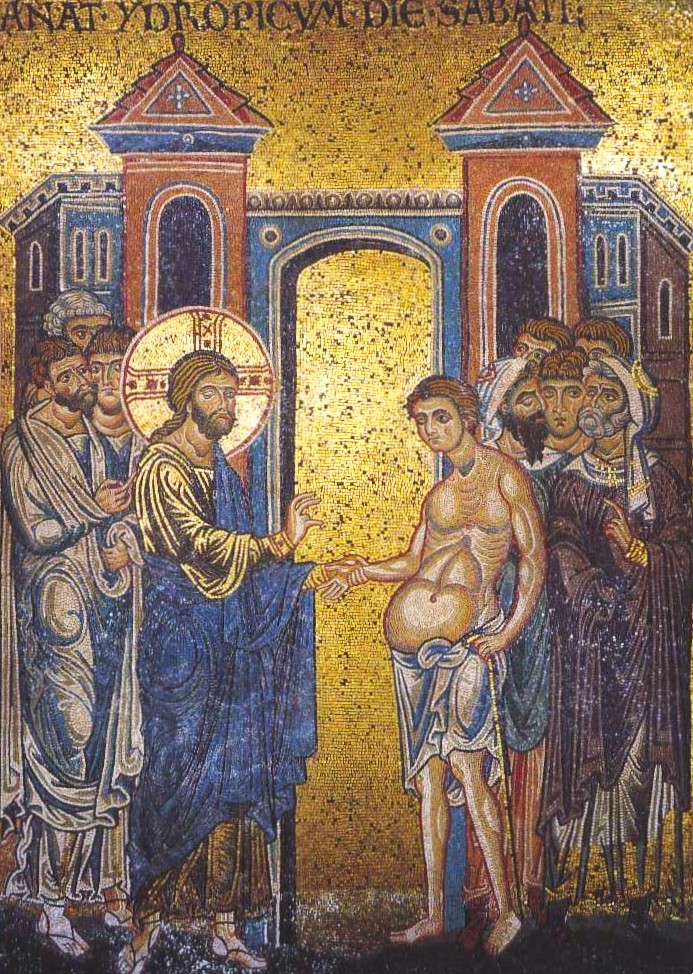
At that time, when Jesus entered the house of one of the rulers of the Pharisees on the Sabbath to take food, they watched Him. And behold, there was a certain man before Him who had the dropsy. And Jesus asked the lawyers and Pharisees, saying, Is it lawful to cure on the Sabbath? But they remained silent. And He took and healed him and let him go. Then addressing them, He said, Which of you shall have an ass or an ox fall into a pit, and will not immediately draw him up on the Sabbath? And they could give Him no answer to these things. But He also spoke a parable to those invited, observing how they were choosing the first places at table, and He said to them, When you are invited to a wedding feast, do not recline in the first place, lest perhaps one more distinguished than you have been invited by him, and he who invited you and him come and say to you, ‘Make room for this man’; and then you begin with shame to take the last place. But when you are invited go and recline in the last place; that when he who invited you comes in, he may say to you, ‘Friend, go up higher!’ Then you will be honored in the presence of all who are at table with you. For everyone who exalts himself shall be humbled, and he who humbles himself shall be exalted.
The Saving Words of the Gospel.
And Jesus took him and healed him and sent him on his way.
In the Name of the Father, and of the Son, the Holy Ghost. Amen.
Transcription of Homily

It says, A certain man, ἄνθρωπος τίς (anthropos tis), which can also mean any man. And indeed, that’s the interpretation that Bede the Venerable gives in his commentary on this passage. He says that this man with a dropsy stands there in our place. It’s a real event, and nonetheless, there is a significance for each one of us. So, this man, this man in our place, was suffering from dropsy, which is edema, water retention. You can see modern cases of it in the arms or in the legs. Often, when you see it cited or described in classical literature, it shows a bloated belly that retains water, and one of the symptoms is an insatiable thirst. And so, one is feeling like he’s dying of thirst and filling himself with water, and the more he drinks the more he retains the more he retains, the more he thirsts. And so, it’s a vicious cycle, and that’s why this man stands there in our place, because we’ve all had this experience of spiritual dropsy.
Spiritual edema in which we seek something that is not Christ, thinking that it will fill us, and for as bloated as we may feel, we don’t find satisfaction. Think of any of our obsessions, our gluttony of every stripe, or possessiveness, or vanity, or pride, or fill in the blanks.
Thomas Aquinas, when he speaks about the difference between spiritual and carnal sins, he says that the more dangerous are the spiritual sins because the glutton ultimately has to put down the fork. On the other hand, the person who is addicted to spiritual sin, whether it’s vanity, or possessiveness, or pride, or whatever, is never satisfied, and it’s something that becomes an addiction. Thomas says also that temporal punishment for sin in this life is precisely the addiction because it reveals to us who our true God is; that we have not chosen the objective God, rather a god of our own making. Our passions, our appetites, if left unfettered, will demand totality. And so, our Lord allows us to fall into all sorts of sinful habits to show us the makeup of our interior.
There’s a French poet, François Villon who says, Je meurs de soif auprès de la fontaine. I die of thirst next to the fountain. When we have Christ here before us, when we have Christ exposed in the Blessed Sacrament, when we receive Him, we go to the Source, we have access to the Source and the end of all spiritual life, and, nonetheless, we find these competing thirsts that can crowd out our thirst for Christ.
Yesterday’s Ember Saturday collect points us in the right direction. We asked Our Lord to fill us with His grace through fasting, and that’s not ironic. To fill us through fasting and to strengthen us through abstinence. And so, Our Lord, who meets people where they’re at, not in order to leave them there, but to reveal something, I think, is toying with these Pharisees in the way He places the question. He places it in a very legalistic way, something that is more along the lines of a contract. And He says, Is it lawful to cure on the Sabbath? Because that’s the way they think, and they’re reduced to silence. If he’s speaking to somebody whose interior life was in order, He would say, “Is it good to heal on the Sabbath?” And we know the answer to that one, but He puts them in this situation of confusion.
In fact, confusion for sin is something that we should ask for, because sin is a form of schizophrenia and insanity. That’s why St. Ignatius of Loyola mentions in his Spiritual Exercises for the First Week that we should ask for the grace of confusion over sin because when we look at it, we ought to be confused when we consider our bad choices.
So, what does Our Lord do? It says He took him and healed him and sent him on his way. He took him. We use the word take. Luke uses this verb λαβὼν (labōn) to mean take in the Last Supper narrative. Christ took the bread, λαβὼν (labōn). He took the bread, blessed it, broke it, so, took. But here we see the importance of prefixes, ἐπιλαμβάνομαι (epilambanomai). So, He took him by placing His hand gently on him. Paul will use a similar verb with a different prefix when he’s talking about his own encounter with Christ, it’s καταλαμβάνω (katalambano). And this καταλαμβάνω is forceful. There’s a certain aggressiveness in it in the way Paul describes it. ‘He took me by force, he took possession of me,’ says Paul. And he’s talking about Christ entering into his life.
So, Our Lord approaches each one of us in a way that we will understand in hopes that we will correspond with His grace. So, this is the importance of prefixes. So, the way this verb is laid out by Luke is that He took him gently. He placed His hand on him. He seizes him, but not with force. In order to what? θεραπεύω (Therapewo). θεραπεύω is an interesting word which has three meanings. It can mean heal or cure, which is the clear meaning of it here. It could also mean worship of God, but it could also mean to wait upon somebody, as a valet or a butler, to wait upon somebody. And you see Our Lord patiently, humbly waiting for this man to reveal to Him his illness.
And how humbly Our Lord waits for us to reveal to Him our illness in Confession. We ought not make Him wait long. How does Christ gently place His hand on us in order to heal us, to cure us, to lead us to true worship? He waits for us in the confessional. He waits for us in the Eucharist. He also allows us this immediate contact with Him, not only through the sacraments, but also through the theological virtues, because it’s precisely in the theological virtues where man and God cooperate directly. That’s why they’re called theological virtues, because Our Lord is one of the principal actors, but not without our cooperation, and the object of the theological virtues is Our Lord.
Saint John of the Cross, one of the greatest spiritual writers in the history of the Church, he was called the pneumopathologist of the soul. He was a doctor of the soul who understood all of the maladies of the soul. And I recommend you take for your homework Book I of the Ascent of Mount Carmel, Ch 6-10 [—>CLICK ME<—] in which he reveals these different pathologies of the soul. And he goes through each sense, how our attachment to the sense then leads to further sins. He uses the word “appetites” frequently. He almost never uses the word “sin.” And he doesn’t consider the appetites as something always pejorative. He says we also have to have an appetite for God. We also have to have an appetite for Christ crucified.
And so, our appetites are not condemned, but through our own experience, we know how they’ve been misdirected in many cases. He says, “The soul does not have full health until love is complete. A sickness is nothing but the lack of health, and when the soul has not even a single degree of love, she is dead. In the measure that love increases, she will be healthier, and when love is perfect, she will have full health. Because we were created by God, who is love, and we’re created for love. He’s planted in us an innate desire for Him. When we misdirect this desire and channel it towards something else, we become much like this dropsical man through our pleasure seeking our possessiveness, our vanity, etc. And Our Lord allows us the frustrations and the emptiness that we can experience from that precisely to reveal to us that that was not the right way. St. Augustine says, Do I seek him because I found Him or is it because I seek Him that I find Him? He says, I’m not sure which comes first, but there’s a certain insatiable desire here in this contemplative soul of St. Augustine who seeks, and finds, and finds he seeks all the more.
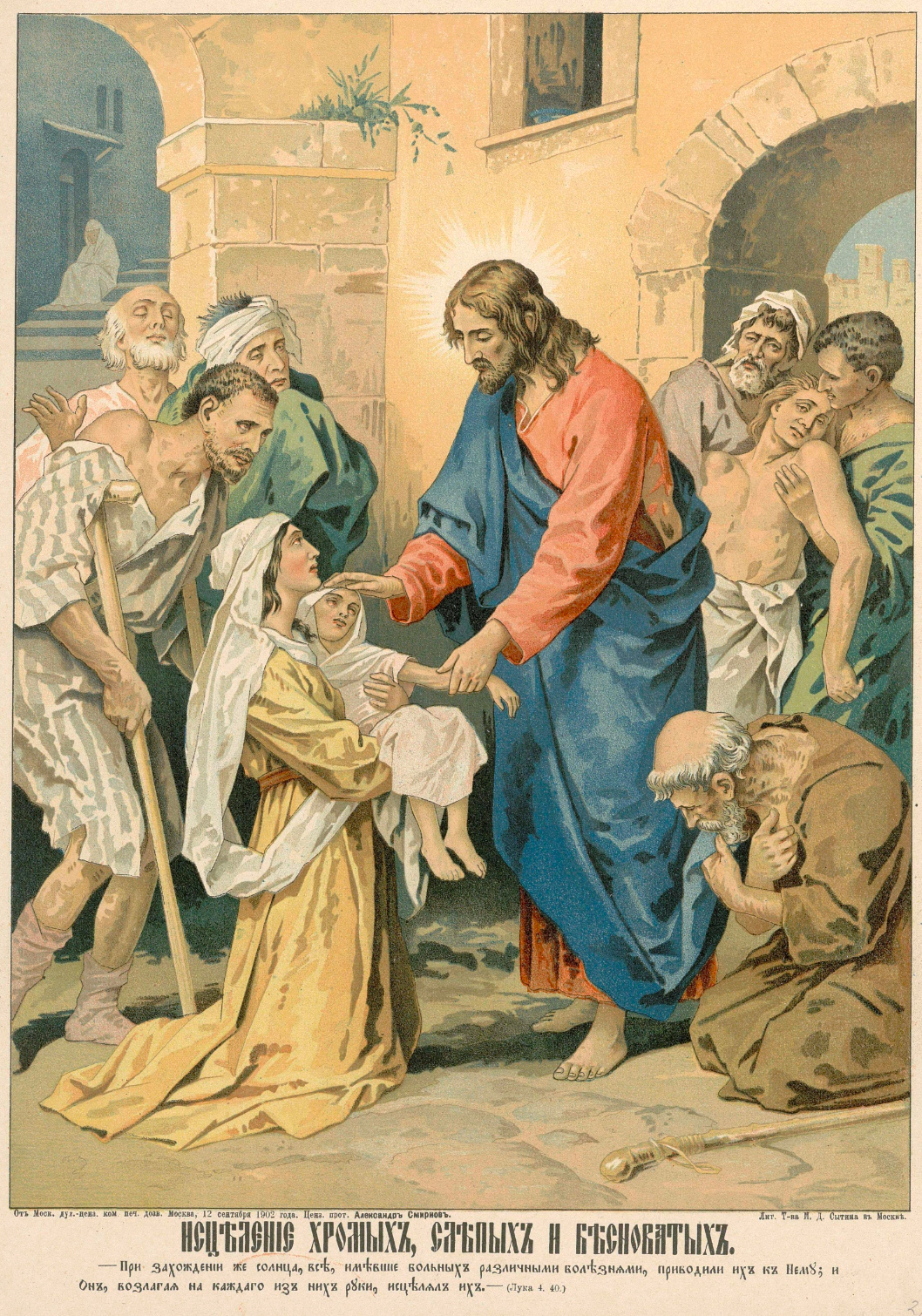
So, notice the different dynamic of seeking satisfaction in created things, which leaves us bloated and empty, and the constant seeking of Christ, which brings satisfaction and then, nonetheless, doesn’t leave us completely content in this life because our possession of Him, inasmuch as we are in this life, is still imperfect.
And so, this dropsical man stands there in our place, bloated and empty in need of Christ, and then Christ comes into his life in a radical way, and he’s healed on multiple levels. Our Lord took him, healed him, and sent him on his way, and yet his way is no longer the way of before. It’s a new life in Christ.
In the name of the Father, and of the Son, the Holy Ghost. Amen.
~Fr. Ermatinger