
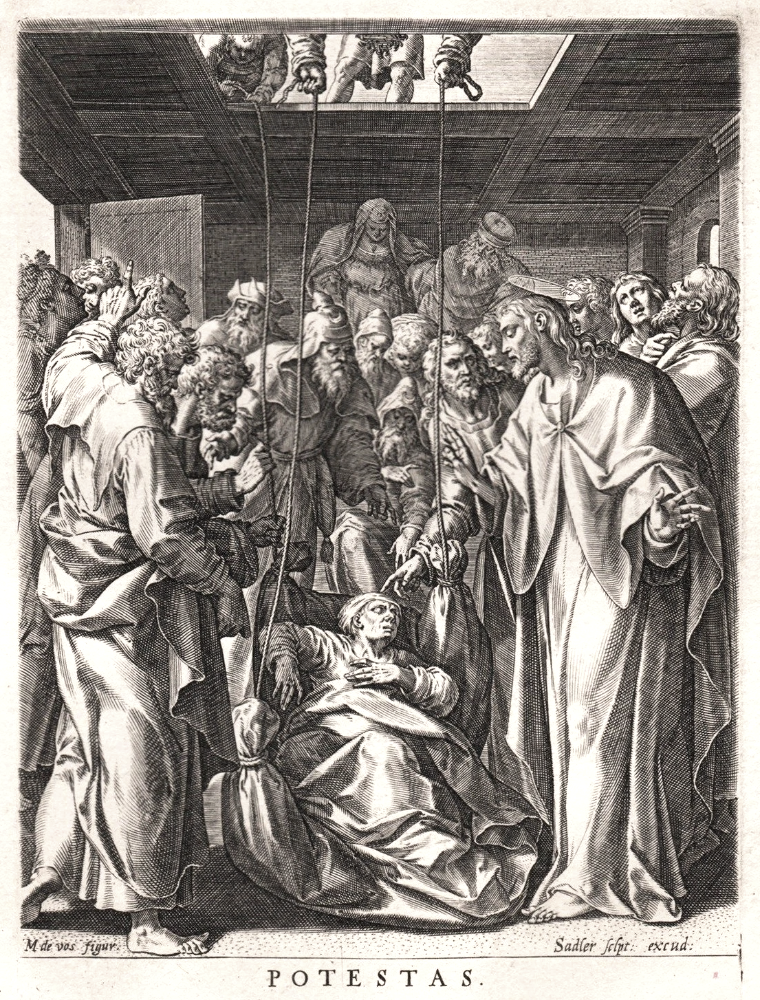
Marten de Vos, c. 1600
Translation of the Epistle for the Eighteenth Sunday After Pentecost
Brethren, I give thanks to my God always for you, for the grace of God that is given you in Jesus Christ, that in all things you are made rich in Him in all utterance and in all knowledge, as the testimony of Christ was confirmed to you so that nothing is wanting to you in any grace, waiting for the manifestation of our Lord Jesus Christ, Who will also confirm you into the end without crime, in the day of the coming of our Lord Jesus Christ.
Continuation of the Holy Gospel According to St. Matthew
At that time, Jesus entering into a boat, passed over the water and came into His own city. And behold they brought Him one sick of the palsy lying on a bed and Jesus seeing their faith, said to the sick man of the palsy: Be of good heart, son, thy sins are forgiven thee. And behold some of the Scribes said within themselves: He blasphemeth. And Jesus seeing their thoughts, said: Why do you think evil in your hearts? whether is it easier to say: Thy sins are forgiven thee or to say: Arise and walk? But that you may know that the Son of Man hath power on earth to forgive sins (then said He to the man sick of the palsy): Arise, take up thy bed, and go into thy house. And he rose, and went into his house. And the multitude seeing it, feared, and glorified God, who had given such power to men.
The Saving Words of the Gospel.
“He blasphemes because he said, “Your sins are forgiven.”
In the Name of the Father, and of the Son, the Holy Spirit. Amen.
Transcription of Homily
The paralytic was expecting a somatic healing, and the Scribes were expecting language that they were more accustomed to. Everyone seemed initially disappointed because they expected less than Our Lord had on offer. In fact, what He initially granted so far exceeded their expectations that they were reduced to silence. But their interior was anything but silent. This one blasphemes, they said in their interior, as if God couldn’t hear their thoughts. βλασφημέω (blasphemeo). βλασφημέω means to speak harmfully about God. Obviously, we cannot harm God, but we can insult Him.
Some people get upset at God because they ask for work, or a lover, or whatever created good, and then threaten Him, because they don’t get what they asked for. Threatening Him with a faith crisis when, all along, Our Lord is offering forgiveness and eternal life. In other words, they want too little. And that is often our problem, too. We don’t ask enough from Him. We want things rather than Him. But His ways are not our ways; His thoughts are not our thoughts.
The Scribes, the Γραμματεύς (Grammateus) as they’re called in Greek, are men of the Law and of the letter. They’re so consumed by the written word of God that they became incapable of recognizing the Eternal Word of God manifest in human flesh before them. They remind me of these modernist scripture scholars who are immersed in the word of God and yet, have lost their faith. These Scribes know that only God can forgive sins, and this passerby is making such a claim. How can there be forgiveness without the visible signs of God’s forgiveness? The ablution and the proper Temple sacrifice is described by the Law. Where’s the sign of this paralytic’s forgiveness? When Moses was receiving the Law on the Mountain, the Jews had fallen into filthy pagan practices at the foot of the Mountain, and Moses was presented with this dilemma: ‘How do I procure forgiveness for these wayward Jews?’ He never thought to forgive them himself. He knew he couldn’t, and yet he was the greatest mediator between God and man. He had to plead to God for them.
Christ doesn’t go up to a holy mountain. Christ doesn’t plead to the Father, to parley with God, seeking the forgiveness of this paralytic. Man and God meet perfectly in Jesus of Nazareth. He makes Himself the mediator. He is Divine Mercy itself. His fidelity to the Covenant between God and man is indefectible because in His case, His nature as God’s Son and His fidelity to His Father are one in the same. Jesus Christ, in anticipation of everything, the incarnate forgiveness, unceasingly coming down from the Father, to whom He no longer need appeal, since it is for this that the Father Himself sent the Son. And in this, that He continually supports Him, for as St. Paul says, God was in Christ, reconciling the world to Himself. So, where is the sign of this man’s forgiveness? Christ is the sign. His very word, Your sins are forgiven, is more than enough.
Just as the Scribes were incredulous about Christ’s ability to forgive, sometimes Catholics can have questions even after Confession. Was I really forgiven? Perhaps you remember from The Diary of St. Faustina, in which one of the few nuns who believed in her visions said to her, I know you see Our Lord frequently. Will you ask Him for me if I was really forgiven in Confession? And Faustina was so insulted and so taken aback by this petition, she said, I would never insult His mercy by questioning it. And so, she didn’t say anything to Our Lord, and in the next vision, she didn’t bring it up, but He did. And He said, Tell sister, what’s her name?, her doubt after Confession hurts Me more than the sins I’ve already forgiven.
Sometimes we can set ourselves up for all sorts of complications. If somebody thinks to say their confession in such a way that the priests won’t understand it, they want forgiveness, but they don’t like Confession. And then they, maybe later in life, realize their problem, but what they’ve done is they’ve created a certain habit of distrust. And so, they start to question even their valid confessions. This calculation, then, skews our vision of God and of His mercy. Still others eclipse the intellect with their emotions and feel so horrible, perhaps even after having been forgiven, they can’t forgive themselves, and this inability to forgive themselves clouds their vision of God’s forgiveness of them. In other words, they’re keeping themselves from appropriating His mercy in its entirety.
We can believe in the transubstantiation of the Real Presence. We can believe in the miracles of the saints and of Our Lord and Our Lady. We can believe that others are holy, but we don’t think that we can be holy because we’re more absorbed with ourselves, perhaps, than Our Lord. And sometimes, this can encroach on our relationship with Our Lord, making us doubt or question His mercy.
Javert in Les Misérables was this man of radical justice. His life was hyper-focused on the execution of justice, and he can’t understand when mercy is shown to him by Jean Valjean, whom he had pursued for so long, and it drives him to his own self-destruction; a man incapable of accepting mercy. I suspect that being a doubter of mercy is an affliction that lives next door to scrupulosity.
It’s akin to a certain obsessive-compulsive inability to know what one knows, and it’s a deformation of conscience. The memory of sin can stimulate uncertainty related to forgiveness or whether we’ve been truly sorry, and then we start confessing, reconfessing our sins. ‘I’m not sure if I was sorry enough in this last confession.’ This leads nowhere good. We begin to investigate the matter, hoping to find some emotional ease to confirm hope and provide certainty that, in a human sense, will never come. And this then creates something akin to, if you’ve ever read some of the late 1800 romantic poets, they’re kind of hard to stomach I agree, it’s all about infatuation. But it’s something similar to this, this obsession with the other. It’s like an infatuation. Her look was at a smile. I’m not sure. It’s like this man, young man infatuated with a woman and interpreting every aspect of her body language in terms of the self. Was that a frown? Was that a smile? Ultimately, it’s an infatuation with oneself. It’s not love; it’s infatuation.
Love is seeking the good of the other, which Our Lord certainly does in this Gospel. Now, what can we do to seek the good of the other; to love Our Lord? What can we give Him that He doesn’t already have? Well, perhaps our trust, our faith, our hearts, our affections, our imagination, our memories, our entire selves. There’s great comfort in knowing that we are dust and to dust we shall return. We’re not that important. Our Lord doesn’t obsess over us in an infatuated way. He loves us. And His love is to seek our good.
There’s a phenomenon called limerence. Limerence is this psychological state in which one is infatuated with the other and is forever questioning what the situation is. It’s an obsessive-compulsive disorder. It’s not rooted in reality; it’s rooted in one’s head. And similarly, to people that question God’s mercy after confession, the problem is in the head; it’s not a defect of the sacrament. It’s not a defect of anything except for one’s inability to simply accept. So, the solution is not to figure things out. The solution is not to finally get some emotional certainty, which will never come on human terms. The solution is an act of the will. ‘Yes, Lord, I believe you. I trust you. You are mercy itself.’
The Holy Name also called the… egg-headed theologians call it the Tetragrammaton, okay? Yahweh, the Holy Name, which was unpronounceable in the Old Testament, right? It was unpronounceable because it was an affront to God to say His Name, because with our mouths and our minds we could never encompass Him. He was so utterly transcendent and holy, how could I even utter that? And so, they would call Him Hashem, the Name, without saying the Name. Well, Christ resolves that through the incarnation. He takes the name Yeshua, which means Yahweh Saves, God Saves. And so, now God is not only imminent and right here in front of us, He’s pronounceable, He’s visible, and He’s really the solution to all of these time and energy wasting obsessions and infatuations and worries and emotional quagmires that we can get stuck in.
Thomas Aquinas says that mercy is God’s greatest attribute because it’s the one that most corresponds to His nature. And so, these unhappy Scribes think that Our Lord blasphemes because He purports to forgive, yet they don’t think He can, and we have to make a choice. We’re confronted with a situation, am I going to be like the Scribe who says, ‘Actually, I’m not forgiven,’ or am I going to be like the paralytic says, ‘Thank you,’ and gets up and goes home, acts and trusts? It’s not complicated, we are, that’s for sure, but it’s not complicated. What our Lord asks of us is rather simple because He is simplicity itself. No existent is as simple as Our Lord is simple. And so, we’re left with this choice. Do we say, ‘You blaspheme because you can’t forgive,’ or do I blaspheme by saying, ‘I’m not forgiven,’ or do I say, “Thank you, Lord. You’ve forgiven me. You’ve revealed yourself to me. I accept You.’ And then we’re faced with that question that He asked Peter after Peter’s great sin of denial, Do you love me? And the question is said with the mouth but shown in trust. So, we trust and we act. We say, “Yes, Lord, I love you.” And we act on it as a result of this relationship that He made possible. And this is not in the will… I’m sorry, it’s not in the emotions. It’s not in our head. It’s only in the will. It’s an act of the will under the action of grace, and it is a grace that He will deny no one.
In the Name of the Father, and of the Son, the Holy Ghost. Amen.
~Fr. Ermatinger