
Translation of the Epistle for the Twenty-Third Sunday After Pentecost (Phl 3:17-21; 4:1-3)
Brethren: Be imitators of me, and mark those who walk after the pattern you have in us. For many walk, of whom I have told you often and now tell you even weeping, that they are enemies of the Cross of Christ. Their end is ruin, their god is the belly, their glory is in their shame, they mind the things of earth. But our citizenship is in heaven from which also we eagerly await a Saviour, our Lord Jesus Christ, Who will refashion the body of our lowliness, conforming it to the body of His glory by exerting the power by which He is able also to subject all things to Himself. So then, my brethren, beloved and longed for, my joy and my crown, stand fast thus in the Lord, beloved. I entreat Evodia and I exhort Syntyche to be of one mind in the Lord. And I beseech you also, my loyal comrade, help them, for they have toiled with me in the gospel, as have Clement and the rest of my fellow-workers whose names are in the book of life.
Continuation of the Holy Gospel According to St. Matthew (9:18-26)
At that time, as Jesus was speaking to the crowds, behold, a ruler came up and worshipped Him, saying, “Lord, my daughter has just now died; but come and lay Your hand upon her, and she will return to life.” And Jesus arose and followed him, and so did His disciples. Now a woman who for twelve years had been suffering from hemorrhage, came up behind him and touched the tassel of His cloak saying to herself, “If I touch but His cloak I shall be saved.” But Jesus, turning and seeing her, said, “Take courage, daughter; your faith has saved you.” And the woman was restored to health from that moment. And when Jesus came to the ruler’s house, and saw the flute players and the crowd making a din, He said, “Begone, the girl is asleep, not dead.” And they laughed Him to scorn. But when the crowd had been put out, He went in and took her by the hand; and the girl arose. And the report of this spread throughout all that district.
The Saving Words of the Gospel.
A ruler came up and worshipped Him.
In the Name of the Father, and of the Son, and of the Holy Spirit. Amen.
Transcription of Sermon
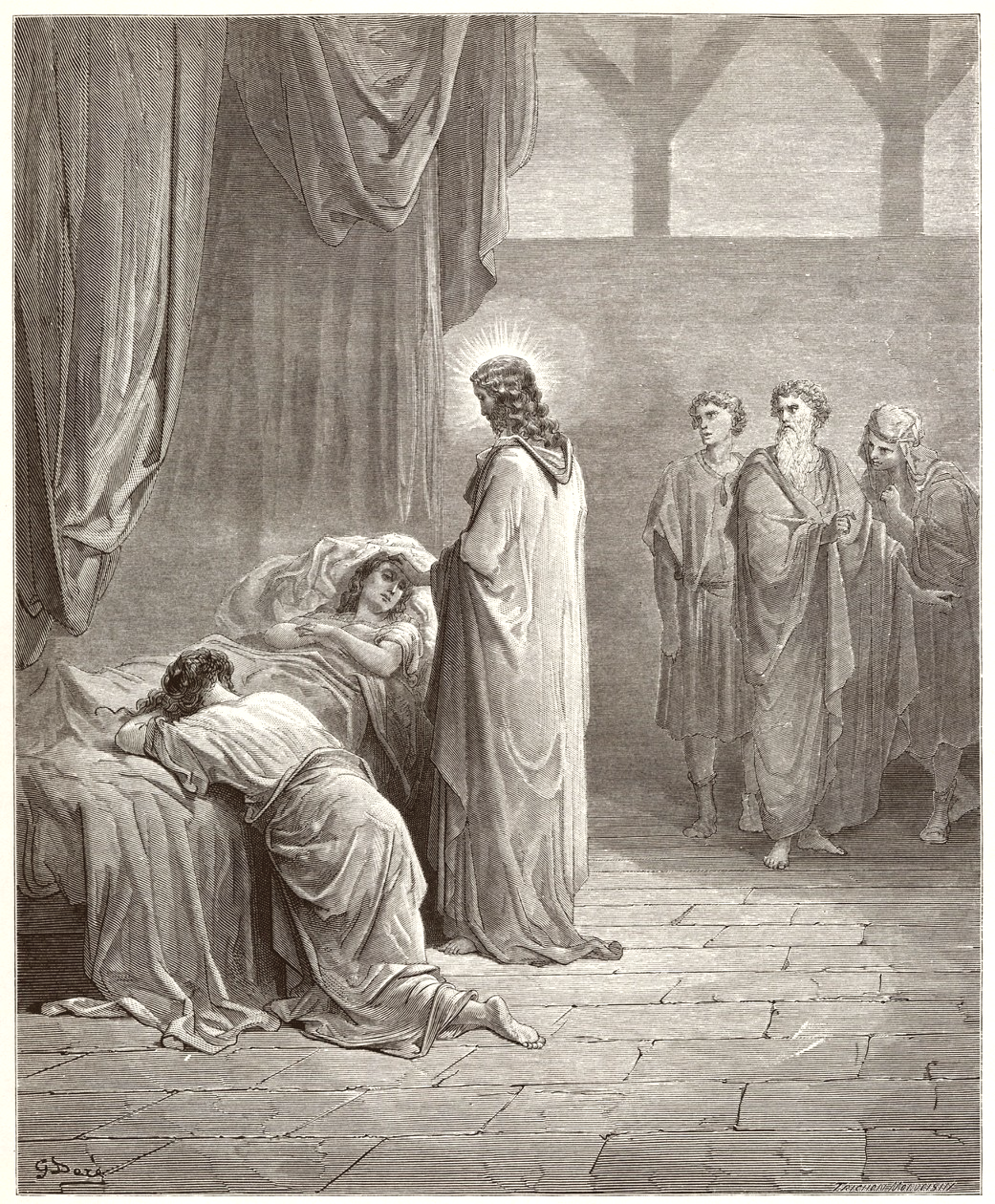
The word here for ruler is αρχών (archon), and αρχών has multiple usages in the New Testament. It can be ruler. Here, it’s a ruler of the synagogue; somebody who takes care of order in their synagogue. You know, synagogues were not for worship. They were for catechises. Worship was in the Temple. And αρχών can also mean prince. It can mean the first one in a series. It can mean the first in terms of quality. So, we see this word used multiple ways in the New Testament. For example, the first words of John’s Gospel, Ἐν ἀρχῇ In the beginning. We also see that in Genesis. In Colossians, Paul calls Christ αρχών; the beginning, in whom and for whom all things were created.
And so, this αρχών of the synagogue comes to the Αρχών of the cosmos, asking him to restore life where it was lost, reordering this disaster. And he prostrates himself and worships Christ. And these are gestures that are forbidden to every Jew. No Jew was allowed to prostrate himself before a man. Further, the Mosaic prohibition of fashioning idols and images is connected to this. But what if God is the image?
What if He’s the image? Paul calls Him in Colossians 1, He is Christ. He is the image of the invisible God. So, Jesus Christ, who by rights is the object of adoration, obeisance, and entreaty, has made Himself visible. The Word was made flesh and dwelt among us. And so, now God has a face that we can depict. He has a Name we can say, the Jews couldn’t say YHWH, they couldn’t say the Tetragrammaton, they had to call Him Hashem, which means the Name. They couldn’t even say the Name of God. But it’s His incarnation that makes His name utterable, that allows us to make images of the Image. So, why were they not allowed to make images of God?
Because they never saw Him. Nobody had seen Him. Moses only heard the voice in the Burning Bush. And so, if he were to create an image, it would be from his own imagination. It would ultimately be an insult, much like Aaron insulted God when he made this Golden Calf and said, This is the one who brought us out of Egypt. Whatever we do is going to be an insult and fall short if it’s not rooted in Christ, who is the Image of the invisible God. So, every attempt outside of revelation fails until God reveals Himself.
I suppose this is why tradition places this Gospel here at this Sunday, shortly before we begin Advent. It’s something like a preparation for preparation.
And we see this Jairus; he’s not named in Matthew, but elsewhere we see his name. Jairus comes to Our Lord. His daughter has just died, and his first reaction is to come to Jesus and worship Him and make his petition known. And Christ’s response is the logical consequence of this invisible voice from the Burning Bush, now taking flesh and dwelling among us. This is why Paul calls Him the power of God, the wisdom of God, in 1 Corinthians.
St. Ambrose says, This is the gift of the Most High Father to His Son, that at the name of Jesus, every knee should bow in heaven, on earth, and in the depths. And every tongue confess that Jesus is the Lord, in the glory of God, the Father. The Father, good Father that He is, wants to give everything to the Son from Himself, boundless love; from creation, joyful adoration. So, if we think about what Ambrose is saying, back in the fifth century, he’s saying, and it sounds a little uncomfortable to say it, but He’s made us to be a gift to the Son. When you look in the mirror, do you feel like you’re a gift to God? Well, that’s what Ambrose is saying, and nonetheless, through God’s grace, it’s in our power to be a very pleasing gift to God by being configured with Christ, by becoming images of the Image. How do we do this? It starts with the sacraments, it starts with our insertion into the Trinitarian life through grace, and it’s continued through our prayer, our adoration, our askesis, our virtue.
This prostration of Jairus before Our Lord is very telling. It’s like a glimpse into what our life is supposed to be. One of worship, one of adoration. And he wasn’t the first to do it. The Magi bowed down and worshipped the Christ Child. When the blind man in John 9 was healed and he eventually sees Christ and finds out he’s the one who healed him, he bows down and worships Him. And he says, My God. Mary Magdalene worshipped Christ in prostration after the Resurrection. The Romans mocked adoration of Him. In Philippians 2, it says all creation bows down to worship; every knee shall bend of all things on earth above the earth and under the earth, and we see something similar in Revelation 5.
So, those former prohibitions that come from the Mosaic Law were laws of not yet, but now with the coming of Christ, the time is here; the time to worship God in the flesh; the time to make images because He is the Image who’s revealed Himself. Part of the Mosaic prohibition is rooted in this principle that What other God is like Our God, says Moses, Who has taken a Nation out of a nation, and made it for Himself? We see this in a microcosm form where Christ has taken the daughter of Jairus out of the realm of death and brings her back to life. Only He can do this. He stretched out His arm and raised this girl up, saying she’s not dead; she sleeps. And they all laughed at [Him].
We can be kind of like those faux mourners who laugh when Christ says, she sleeps. We go to Mass, we confess, we pray, we try to be good Catholics, and we see people who are clearly living in the realm of death. And we can easily dismiss them and say they’re dead. But they’re part of all of creation; supposed to bend a knee and worship Our Lord. They’re supposed to be part of the gift of the Father to the Son. So, am I doing my part? Am I fasting for their conversions? Am I praying for them? Do I do apostolate, or do I evangelize? It’s easy to write people off because “I know the truth,” and, nonetheless, we’re sleepwalking.
We’re sleepwalking because so many things contradict our call to permanent adoration in our lives when we’re not aware of Him, when our thoughts, our words, or actions are not rooted in Him, and are not directed towards Him. And so, how do we get out of this cycle of schizophrenic sleepwalking? Well, we have to be docile to the movements of grace. What do you want me to do now, Lord? We, you know, we can follow a very low bar if what moves us is, Is this a sin? That’s really a cheap way of following Our Lord. It’s not serious.

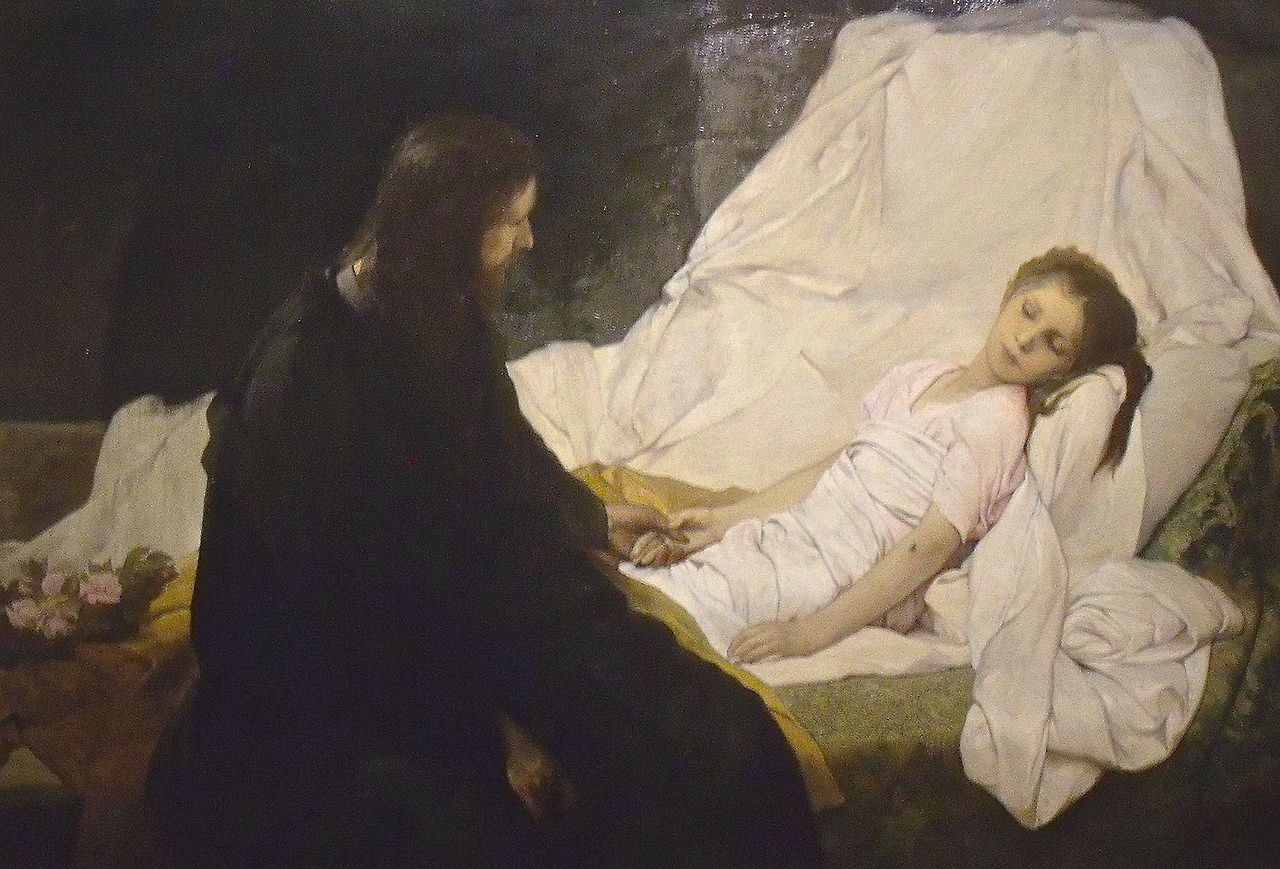
Gabriel von Max, 1881
The question that ought to be directing our thoughts and our interactions is, “What will please you, Lord? What do You want from me? What will make You happy?” And so, when we live like that, we’re letting Our Lord stretch out His arm to raise us like [He] raised Jairus’ daughter. And then, we’re truly awake. If we choose to purify our hearts and heed His quiet promptings in our souls, we will be amongst the gifts that God the Father gives His Son at Christmas and at the end of time.
In the Name and the Father, and of the Son, the Holy Ghost. Amen.
~Fr. Ermatinger