
Translation of the Epistle for the 24th and Last Sunday After Pentecost (Col 1:9-14)
Brethren: We have been praying for you unceasingly, asking that you may be filled with knowledge of God’s will, in all spiritual wisdom and understanding. May you walk worthily of God and please Him in all things, bearing fruit in every good work and growing in the knowledge of God. May you be completely strengthened through His glorious power unto perfect patience and long-suffering; joyfully rendering thanks to God the Father, Who has made us worthy to share the lot of the saints in light. He has rescued us from the power of darkness and transferred us into the kingdom of His beloved Son, in Whom we have our redemption, through His Blood, the remission of our sins.
Continuation of the Holy Gospel According to Saint Matthew (24:15-35)
At that time, Jesus said to His disciples: When you see the abomination of desolation, which was spoken of by Daniel the prophet, standing in the holy place – let him who reads understand – then let those who are in Judea flee to the mountains; and let him who is on the housetop not go down to take anything from his house; and let him who is in the field not turn back to take his cloak. But woe to those who are with child, or have infants at the breast in those days! But pray that your flight may not be in the winter, or on the Sabbath. For then there will be great tribulation, such as has not been from the beginning of the world until now, nor will be. And unless those days had been shortened, no living creature would be saved. But for the sake of the elect those days will be shortened. Then if anyone say to you, ‘Behold, here is the Christ,’ or ‘There He is,’ do not believe it. For false christs and false prophets will arise, and will show great signs and wonders, so as to lead astray, if possible, even the elect. Behold, I have told it to you beforehand. If therefore they say to you, ‘Behold, He is in the desert,’ do not go forth; ‘Behold, He is in the inner chambers,’ do not believe it. For as the lightning comes forth from the east and shines even to the west, so also will the coming of the Son of Man be. Wherever the body is, there will the eagles be gathered together. But immediately after the tribulation of those days, the sun will be darkened, and the moon will not give her light, and the stars will fall from heaven, and the powers of heaven will be shaken. And then will appear the sign of the Son of Man in heaven; and then will all tribes of the earth mourn, and they will see the Son of Man coming upon the clouds of heaven with great power and majesty. And He will send forth His angels with a trumpet and a great sound, and they will gather His elect from the four winds, from one end of the heavens to the other. Now from the fig tree learn this parable. When its branch is now tender, and the leaves break forth, you know that summer is near. Even so, when you see all these things, know that it is near, even at the door. Amen I say to you, this generation will not pass away till all these things have been accomplished. Heaven and earth will pass away, but my words will not pass away.
The Saving Words of the Gospel.
In the Name of the Father, and of the Son, the Holy Ghost. Amen.
Transcription of Sermon
This is the last Sunday of the Holy Year… of the Liturgical Year, I should say, and the Church, through the readings, is directing us, and encouraging us, to perseverance even as we consider the End of Time. Now, the new calendar places Christ the King on this Sunday, emphasizing Christ’s reign in the future. That wasn’t the original idea when Pope Pius XI gave us this feast day. The original date for Christ the King, which the traditional calendar still holds, was the last Sunday in October because it precedes All Saints, but it also coincides with what the Protestants call Reformation Day. And so, this was basically reaffirming the truth that Christ is the King, not just to come in the future in some eschatological sense, but now and here. And He wants to establish a social kingship.
Why did Pius XI give us this feast day? Because think of the time when it was happening, a hundred years ago this year. With the rise of the Masonic government in Mexico, the Bolshevik Revolution in Russia, the communists in Spain, the rise of materialist, fascist ideologies that were at odds with the dignity of man and divine revelation, often making the Church to suffer. Today, on this day in 1927, Padre Pro, Miguel Pro, was executed. If you’ve seen the famous pictures of him, you see him praying, kneeling, and then you see him in cruciform, hands outstretched, in one hand a crucifix, and the other a rosary, and he has a face that is peaceful, prayerful, and serious, much like a priest offering Mass. He doesn’t look afraid. He’s recollected. He’s serious because he’s doing serious business. He’s doing God’s work. And as he was carted out in front of the executioners, they offered him a blindfold, and he said, “No, thank you.” And he faced his executioners. And he said, “May God forgive you. May God bless you. And I know that I am innocent. Viva Cristo Rey!” Long live Christ the King. And they shot him. He wasn’t immediately killed. And so, the officer present came over and gave him a coup de grâce with his pistol.
But Christ the King was in response to that. Precisely to that type of persecution of the Church by these godless anti-Christian regimes. They were materialists. And this materialism rose up in the 1800s, well… was all a fruit of, basically, it all came about through the Protestant Reformation. That’s where the materialism and the radical separation of Church and State began. The Church doesn’t promote a separation of Church and State, rather a distinction, just as the body and a soul are distinct from one another but are unified. This is the mind of Christ. This is the mind of the Church. This is what the Social Kingship of Christ should look like.
The liturgical year, which we’re ending this week, is a microcosm of time. We just had a little glimpse into the festivities at the End of Time, and we’re awaiting that… interesting day. And nonetheless, we live it in a certain sense this week as we end the liturgical year. We’re called to live liturgically as Catholics. That means we don’t go from, as a former Vice President called it, you know, “Sparkle Season,” which was… he alluded to, he was allergic to saying the word Christmas for some reason. He called it the Sparkle Season, that special Sparkle Season. Well, we don’t associate time with Sparkle Seasons, Easter Bunnies, and Santa Claus. We associate liturgical time with creation and eschatology, with the birth of Christ, the death of Christ, and the Ascension of Christ. And so, the liturgical year is also a re-presentation of the life of Christ. And that’s why we’re called to immerse ourselves in the calendar of the year, because it’s precisely the Church who tells us when it’s time to feast, when it’s time to fast.
When we have austere liturgy with no flowers, for example, in Advent, Septuagesima, and Lent, and we have the glory of Christmas and Easter. How can we enjoy a feast if we haven’t fasted? How can we enjoy the good things that Our Lord allows us if we don’t deny ourselves those good things at times? We start to take them for granted if we don’t deny ourselves. And we’re just about to embark upon a time of self-denial, which is Advent.
Advent is not the time for holiday parties. Advent is the time of penance, but it’s a different type of spirit of penance than Lent, because this is a time of penance in preparation, as opposed to Septuagesima and Lent, which are penance of reparation. So, what are we doing?
We’re doing something like St. Joseph. Imagine the care with which St. Joseph took to clean out the stable to make it dignified for his bride, the Blessed Virgin Mary, and the God-man who was about to be born. He cleaned it up; he put everything in order. Joseph was very meticulous, as any carpenter is. That’s one of the reasons why I’ll never be practical. He was, and he used all of those human gifts to make the stable just as dignified and clean and orderly as he could. And that’s the idea of our Advent penance. We’re clearing out space for Christ. We want to give Him a worthy place where he can be born at Christmas.
And so, this is living liturgically. Our life is directed by the Ordo. Ordo is what we call the Church Calendar. But when we think of order because of the German influence on the American psychology, when we think of order, we think of everything in its proper place, like a bunch of drawers and boxes, well, in file cabinets. Okay, that’s the German sense of order, but the Latin sense of order is something that is moving, something that’s alive, something that’s teleological. It’s going from one spot to another, but with order. It’s not arbitrary, frenetic movement. It’s ordered movement, and it’s where there’s movement, there’s life. So, this is the life of the Church, and we’re called to live liturgically.
Yet another microcosm is our day. It’s a microcosm of creation and death, of creation and end times, of our birth and our death. We wake up, it’s a new creation. Each day is a new creation. We sing God a new song.
Every time Augustine says,” Sing to God a new song,” every time he refers to that Psalm, “Sing to God a new song,” he’s talking about what grace does in our souls. Why is it a new song? Because it’s unique. It’s singular. It’s something that is born of God in our souls, and we cooperate with it. He didn’t say everyone who sings praise twice; he said that everyone who sings well prays twice. Note the difference. So, this living liturgically is the opportunity to immerse ourselves into the life of the Church, which we’re called to meditate on the End of All Things today.
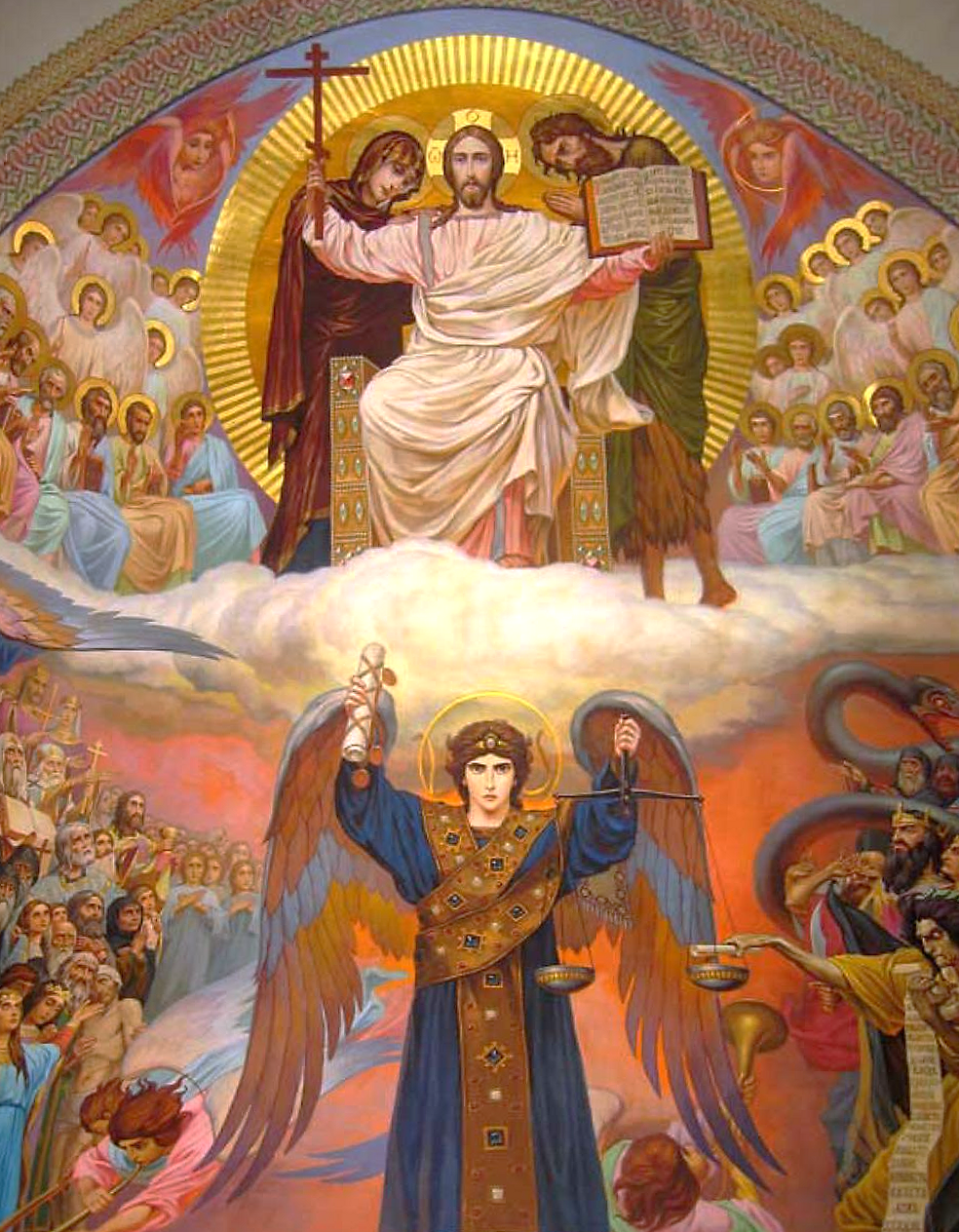
Now, you read in Paul’s Letters, you read at the end of John’s Apocalypse, Maranatha, right, Come Lord Jesus, there’s a longing for the coming of Christ. And then you see later on centuries later in medieval spirituality, they have the hymn Dies Irae, the Day of Wrath, which the Gospel today is depicting; the Day of Wrath. So, how do we reconcile this longing for the Day of Wrath?
Well, we know who it is who’s coming. We don’t have servile fear of Him if we are immersed in the life of the Church. If we’re living liturgically, if our life is ordered by the Church, if we are true sons and daughters of the Church, living the sacraments, living prayer, living virtue. Then what happens? He starts to change us. We don’t have servile fear of punishment. We know Purgatory is coming for most of us. We don’t fear Purgatory. We thank our Lord for it because it’s perfect. It’s perfect justice. It’s perfect mercy. We thank Him for it. Whatever you have in store for me, Lord, is going to fit perfectly for me. It’s exactly what I need. Thank you. So, we know that the One who is coming at the End of Time is the one who’s coming in a few moments on the altar. He’s the One who comes to us each day as we live liturgically with our new creation at the beginning of the day, our daily Mass, our prayer. We ought to be living liturgically by ongoing conversion.
So, we make a program, a spiritual program. I take into account my capital sin and its counter virtue. The dominant vice that I have, how does it express itself? This way, this way, this way, five, six, seven expressions. And then I’m going to address those manifestations of my dominant virtue; I’m going to write it out. This is going to direct our Advent, because then we’re going to be really clearing out our heart for the Birth of Christ. And in my morning offering, I go over this program. This is what I’m going to do for You, Lord, to be converted, to be adequate in heart, and mind, and soul to You. And then I work on it during the day, more or less, according to my generosity. And at the end of the day, I do my conscience exam.
Before I go to bed, it’s the end of my life. It’s the end of my day. I’m going to render accounts to God. These are the graces. I reflect on the graces that you’ve given me, Lord. Thank you. This is where I was blessed to cooperate with Your grace. And this is where I failed. So, we take note, and we say, “I’ll do better tomorrow.” I think, as we grow in our longing for Christ, we can even wonder at yesterday’s insanity. Ours, not anybody else’s, our own. How could I have done that? How could I have been so asleep to the action of grace yesterday? How could I have acted on my passions and not on grace? And then we just take note. We don’t spiral into ourselves. Rather, we say, and tomorrow I’ll do better. Because tomorrow You give me a new day in order to sing a new song. And so, this longing, desire for Christ shapes our hearts, our minds, our souls, adequates us, prepares us for Him even as He comes to us now so that we’re ready for the Day of Wrath, and we see it as nothing less than the fulfillment of all our desires.
~Fr. Ermatinger