
Translation of the Epistle for the First Sunday of Advent (Rom 13:11-14)
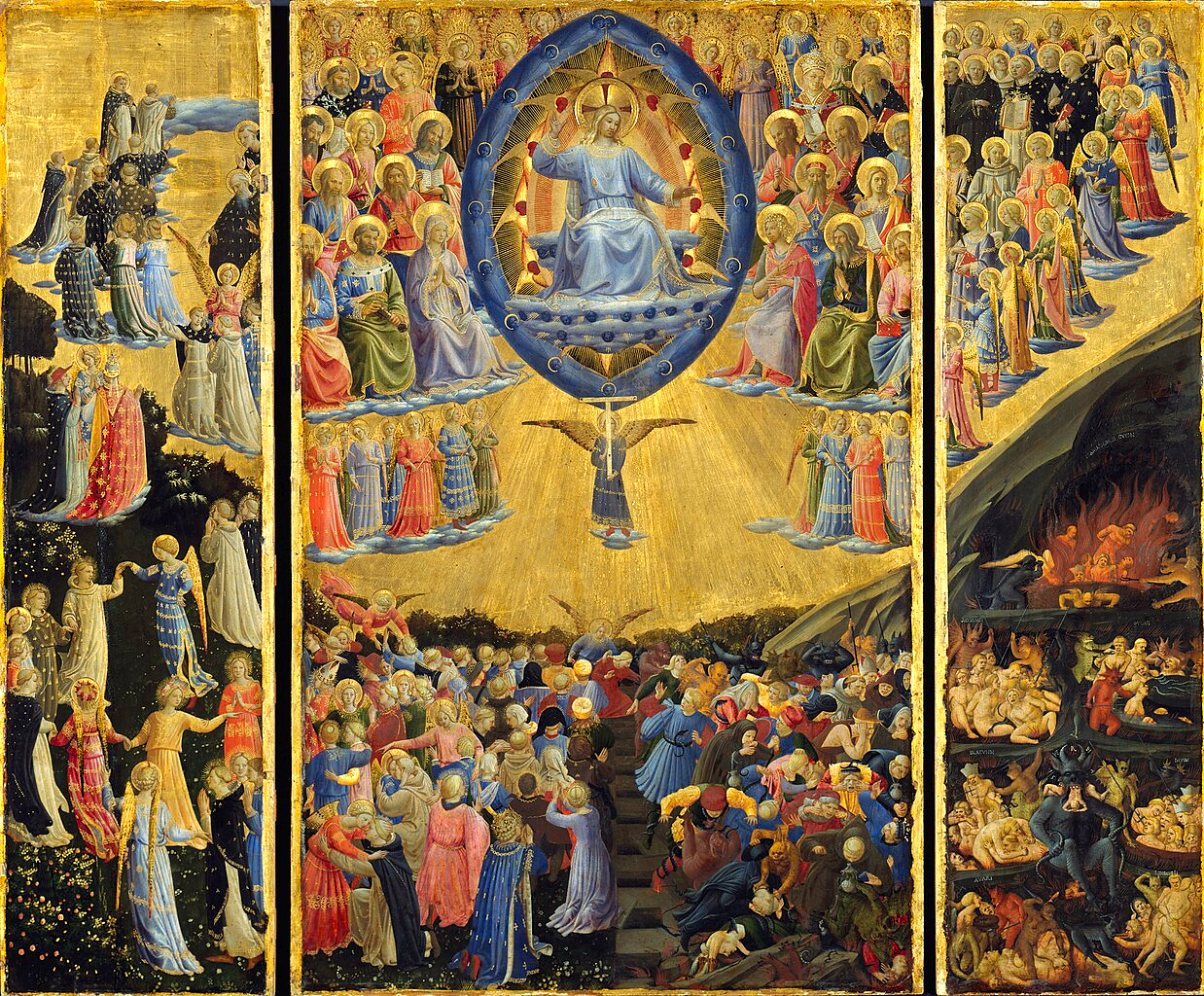
Fra Angelico, 1435-40
Brethren, knowing the time, that it is now the hour for us to rise from sleep; for now our salvation is nearer than when we believed. The night is past, and the day is at hand; let us therefore cast off the works of darkness, and put on the armor of light. Let us walk honestly, as in the day; not in rioting and drunkenness, not in chambering and impurities, not in contention and envy; but put ye on the Lord Jesus Christ.
Continuation of the Holy Gospel According to St. Luke (25:21-33)
At that time, Jesus said to His disciples: “There shall be signs in the sun, and in the moon, and in the stars; and upon the earth distress of nations, by reason of the confusion of the roaring of the sea and of the waves: men withering away for fear and expectation of what shall come upon the whole world. For the powers of heaven shall be moved; and then they shall see the Son of man coming in a cloud with great power and majesty. But when these things begin to come to pass, look up and lift up your heads, because your redemption is at hand.”
And He spoke to them a similitude: “See the fig tree, and all the trees; when they now shoot forth their fruit, you know that summer is nigh; so you also, when you shall see these things come to pass, know that the kingdom of God is at hand. Amen I say to you, this generation shall not pass away till all things be fulfilled. Heaven and earth shall pass away, but My words shall not pass away.”
The Saving Words of the Gospel.
Put ye on the Lord Jesus Christ.
In the Name of the Father, and of the Son, the Holy Ghost. Amen.
Transcription of Sermon
As we prepare this season of Advent, the Church reminds us of several comings of the Lord. We begin preparing ourselves to commemorate His first coming in the flesh, in poverty, and darkness, simplicity, purity, obedience, amidst the holy company of the Blessed Mother and St. Joseph. We’ve also experienced different comings of the Lord in a personal way through our baptism, through the Eucharist, through His absolution in Confession. His Holy Birth in Bethlehem marked a division of time; a new beginning for humanity, a second chance in order to get it right with his grace. And so, ever since then, time has been divided by the Birth of Christ.
And if you notice, this Gospel today didn’t mention reindeer or the North Pole. Rather, it’s speaking about the End of Time, the Last Coming of Christ, to put an end to all of this. And for that, we need to be prepared. And so, the Church gives us this period of Advent, also known as a little Lent.
The Great Fast, or the Great Lent, is a penitential time in reparation for our sins in preparation to receive the benefits of the Passion of Our Lord. And Advent is a penitential time, but of a different nature. It’s a penitence of preparation, a cleaning out of things, making space for Our Lord. And there has always been, until recently, there has always been a clear notion in the Catholic Church that this is a penitential time and that the difference of penitence from Lent is also stark.
In the mid-400s, there was already, one could see in different regions growing up a sense of penitential spirit that belongs to Advent. Many of the early Catholics would celebrate what they called Martin’s Fast from the Feast of St. Martin, November 11th, all the way through Christmas Eve. Others said, perhaps a little more scrupulous, said, ‘Yes, but even if we do that, we have Sundays, and we’re not allowed to fast on Sundays, and where are our 40 days of preparation?’ And so, they even extended that early notion of Advent to before St. Martin’s, and it started the day after All Saints on November 2nd. Gregory the Great mandated that all Catholics should fast during Advent on every Monday, Wednesday, and Friday. And then, since the times of Lent were different in different periods and the rigors of Lent were different, these things, since they weren’t coming from the Holy See, these things started to take different shapes, and some of them fell away, so much so that by the 12th century, there was a push to renew the penitential spirit in Advent. And then 400 years later, St. Charles Borromeo was recorded as inviting his priests to promote fasting amongst the laity on Mondays, Wednesdays, and Fridays. So, it’s clear that it fell away. St. Charles Borromeo recognized the value of it and enjoined his priests to promote this. At this time, it was only mandatory in religious houses and in the Papal Household. When the Church was founded in the United States, Advent fasting was obligatory for all Catholics on Wednesdays and Fridays up until 1840, and then it was only obligatory on Fridays.
Now, across the board, we’ve only spoken about fasting. Across the board, it was a time of abstinence, so no one was allowed to eat meat during Advent. Then, with the publication of Canon Law, 1917, there was no more mandatory fasting on Friday for Advent. We had, nonetheless, our Ember Days, Rogation Days. There were fasts on the vigils of feasts, and there was the long communion fast all the way up until Paul VI published Paenitemini, in which he told us, perhaps somewhat optimistically, it’s no longer obligatory, but it would be nice if you continued doing it. And everybody, of course, understands that as, well now, we don’t have to do it. And so, it wasn’t a very difficult jump from abrogation of fasting to godless holiday parties, reindeers, and consumerism marking this season. And nonetheless, Paul VI said in Paenitemini that we owe God our fasting. It’s a duty, and it’s a right that God has from us.
And so, in today’s Gospel, we’re seeing the “why” of all of that because the Final Coming of Christ will definitely relativize every penitence, every discipline, every difficulty, everything created will become relativized by this eschatological event.
Paul enjoins us in today’s brief reading “to put on Christ.” This is a fascinating concept. And he uses it in multiple places; to put on Christ. And he tells us what that means and what it doesn’t mean. It doesn’t mean drunkenness, rioting, chambering, impurities, contention, and envy. He said it’s none of those things. Those are at odds with putting on Christ. And Paul, when he speaks about putting on Christ, uses this verb, ἐνδύω (ĕnduō). Ἐνδύω. And it regards, it’s a pretty graphic term of sinking into one’s clothing, and you’re just enveloped by it, and he says this is what has happened to us in baptism; we’ve been enveloped by Christ. You’ve been transformed. We’ve put on Christ. That’s why at Funeral Masses we have the pall over the casket as a symbol. We have the Pascal Candle lit as the symbol of grace that entered one soul, transforming us, elevating, transforming our souls substantially through the invasion of the Blessed Trinity, through grace, through the baptismal waters. And this, he calls “putting on Christ.”
It’s a royal vestment. He speaks about this Baptismal Vestment of Christ in Galatians 3. And it’s supposed to be something that changes us once and for all. And nonetheless, we have the pull, the downward pull, of original sin, as expressed in some of these heinous actions that Paul tells us not to do. And so, we’ve got this fundamental choice made for Christ. We’ve been baptized, and nonetheless, we experience the effects of original sin. And so, this putting on Christ is not in the Protestant notion “being saved once for all,” because we still have our freedom, which we can use to God’s glory, or to our own eternal frustration. And so, this putting on Christ is supposed to be the foundation of all of my subsequent actions, my thoughts, and my words.
And yet, in Colossians, when [Paul] talks about putting on Christ, he speaks of it in a different sense, not of some interior transformation, but on the level of virtues, on the level of fruits of the Holy Spirit. He says, “Put on the garments of kindness, humility, patience, gentleness.” So, in other words, more than simply falling into this Vestment of Christ and being immersed in Him, surrounded by Him, we cooperate with this newfound reality, this spiritual situation in which we find ourselves. We’re called to be protagonists and, at the same time, cooperators in our own salvation. Protagonists in the sense that our theological virtues of faith, hope, and charity require our cooperation. But they also have God as a subject of the act. And so, this is being immersed in Christ, where He acts through us, and we act through Him at the same time. In all of this, we maintain our personality, and nonetheless, Our Lord elevates it and transforms it.
The welcoming of the Christ Child requires that we make preparation. If Joseph prepared the Inn, the Stall, the Manger, he cleaned it, made it orderly for the Birth of Christ, we ought to go about preparing our hearts, our minds, our interior, for what St. Theres called a “Christmas grace.” A special singular unique visit of Christ to our souls at Christmas, and the traditional means of preparation are still valid if not obligatory; of fasting, of adoration, of prayers, of virtue, and, above all, of longing for Christ.
In the Name of the Father, and of the Son, the Holy Ghost. Amen.
~Fr. Ermatinger