
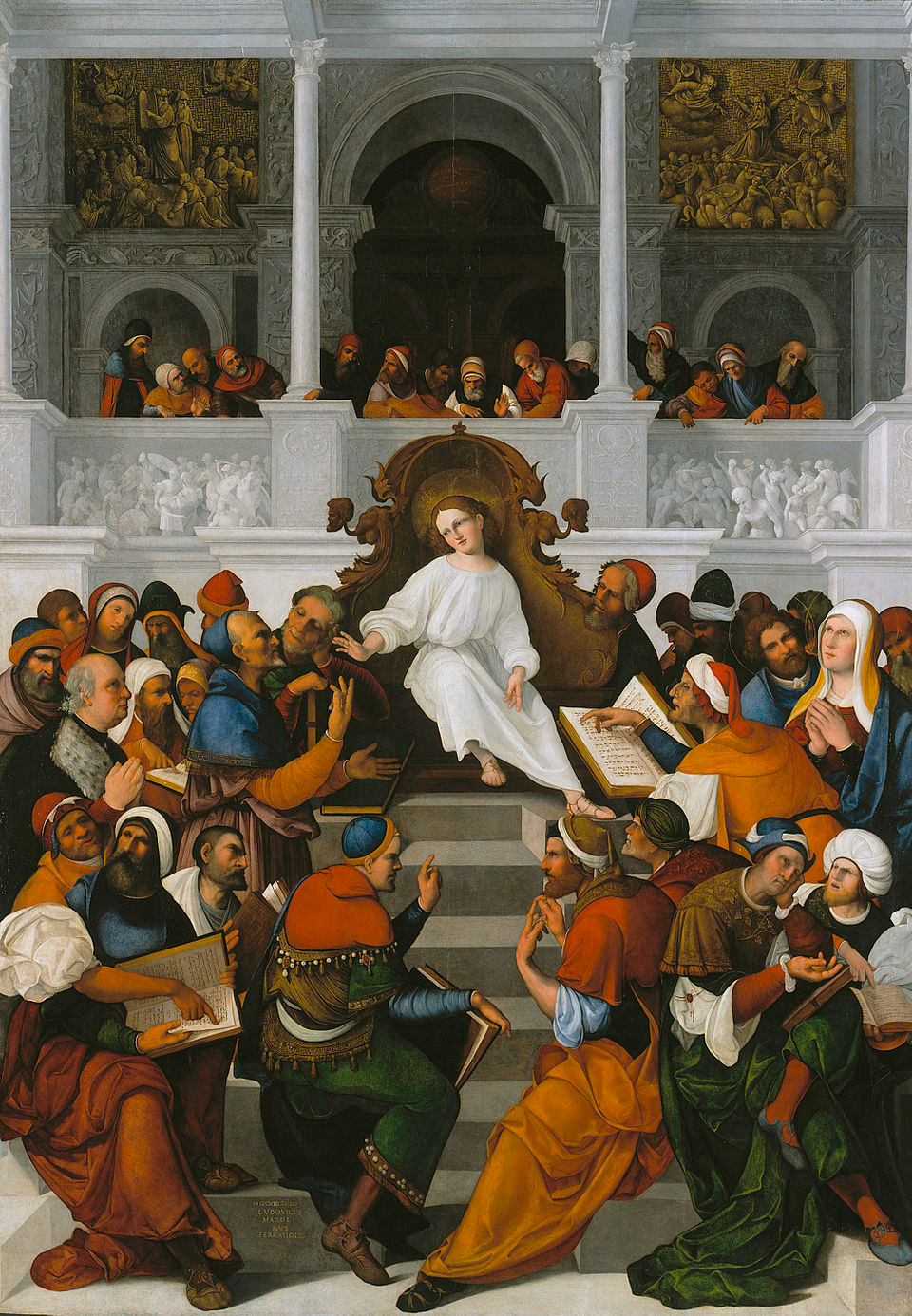
Ludovico Mazzolino, 1524
Translation of the Epistle for the Feast of the Holy Family (Colossians 3:12-17)
Brethren: Put on, as God’s chosen ones, holy and beloved, a heart of mercy, kindness, humility, meekness, patience. Bear with one another and forgive one another, if anyone has a grievance against any other; even as the Lord has forgiven you, so also do you forgive. But above all these things have charity, which is the bond of perfection. And may the peace of Christ reign in your hearts; unto that peace, indeed, you were called in one body. Show yourselves thankful. Let the word of Christ dwell in you abundantly: in all wisdom teach and admonish one another by psalms, hymns and spiritual songs, singing in your hearts to God by His grace. Whatever you do in word or in work, do all in the name of the Lord Jesus Christ, giving thanks to God the Father through Him.
Continuation of the Holy Gospel According to St. Luke (2:42-52)
When Jesus was twelve years old, they went up to Jerusalem according to the custom of the feast. And after they had fulfilled the days, when they were returning, the Boy Jesus remained in Jerusalem, and His parents did not know it. But thinking that He was in the caravan, they had come a day’s journey before it occurred to them to look for Him among their relatives and acquaintances. And not finding Him, they returned to Jerusalem in search of Him. And it came to pass after three days, that they found Him in the temple, sitting in the midst of the teachers, both listening to them and asking them questions. And all who were listening to Him were amazed at His understanding and His answers. And when they saw Him, they were astonished. And His Mother said to Him, Son, why have Thou done so to us? Behold, in Thy father and I have been seeking Thee sorrowing. And He said to them, How is it that you sought Me? Did you not know that I must be about My Father’s business? And they did not understand the word that He spoke to them. And He went down with them and came to Nazareth, and was subject to them; and His Mother kept all these things carefully in her heart. And Jesus advanced in wisdom and age and grace before God and men.
The Saving Words of the Gospel.
Your Father and I have sought you sorrowing.
In the Name of the Father, and of the Son, the Holy Spirit. Amen.
Transcription of Audio
The Holy Family is an icon of Trinitarian Life, it’s a model for us, but most importantly, it’s our own adoptive family into which we’ve been invited through grace. Every family has customs. This was the custom; they had to go down to Jerusalem, to the Temple. Every family has customs, and these customs reveal much about the family. They reveal what it values. They reveal also what its expectations are of its members.
We can ask ourselves what kind of members of the Holy Family are we. Your father and I have sought you, sorrowing, says Our Lady. This word dolor in Latin means pain; could be moral, could be intellectual, could be physical. In Spanish, we have similarly, we have dolor. I remember when I was in the seminary, a seminarian fell during basketball, and he told me he had a sorrow in his knee. My laughter didn’t really help him, apparently, in hindsight.
St. Augustine says that all sorrow is based in love, in City of God, Book 19. Sorrow and joy are not mutually exclusive in the spiritual life. In fact, in a healthy spiritual life, they have to go together. And that’s why we see the Third Sorrowful Mystery of the Chaplet of the Seven Sorrows of Our Lady is also the Fifth Joyful Mystery of the Rosary; the Loss and the Finding of Christ in the Temple. It’s the same episode. Joy and sorrow are not mutually exclusive. They go together, and as we grow into our place, our proper place in the Holy Family, both of those advance in depth and quality of joy and sorrow. If we are in a state of grace and we regard God in Himself, in His perfections, we have an intrinsic joy that’s not contradicted by extrinsic sorrows of the difficulties of life.
What does it mean to sorrow? The term that Luke records Our Lady using here in the Greek text, ὀδυνάω (odunah-o), which means to be tormented, to be grieved. And why was Mary’s sorrow so much greater than any of our possible sorrows? Because of her utter holiness, her perfect appraisal of God’s holiness, her perfect conformity with His will, and her understanding of His absolute condemnation of malice. If, as St. Augustine says that sorrow is rooted in love, the perfect love makes for perfect sorrow, something that we find uniquely in Our Lady. Love in the order of theological charity is the root of sorrow for sin, and this is what we call contrition, something that is foreign to Our Lady’s experience, who was sinless.
Sorrow regards an evil. And what is evil? Evil is a lack of a good that ought to be there. Thus, the greater the evil committed, the greater the contrition should be. Aquinas distinguishes between intellectual, moral, and physical sorrow. And he says that the moral… intellectual sorrow is far, far surpasses physical sorrow. That’s why the fires of Purgatory are so much more painful than any physical fire in this life. The joy of penitent experiences as a result of repentance does not lessen his sorrow, but, on the contrary, increases it. The closer we get to Our Lord, the more we are configured with His will, the more peace and joy we experience, and at the same time, the more we appreciate those of affronts against Him in our own life and those around us, and the more we experience sorrow unto the beatitude of blessed are those who mourn.
The degree of displeasure that one experiences ought to be in proportion to the degree of malice of one’s sin. But this will be determined by the degree of one’s love for Our Lord. When we speak of state of sin/state of grace, we’re talking about estasis. We’re talking about a place that one is in. There’s a certain stability there. It’s all relational. We can make the mistake of seeing sin as breaking rules as opposed to breaking Our Lord’s heart, whereas grace makes us right with God, puts us in a proper relation with Him. And of course, in the life of grace, there’s an entire spectrum of degrees of intimacy, of which we have absolute control.
So, the saints are not the lucky ones who were especially blessed with love for God. They chose that. It was a fruit of their choice under the action of grace. And then, according to our state in sin or grace, all of our doings correspond to that state. That’s why in a state of sin, we can do nothing pleasing in the eyes of God. In a state of grace, we can do heroic things invisible to others’ eyes, but infinitely pleasing to Our Lord, according to our degree of charity with which we carry it out. It’s in our hands to give Him joy in consolation; do we want to?
For the soul who truly loves Our Lord, he understands that this love is not sentimental. It’s a love that is carried out in actions, in the will, through obedience. If you love me, you will keep my commandments, says the Lord. That’s the guarantee of holiness, conformity with the will of God. From His fullness, we have all received grace upon grace, so He gives us all of the tools. He doesn’t set us up for failure. And for the soul who loves Him in this fashion, there is exponential merit.
As one grows in the relationship with Our Lord, it gets easier to correspond with His will. And one of the secrets of the spiritual life is that the easier it gets for us, the more pleasing it is in His eyes because there’s no interior dialogue; will I obey or will I not? And that’s why, for example, the Congregation of Saints, when they’re considering a candidate for to be a Servant to God or a Blessed, they’re going to look at the entire life, but especially at the last ten years, because those last ten years are where you see the fruits of so many previous choices. In other words, there is a snowball effect in holiness. On the other hand, if we have fallen away, there is also a snowball effect of sin. And this is why Thomas Aquinas tells us that one of the punishments for sin is addiction to pleasure. So, that for two reasons; so that we can see who our god is that we’ve chosen, the pleasure that we’ve chosen, and as a lesson for others, as a warning for others.
This begins with the withdrawal of grace. Sin begets sin. And it’s an accidental punishment. In other words, it’s not directly desired by God, but it’s permitted as part of His plan. And it’s more than something He does for us. It’s the consequence of choices. Many confuse their own self-hatred as a result of slavery to sin with contrition, and nothing is further from the truth. Self-hatred is wrapped up in self. Contrition is oriented towards Our Lord. It’s sorrow for the One that we’ve offended, who is so good to us.
There is something called imperfect contrition. It’s also called attrition. It’s sorrow for sin because of loss of heaven, because I’ve merited hell, or I’m disgusted at my actions. But if I have a purpose of amendment in my confession, it’s valid. And God will work with that, imperfect love. It’s called imperfect because the primary motive is not love for God. There are certain necessary elements. And all four have to be there. It has to be interior. In other words, there’s a choice to never offend Our Lord again. It’s supernatural. It’s an action of grace with which I cooperate. It’s universal. It means I hate all my sins, not just some of them, and its sovereign. I recognize sin as the greatest of evils, not any ill that can befall me, whether illness, misfortune, calumny; those are externals. The most important thing here is the sovereignty of evil. We recognize that the greatest evil is sin itself, and we would rather die than offend Him.
Perfect contrition has, as its object and its motivation, pure love for God. Perfect love for God. And this is within everyone’s grasp in as inasmuch as we’re in a state of grace, because it’s a choice. The common denominator between imperfect contrition and perfect contrition is the firm purpose of amendment. When I go to Confession, I am telling Our Lord I am going to do everything in my power to never sin again. We’ll get in line in confession weak, but we’re not planning on it. We are not planning on sinning; we are not giving in to the inertia… the inertial pull of sin. Rather, I’m making a firm commitment. And this firm commitment also has to be intelligent. If there’s a pattern of sin, I have to come up with a new pattern of virtue. So, there has to be a firm purpose of amendment, or confession is invalid and even sacrilegious. And this is presumption.
Presumption takes several shapes. It’s a rash expectation of God’s mercy without availing oneself of the means to obtain it. It lacks curative sorrow. It puts off one’s Confession while in a state of sin. It delays the amendment of our lives and repentance for our past sins. Falling into sin, then I commit still more sins, even though I know it’s wrong. Or I simply place myself in the occasion of sin, thinking that I’ll be fine without being vigilant. There’s a certain self-reliance rather than relying on God’s grace and the counsel of one’s confessor.
To decide the sin is one thing. To decide the sin, thinking that I can later go to Confession, that becomes really a sacrilege and makes the subsequent confession invalid. God will not be fooled, and if we make a mockery of His means of salvation, it doesn’t go well for us because we reduce God to a utility.
Imagine in the early Church, the practice was you were allowed to go to confession once in your life. And so many put off their Confession to their deathbed, but never made it to their deathbed. They were taken by surprise. And so, recognizing this difficulty, the Church loosened the discipline and promoted frequent confession. With good reason, but there is a danger in frequent Confession, if we are not careful, just as there is a danger in our frequent Communions, of a certain routine, and this is where we have a simple solution which is pure love for Our Lord, pure love for Our Lord in our Confessions, pure love for Our Lord and our Communions, and then we start to see the exponential growth. And we avoid routine.
We should ask for the grace of perfect contrition. St. Ignatius Loyola says in his Spiritual Exercises that the retreatants should ask for the grace of confusion over their sins. Sounds like a strange thing to ask for, but if we understand the insanity of sin, it should confuse us. How was that possible? How did I do that? What was I thinking? I wasn’t thinking. It’s a form of willed insanity.
As we learn to cooperate with grace, we find that, yes, we belong there with Mary and Joseph. We’re not intruders on sacred mysteries. We’ve been invited, and God is giving us the grace to be there. And when we rejoice with them, we sorrow with them. And grace refines the moral sense. It clarifies our soul’s vision until it’s smitten by love of the Father. And divine mercy as it did with St. Paul, who finally, through God’s grace, snapped asunder the chains of his own slavery.
The more we put on the mind of Christ, the more clearly we see things not according to the world, the flesh, or carnal prudence. A tactic of the evil one is to convince us that the way I am now is how I’ll always be. And that’s a lie. If we believe in grace, we know that God can bring about wonderful things, and He has still greater things in store for us. The truth is right there in the Holy Family. Christ is at the center. Everything Mary and Joseph thought about, everything they said, everything they did was in function of Christ. And that’s the model for us. Everything was organized around Christ.
And here, following the lead of Mary and Joseph, we allow Christ to be the why and the center of everything in our lives, our sorrows and our joys. And like Mary and Joseph, if we seek Him sorrowing, we will definitely find Him and adore Him as He deserves and so desires.
In the Name of the Father, and of the Son, the Holy Ghost. Amen.
~Fr. Ermatinger