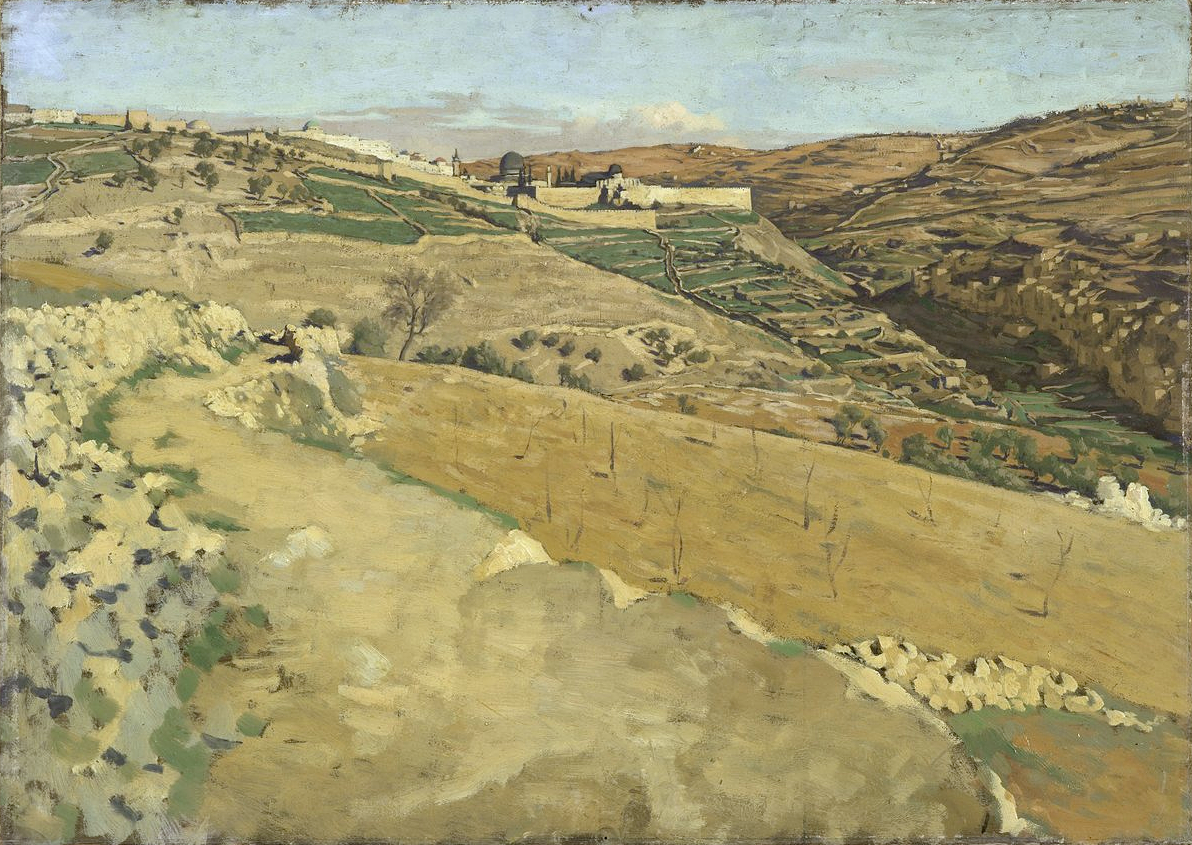
James Tissot, 1886-94
Translation of the Epistle for Quincuagestimus Sunday (1 Corinthians 13:1-13)
Brethren: If I should speak with the tongues of men and of angels, but do not have charity, I have become as sounding brass or a tinkling cymbal. And if I have prophecy and know all mysteries and all knowledge, and if I have all faith so as to remove mountains, yet do not have charity, I am nothing. And if I distribute all my goods to feed the poor, and if I deliver my body to be burned, yet do not have charity, it profits me nothing. Charity is patient, is kind; charity does not envy, is not pretentious, is not puffed up, is not ambitious, is not self-seeking, is not provoked; thinks no evil, does not rejoice over wickedness, but rejoices with the truth; bears with all things, believes all things, hopes all things, endures all things. Charity never fails, whereas prophecies will disappear, and tongues will cease, and knowledge will be destroyed. For we know in part and we prophesy in part; but when that which is perfect has come, that which is imperfect will be done away with. When I was a child, I spoke as a child, I felt as a child, I thought as a child. Now that I have become a man, I have put away the things of a child. We see now through a mirror in an obscure manner, but then face to face. Now I know in part, but then I shall know even as I have been known. So there abide faith, hope and charity, these three; but the greatest of these is charity.
Continuation of the Holy Gospel According to St. Luke (18:31-43)
At that time, Jesus taking to Himself the Twelve said to them, Behold, we are going up to Jerusalem, and all things that have been written by the prophets concerning the Son of Man will be accomplished. For He will be delivered to the Gentiles, and will be mocked and scourged and spit upon; and after they have scourged Him, they will put Him to death; and on the third day He will rise again. And they understood none of these things and this saying was hidden from them, neither did they get to know the things that were being said. Now it came to pass as He drew near to Jericho, that a certain blind man was sitting by the wayside, begging; but hearing a crowd passing by, he inquired what this might be. And they told him that Jesus of Nazareth was passing by. And he cried out, saying, Jesus, Son of David, have mercy on me! And they who went in front angrily tried to silence him. But he cried out all the louder, Son of David, have mercy on me! Then Jesus stopped and commanded that he should be brought to Him. And when he drew near, He asked him, saying, What would you have Me do for you? And he said, Lord, that I may see. And Jesus said to him, Receive your sight, your faith has saved you. And at once he received his sight, and followed Him, glorifying God. And all the people upon seeing it gave praise to God.
The Saving Words of the Gospel
Behold, we go up to Jerusalem.
Transcription of Audio
This is the third and last prophecy of Christ’s Passion, and He says, We go up… Αναβαινομεν (Anabainomen). Ascendamus. We go up. It’s interesting that this word to go up in, for example, in Matthew’s Gospel is only used in reference to Christ. But here we see this one-off in which Our Lord includes His disciples in this ascent. צלה (Hol) in Hebrew means to go up, which is the root for the word holocaust. Ὁλοκαύτωμα (Holocautoma), in Greek, is to be wholly burnt up as a burnt offering. So, the whispered context of this we ascend, we go up, is that we’re going up as an offering, as a holocaust, as a sacrifice. And that’s, I think, why the Church has chosen to put this Gospel here right before we begin the Lenten Season. Behold, we go up to Jerusalem with Christ in order to be offered with Him. And this offering, this being a sacrifice, is a watermark, like on every page of the Gospel, if you hold it up to the right light, if you have eyes to see and ears to hear. This is a constant theme of Christ’s self-offering.
I recommend for your spiritual reading this Lent to take Passion Gospels and go through them slowly. Also, helps would be something like Catherine Ann Emmerich’s Dolorous Passion of Our Lord and Savior Jesus Christ.
What I wanted to go over today were some principles to guide a Lenten program of penance.
Now there’s a difference between penance and mortification. Mortification has to do with curbing our appetites and our passion so as not to sin, but also because we need discipline and to acquire virtue. Penance is in reparation for our sin and those of the world. Sometimes they can look materially exactly the same, and the difference is the intention. Remember, too, that our Lady of Fatima said, Make everything a penance. So, even those mortifications that we have to impose upon ourselves ought to be offered as a penance.
When Socrates was teaching some of the youth, a man interrupted his class and said, Don’t believe him. You can tell by his face, he’s a pervert, a drunkard, and a liar. And Socrates said, Yes, I would be all of those things had I not mortified myself, but I do mortify myself. And so, this is something that even the pagans recognized as necessary in order to maintain their humanity. Of course, when we are in a state of grace, and we have a supernatural intention, reparation for our sins, reparation for sins against the Immaculate Heart and against the Sacred Heart, then they become penances and sanctifying and very pleasing to our Lord.
So, I wanted to go over some principles, guiding principles, and practical examples of what Lenten penance can look like for your consideration. You can accept it, you can reject it, do whatever you think is right with it. But a couple of guiding principles would be that moderation is a watchword. Moderation, there’s something called supererogation, which means too much of a good thing in the spiritual life, and that’s something that wears us out, and then all of a sudden we end up doing nothing. And so, our moderation, our constancy, are the things that assure progress. Also, if you’re going to do corporal penance, it ought to be under the direction of a spiritual director. Our penances ought not harm our health. They ought not get in the way of the accomplishment of our duties. And we ought not tell anybody about them so as not to lose the merit.
Certain things that we can do with regard to food would be to abstain from meat on certain days. You know, in the old Church, there was no meat during Lent at all, so you can be generous, and you’ll survive if you don’t have a lot of meat during Lent. When I am eating, though, it’s good to not eat between meals, to only eat what’s necessary, not choose what I like best when I’m given options. And if I am given something that I really like to remember the Passion of Our Lord and to thank Our Lord for the gift of the food, as Paul says, whether we eat or drink, to do it to God’s glory.
We have to keep the Passion of Our Lord before us to not make these means an end. I think all of us have become pretty good at making ends out of means and we end up serving it, and we turn it on its head by serving this creature rather than having that creature serve us in the service of God. Paul says, whether you eat or drink, do it to God’s glory. Eating only at the prescribed times, simple food, not spending too much money on food, not fussing about how it’s prepared.
With regard to corporal penance, something like sleep, for example, we ought to establish when we go to bed, when we get up, and be strict with ourselves.
With our exterior senses, in terms of the eyes, it’s important to not look and gaze at people to see if they’re beautiful or ugly. To have a custody of the eyes.
For our ears, also a custody of our ears, not believing any flattery we hear, not listening to gossip, not listening to news, talk shows, podcasts.
With regard to touch, things that can help would be cold showers, sleep on the floor, if you’re alone in the car, not turning the heat up, keeping a pleasant face when you feel sick or tired or hungry, not showing anybody your crosses, your anxieties, your difficulties.
With regard to speech, making sure that our jokes aren’t at the cost of charity. We don’t exaggerate. We don’t criticize. We don’t interrupt. We would rather listen than speak.
Mortification of the memory is important. If we hold on to a resentment, that’s like a small tear in a cloth; it doesn’t get better on its own. We have to submit little wounds that we have, memories of injustices to the Blood of Christ, and we have to make a threefold act of forgiveness. Lord, I forgive that person. I ask you to forgive that person, and I ask you to forgive me if I’ve held on to any grudge. So, the purification of our memory is going to be important for our interior life, or we will never have union with Christ. We have to take charge of our thoughts. St. Paul says that we should take every thought prisoner for Christ. And that means immediately, we isolate the thought; we examine it quickly. Does this give God glory? Yes or no? If yes, I pursue it. If no, we dispatch it quickly. We pray for those. When we hear bad news, we pray acts of reparation to the Sacred Heart, not taking into account how we feel about this situation, whether it’s in the Church or in the world, but how Our Lord does. And we are about solutions, making reparation to the Sacred Heart, not repeating bad news for the sake of repeating bad news and falling into gossip.
Remember, too, that curiosity is a vice. Curiosity, says St. Thomas Aquinas, is the opposite of studiousness. Curiosity regards disordered knowledge, whereas study is ordered knowledge. Thomas says that all study and all art, when it’s true, should lead to adoration. And so, we can ask ourselves, this thing, this article I’m reading, does this lead to adoration? Does this really give God glory? Is it proper to my state in life? Remember, too, that the angels in heaven know only what they’re supposed to know. They’re not curious. They know a lot more than we do, but none of them know, no two angels know, the exact same amount of stuff. Each one is going to have, according to his nature, is going to have a different capacity and necessity for knowledge.
Mortification of the affections. We, just like food, we can turn any other creature into a minor God, a minor deity that we serve by giving it too much affection. It could be music, could be a hobby, it could be anything that is not God. How do I know if I’m detached from a creature that I use? Well, if all of a sudden I don’t have it, I’m indifferent about it. If I’m not indifferent about it, there’s probably a disordered attachment. John of the Cross says that creatures are like darkness, whereas the Creator is light. He says, What does light have to do with darkness? We can’t have them both. We have to make a choice. If our hearts and our minds are made for Christ, why would we fill them, why would you fill our hearts and our minds with lesser things, which we know ultimately do not satisfy us?
Thanks to our fallenness, we tend to absolutize means. So, we have to constantly go back and purify our intention with how we see and use things. I remember… I can’t remember her name… it was a very penitential saint who was asked by Our Lord if she was truly detached from everything. She said, Of course, I am. Look how much I pray, how much I fast, I do all this penance. He said, What about that relic in your pocket? And so, even, even something holy can become a disordered attachment for us. It all has to do with our will.
With regard to others, we bear with others defects with patience and charity. When tempted to anger, we have to take charge of our passions. Remember that our revenge is charity and blessing. We should never think of ourselves as victims or have any self-pity because whatever we suffer, and everybody suffers something, not everybody suffers well, but it never compares to the Passion of Our Lord. So His Passion, keeping that foremost in our thoughts and our heart, His Passion is going to relativize everything in our life.
We have to remember, too, that we are debtors to God. The time and the space of this life is the opportunity we have to pay this debt. St. Francis DeSales said, It’s necessary to die. It’s necessary to die in order that God may live in us, for it is impossible to achieve the union of the soul with God by any means other than this mortification. And St. Paul reminds the Corinthians. He says, In all things we suffer tribulation, always bearing about in our body the death of Jesus, that the life also of Jesus may be made manifest in our bodies. And so, as we begin, Lent, we ascend with Christ to Jerusalem, thinking less of our own sacrifice and more of His.
In the Name of the Father, and of the Son, the Holy Ghost. Amen.
~Fr. Ermatinger