
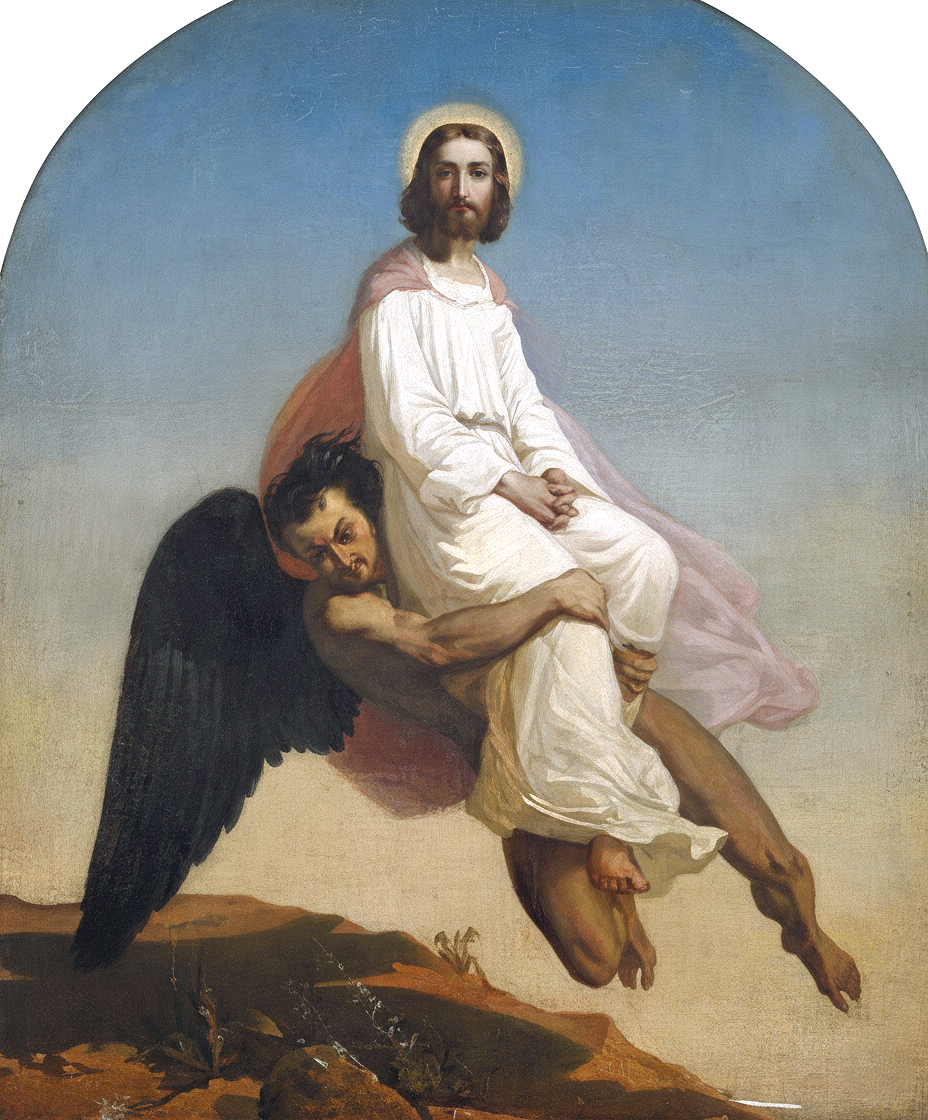
(AI reproduction), Ary Scheffer, 1854
Translation of the Epistle for the first Sunday of Lent (2 Corinthians 6:1-10)
Brethren: We exhort you that you receive not the grace of God in vain. For He saith: In an accepted time have I heard thee, and in the day of salvation have I helped thee. Behold, now is the acceptable time, behold now is the day of salvation. Giving no offense to any man, that our ministry be not blamed: but in all things let us exhibit ourselves as the ministers of God, in much patience, in tribulation, in necessities, in distress, in stripes, in prisons, in seditions, in labors, in watchings, in fastings, in chastity, in knowledge, in long-suffering, in sweetness, in the Holy Spirit, in charity unfeigned, in the word of truth, in the power of God: by the armor of justice on the right hand and on the left: by honor and dishonor, by evil report and good report: as deceivers and yet true, as unknown and yet known: as dying, and behold we live: as chastised and not killed: as sorrowful, yet always rejoicing: as needy, yet enriching many: as having nothing and possessing all things.
Continuation of the Holy Gospel, According to St. Matthew (4:1-11)
At that time Jesus was led by the Spirit into the desert, to be tempted by the devil. And when He had fasted forty days and forty nights, afterwards He was hungry. And the tempter coming said to him: If Thou be the Son of God, command that these stones be made bread.’ Who answered and said: ‘It is written: Not in bread alone doth man live, but in every word that proceedeth from the mouth of God. Then the devil took Him up into the holy city and set Him upon the pinnacle of the temple, and said to Him: If Thou be the Son of God, cast Thyself down. For it is written: That He hath given His angels charge over Thee, and in their hands shall they bear Thee up, lest perhaps Thou dash Thy foot against a stone. Jesus said to him: It is written again: Thou shalt not tempt the Lord Thy God. Again the devil took Him up into a very high mountain and showed Him all the kingdoms of the world and the glory of them, and said to Him: All these will I give Thee, if falling down Thou wilt adore me. Then Jesus saith to him: Begone, Satan! For it is written: The Lord thy God shalt thou adore, and Him only shalt thou serve. Then the devil left Him: and behold angels came, and ministered to Him.
The Saving Words of the Gospel
In the Name of the Father, and the Son, and of the Holy Ghost. Amen.
Transcription of Audio
Our Lord was led out into the desert by the Holy Spirit. This is the same Holy Spirit who had descended on the Blessed Virgin Mary in the Incarnation, thus bringing about His sacred humanity; the same Holy Spirit who had just revealed Christ as the Son of God in the baptism right before this. Now is the One who interiorly impels Him. The verb in Greek is ἀνήχθηἀνάγω (anechthanago). It can be led, it could be pushed, it could be impelled. So, there’s this interior, very profound, deep movement of the Holy Spirit, deep within the sacred humanity of Christ.
And it says, in order to be tempted, and so, this is part of the program for Him. We’re not allowed to seek temptation; if you are the Son of God, you may. We don’t put ourselves in occasion of temptation. We don’t seek it, but it seeks us and finds us without much difficulty, so it seems. And the word there that πειράζω (peirazō), πειράζω , can be tempt. It can also be tried or scrutinized; put to the test. And so, all of these things are Our Lord is going to undergo. And notice when it happens; He’s already fasted 40 days and nights, and He’s about to return to the world that He wants to save. Now, this isn’t a, this isn’t a temptation to gluttony, okay? After 40 days, you’re allowed to be hungry, I suppose. So, this is not a temptation to gluttony. It’s a temptation that the devil is presenting to Him, much like the following, too, that doesn’t really have much effect.
Notice how the Holy Spirit works, how the evil spirit works, and the differences. St. Ignatius of Loyola tells us that we can trust that God will always act as God, working for our salvation, and that whatever He asks of us is always for our good; and the devil is the opposite. Now, we’re not Manichaeists. We don’t believe that there’s a good God and a bad God at odds with each other. The devil is a little cockroach in comparison to the Almighty. He’s a creature, and nonetheless, much more powerful and intelligent than we. And when he works on us, it’s helpful for us to understand patterns. Patterns. How the Holy Spirit works, how the evil spirit works.
Now, in spiritual life, we have these phenomena called consolations and desolations.
Consolation, people often mistake for God Himself. Well, no, God cannot be felt. Okay. God is pure spirit. He can’t be felt. So, what is consolation? Consolation is the convergence of the intellect and the will. Okay? We have two spiritual intellects that make us in the image of God. Our intellect and our will. Intellect is ordered towards the truth. The will is ordered towards the good. When they regard the same object, it brings about a certain inner cohesion, and this is what we call consolation. Why? There are no fissures, no fractures. Now, be careful, because there can be a demonic consolation. There can be a divine consolation. So, not all consolation is from God. If what I want is bad, and I know it’s bad, and I still want it, well, there’s going to be a certain consolation, which will address a demonic consolation.
Now, a desolation is a divergence of intellect and will. I know this is good. I don’t want it. I know this is bad, but I want it. And so this is called desolation. There’s a certain fractioning of the person. Our interior is going in opposite directions, and it brings about this phenomena that we call desolation.
Now, notice how the Holy Spirit worked in the depths of Christ’s sacred humanity, and how did the devil work on Him. Words and images: words and images. Something very superficial; regards the senses. And God works on something much more profound than the senses.
Interesting to note, when St. Ignatius of Loyola wrote his rules for discernment of spirits, for The Spiritual Exercises, he always, when he’s talking about the action of God, he talks about divine consolation, divine consolation. So, he calls it spiritual consolation. El consuelo espiritual. So, this movement of our Lord is in the depths. It’s not on the surface of euphoria. It’s not on the surface of emotions. It’s not on the surface of ‘it makes me feel like all these warm and fuzzies.’
What the evil one will often appeal to will depend on our spiritual state. If I’m in a state of grace, he’s going to act on me in a certain way. If I’m in a state of sin, he’s going to act on me in a different way. And he’s going to appeal to the different corresponding faculties. For example, if I’m in a state of sin, remember, the will is ordered towards the good, and the intellect is ordered towards the true. He’s not going to appeal to my intellect. He doesn’t want to awaken the intellect. Why? Because it’s ordered towards the truth. So, he doesn’t want to take the risk of giving me ideas. He’s going to give me feelings. If I’m in a state of sin, he will confirm me in this sin and mediocrity by giving me all sorts of saccharine, euphoric feelings. One of the hallmarks of demonic consolation is that in the moment it comes over us, and when it leaves us, we’re kind of tired and empty, and it’s on the surface.
If we’re in a state of sin, what is God going to do? Well, my will is already bad, so He’s going to appeal to my intellect. He’s going to wake me up. Point out, could be through a book, an example, through words of a friend, or He’ll use some means as a means of actual grace or prevenient grace to wake me up, to the truth of my situation, so that I come back to Him. And when I come back to Him, what happens? Now, my intellect, my will regard God and His will. This brings about consolation. And the devil is pouting. He’s angry. He’s having a pity party, and he’s not happy that we’re happy. So, what does he do?
He doesn’t appeal to the will or feelings, right? Because we’ve already chosen God, we’re in His grace, we’re in friendship with Him. What’s He going to do? Now He’s got nothing to lose. So, He’s going to come at my mind. This is why you see people who’ve had a conversion, that often they’re attacked in the mind. ‘How do you think you’re going to continue this? Do you think you can really be good? After all of those things that you did, you go to Confession, and you think everything is fine? Well, don’t you remember this? Maybe you didn’t confess this correctly.’ This is all how the devil works on us. And we ought not worry about it. We ought not make a big deal out of it. ‘Oh, it’s the devil. So what?’ So what? Let him die of neglect. Just turn your back on him.
Now, when we’ve made good resolutions to be faithful to Our Lord, we’ve made a Lenten program, then all of a sudden there’s a certain, perhaps, a desolation that overcomes me. Why is this? Well, there are different reasons. One, could be, I’m in a state of grace. I’m trying my best, so I think, and I start to experience dryness or desolation. I feel abandoned by God. What’s going on? Remember, this is on the level of feelings. God allows it. It could be because I’m mediocre or not faithful in my duty. And if there’s any mediocrity in my life, Our Lord isn’t going to bless that with warm and fuzzies. He’s not going to give us consolation to confirm us in mediocrity. He loves us too much for that. He’s somebody who will never say, ‘I love you just the way you are,’ right? He obviously wants us to be better. So, it could be that.
It could be that there’s some culpability in our carrying out of our duties that brings about this desolation. And that’s pedagogical. It could be that God is testing me to see what I’m made of. Fine. It could be that God is testing me to me, to reveal to me my need to be vigilant and that I am utterly dependent on Him. I ought not get complacent. This happens sometimes after a conversion. I’ve been in a state of grace for a long time, and I start to get complacent. ‘I’ve got this.’ Well, no. We’ve got a long way to go to make reparation for our sins. We’ve got a long way to go to become the saints Our Lord wants us to be.
So, when we are confronted with this interior situation of desolation, it is not the time to change my spiritual program. It is not the time to slacken; its not the time to open the fridge and turn on the TV. St. Ignatius of Loyola says when we experience, if we are in a state of grace, and we experience desolation, increase penance and increase prayer. Okay, not what a psychologist would tell you, okay, but that’s what this great doctor of the soul, St. Ignatius of Loyola, tells us. You’re in desolation, increase penance, increase prayer. Get your eyes off yourself, eyes back on Christ, and be generous with Him.
Also, Ignatius tells us, if you’re in desolation, don’t worry, it doesn’t last forever. It won’t be around forever. Consolation is on its way. And if you’re in consolation, well, don’t be dependent on it. Don’t think well of yourself, because that’s also not going to hang around forever, and desolation is on its way.
So, neither of these situations have the last word. They’re not that important. They can be indicative of something, and we ought to do the due diligence of why, but we ought not be dependent on those things. What kind of a relationship with Our Lord is it if I slacken in my duty because I don’t feel good? Well, that’s not a very mature way to deal with the Almighty, my Creator, my Judge, and my Redeemer. If I’m trying to be faithful, if I’m living up to my Lenten proposals, if I’m being delicate of conscience in my prayer, in my virtue, in my sacramental life, and the devil approaches with his temptations, no fear. No fear.
True love casts out all fear, says St. John in his first letter. St. Ignatius tells us in the spiritual exercises that if we stand strong in our resolve, the devil will run away. He’ll repine, his self-love is so exaggerated and twisted that when we rebuff him by simply ignoring him, it’s such a blow to his ego that he runs off into the corner to pout. He said, but the moment you show fear, he enters. And he starts presenting all sorts of complicated ideas.
And so, if our heart and our minds are set on Our Lord, we have what we need to stay strong.
He also talks about the devil being like a soldier mounted on a horse, riding around a fortress, looking for the weak spot. Everyone has a weak spot. We call it our dominant fault. Our dominant fault, our dominant passion. It’s not a problem. It’s just our situation.
Actually, it ought to be a situation that we exploit for our own good, because it’s precisely through our defects, submitted to grace, and worked on with intelligence. That’s why we make our Lenten programs in order to overcome our defects. Then our defect becomes our path to holiness. It’s not a problem. It’s just a situation. Then it becomes even a tool. So, consider your dominant passion. You can do this exercise.
What is the thing that you most frequently confess? And if you could overcome this one defect, your spiritual life would be in much better state. Well, consider that dominant defect and then apply the counter virtue. It’s not rocket surgery. It’s not complicated at all. Okay, so you just apply the counter virtue so that that defect now becomes the focus of not my concern, but of my work. I get busy. And when we do this, Our Lord blesses that. And so, Lent is here, again, for us to become holy, for us to do the hard work that we’re supposed to do that Our Lord expects of us and that only we can do. What I do is really going to be dependent on the degree of love I have for Him. And how much do I love Him? As much as I want. That’s a choice. It’s not a feeling.
In the Name of the Father, and of the Son, and the Holy Ghost. Amen.
~Fr. Ermatinger