
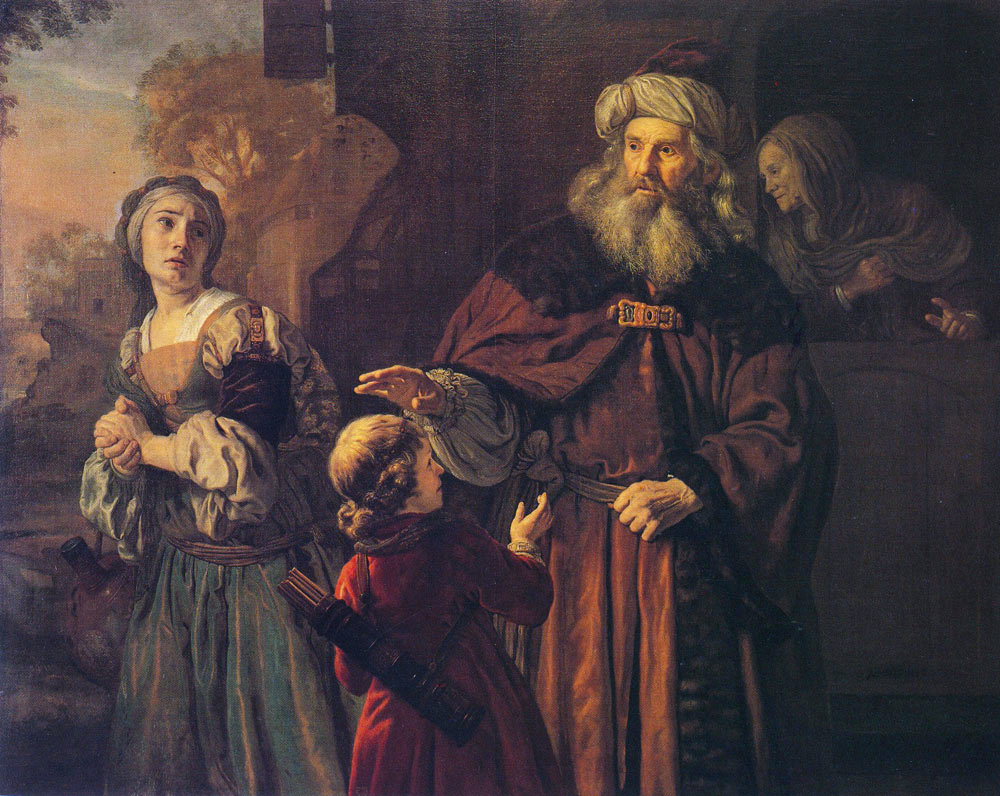
Jan Victors, 1650
Translation of the Epistle for the Fourth Sunday in Lent (Galatians 4:22-31)
Brethren: It is written that Abraham had two sons, the one by a slave-girl and the other by a free woman. And the son of the slave-girl was born according to the flesh, but the son of the free woman in virtue of the promise. This is said by way of allegory. For these are the two covenants: one indeed from Mount Sinai bringing forth children unto bondage, which is Agar. For Sinai is a mountain in Arabia, which corresponds to the present Jerusalem, and is in slavery with her children. But that Jerusalem which is above is free, which is our mother. For it is written, Rejoice, O barren one, that do not bear; break forth and cry, you that do not travail; for many are the children of the desolate, more than of her that has a husband. Now we, brethren, are the children of the promise, as Isaac was. But as then he who was born according to the flesh, persecuted him who was born according to the spirit, so also it is now. But what does the Scripture say? Cast out the slave-girl and her son, for the son of the slave-girl shall not be heir with the son of the free woman.Therefore, brethren, we are not children of a slave-girl, but of the free woman – in virtue of the freedom wherewith Christ has made us free.
Continuation of the Holy Gospel According to Saint John (6:1-15)
At that time, Jesus went away to the other side of the sea of Galilee, which is that of Tiberias. And there followed Him a great crowd, because they witnessed the signs He worked on those who were sick. Jesus therefore went up the mountain, and sat there with His disciples. Now the Passover, the feast of the Jews, was near. When, therefore, Jesus had lifted up His eyes and seen that a very great crowd had come to Him, He said to Philip, Whence shall we buy bread that these may eat? But He said this to try him, for He Himself knew what He would do. Philip answered Him, Two hundred denarii worth of bread is not enough for them, that each one may receive a little. One of His disciples, Andrew, the brother of Simon Peter, said to Him, There is a young boy here who has five barley loaves and two fishes; but what are these among so many? Jesus then said, Make the people recline. Now there was much grass in the place. The men therefore reclined, in number about five thousand. Jesus then took the loaves, and when He had given thanks, distributed them to those reclining; and likewise the fishes, as much as they wished. But when they were filled, He said to His disciples, Gather the fragments that are left over, lest they be wasted. They therefore gathered them up; and they filled twelve baskets with the fragments of the five barley loaves left over by those who had eaten. When the people, therefore, had seen the sign which Jesus had worked, they said, This is indeed the Prophet Who is to come into the world. So when Jesus perceived that they would come to take Him by force and make Him king He fled again to the mountain, Himself alone.
The Saving Words of the Gospel.
In the Name of the Father, and of the Son, and of the Holy Ghost. Amen.
Transcription of Audio
Today we celebrate Lætare Sunday. Much like in Advent, we have Gaudete Sunday, we have this joy amidst sorrow. And when our sorrow is not a sorrow of the world, as Paul discusses, which leads to depression and myopic narcissism, the healthy sorrow of this season is the sorrow for a Lord who grieves, a sorrow for our own sins, a sorrow for the sins of the world. We grieve with Our Lord and for Him. And as a result, we bring Him joy, and He, in turn, shares that joy with us. Not a joy of the world, not a joy that is sensible, not a joy that’s euphoric or on the surface, but a profound sharing of His divine joy, His charity. These graces that He shares with us reveal to Him something of Himself. And it brings us to greater conversion; to repent more fully and, thereby, experience a joy that is dependent on repentance.
There is an interior call to continued conversion, which, when unheeded, leaves Our Lord in His sorrow and grief, and deprives us of that as well. Meanwhile, our humble and generous response to His invitation assures Him and us of a hidden joy. This pain that we can experience when we repent of our sins, when we consider how we’ve offended One who is so good, when it’s a holy sorrow, it’s a pain that heals. It heals our relationship, it heals us, it brings about something that only Our Lord can do in our souls, if we let Him. He gives us grace upon grace, and we’ve, perhaps on retreat, have made all sorts of promises and then not lived up to them, and we’ve brought Him sorrow as a result. He’s shown us so many manifestations of His love, many of which have gone unrequited. And nonetheless, He gives us a way out of our weakness and our misery.
It’s through the gift of Himself in the Eucharist. When we read the Gospel today, we see this poignant line, when Jesus had lifted up His eyes, He saw a great crowd that had come after Him. This is a bittersweet reality of those who seek Christ because of the miracles that He did, and He brought them some excitement in their otherwise mundane lives, not necessarily seeking Him, seeking the externals. They also saw food, and He gives them that, but He also gives them a food that is heavenly, and He gives it to us.
It started on Holy Thursday, for which we’re preparing ourselves. As a result of that Blessed Night, He’s in Tabernacles in churches across the world. In the book, The Way of Divine Love, in which the Sacred Heart revealed His grief at neglects and infidelities by us and His joy at the faithful who are delicate in their treatment of Him. He tells Sister Josefa Menéndez that on Holy Thursday night, when He was beaten, when He was tied up and thrown on the cold stone floor and left alone in His physical and moral pain, that, in an instant, He saw every tabernacle that would ever exist, and how many people would visit Him, how many would not.
And He said to her, “The mockery, the insults, the spits, and the blows on My body were nothing compared to the neglect of those who professed to love Me because they didn’t believe in Me, and they didn’t say they were My friends. But when My friends know that I’m there and they don’t come to visit Me,” He said, “that grieves My heart.”
So, what does He do all day in the Tabernacle? He’s not dormant. He’s there with all of His human sensitivity, with all of His divine love, waiting. Waiting for His friends to stop by and spend time with Him. If He says the loneliness of the Tabernacle was worse than the abuse that was heaped upon Him by the Jews and the Romans, then it’s also within our grasp to alleviate that. Imagine the joy He experiences in the morning when He hears the keys and the click of the lock. The church is about to be opened. And He knows His friends are coming to spend time with Him. His friends are coming to worship Him. And each one of us comes with a different degree of love. Each one of us comes with a history that’s different, perhaps of wounds, of our own forgiven sins. And none of those are problems for Him.
They’re situations. And they’re situations that He’s happy to address. The quality of the soul of each one of us is going to be far different from the other. And so, for the perfect souls, He strengthens them for the fights that await them. He receives great joy at their loving affection in the church and outside. When a perfect soul comes to Him in Adoration, it’s two friends lost in the other. With very little consideration for self. Wholly loving and giving self to the other. For the imperfect but good, they receive graces to attain perfection. And they’re strengthened. They’re fortified by His divine presence here. Weak souls are strengthened. Lackadaisical, mediocre souls have many of their sins covered over through the charity they show Our Lord by attentive, loving adoration. And sinful souls receive graces of conversion.
Which one am I? Which one are you? Each one of us is going to have a different response. But we could also ask ourselves and ask Him, more importantly, ask Him, “When you saw me on Holy Thursday night, when you were in the prison, what did you see? Did you see a faithful friend? Or did you see one that was inconstant? Did you see a traitor? What did you see in me?” And that answer is something each one of us is working out right now. We’re still deciding the degree of our desire for Him, our longing for Him, our configuration with His heart. That’s something each one of us is working out through the space and the time of our lives.
And this is dependent on not only the frequency of our visits, but the quality of our visits. How often do I go to Adoration? How much time do I spend with Him in Adoration? How do I prepare myself to receive Him? Do I lose myself in Him with great selflessness, forgetting my foibles and my sins and being engrossed in Him?
What can we do to increase our Eucharistic life? There’s something called remote preparation. Remote preparation is how I live. Do I live with internal dispersion because I’m watching screens, reading news, listening to podcasts that don’t change my life and don’t really add anything to my relationship with Christ? Or am I living with recollection, aware that through grace, the blessed Trinity dwells in my soul and there’s a Tabernacle in my body, which is my soul, where He dwells, and I can visit Him and live a life of perpetual adoration of the heart.
There’s also something called proximate preparation, which is to exercise the longing and the desire for Him as I’m preparing to go to Mass, as I’m in Mass, as I’m preparing to go to Adoration.
And then there’s immediate preparation, which is as I’m about to receive Him. And this is so important that we exercise our longing, our desire for Him, so that the grace that He gives us can reach its desired effect by Him. At the moment of our reception of Communion, this is the height of our Eucharistic life. And this is when we should make acts of love, thanksgiving, and above all, reparation. Reparation for bad Communions, for sacrilegious, for insults, for ingratitudes, for coldness, for our own distractions. It’s in our hands to use the Eucharist as an occasion to make reparation for abuse of the Eucharist. He gives us the solution, and the solution is Himself.
Second most important moment is our thanksgiving right after we’ve received Our Lord. Εὐχαριστία (eucharistia) is a Greek word that means thanksgiving because the dynamic, the inner dynamic of thanksgiving, is that it creates a virtuous circle. The more we give thanks, the more we’re disposed to receive Him with greater depth. And so, this is something that ought to be spiraling, going ever deeper in our Eucharistic life. And it’s dependent on the degree of thanksgiving we live after we’ve received Him. And we can cultivate this thanksgiving throughout the entire day, elevating our hearts and our minds to Him, thanking Him, thanking Him that He was in a prison, He’s abandoned in Tabernacles, but He’s come to this Tabernacle of my heart, and there I stay with Him. I keep my affections oriented towards Him. I keep my mind elevated towards Him.
So, rather than seeking Christ as a coping mechanism, rather than being consumerists of grace, we’re called into a dynamic of love, of charity, of gift of self in which we receive Him who is everything, and we give Him the littleness of ourselves, and He transforms that littleness. We ride on the coattails of perfect love. This requires some self-denial, control of our passions and our imagination, avoiding screens, avoiding news, avoiding noise, so that we can be wholly engrossed by the one who loves us so much.
We will never regret having given Him our loving affection. What is too much love and affection for Christ? What does too much look like? I’ve accompanied many people on their deathbeds. I’ve never heard anybody say, “I was too generous with Christ during my life.” What’s left of our Lent is the opportunity that He gives us to renew our Eucharistic life, not only preparing for the Triduum, but preparing for what’s left of our life so that we can live true Eucharistic lives and be prepared to continue that loving relationship with Him in heaven forever.
In the Name of the Father, and of the Son, the Holy Ghost. Amen.
~Fr. Ermatinger