
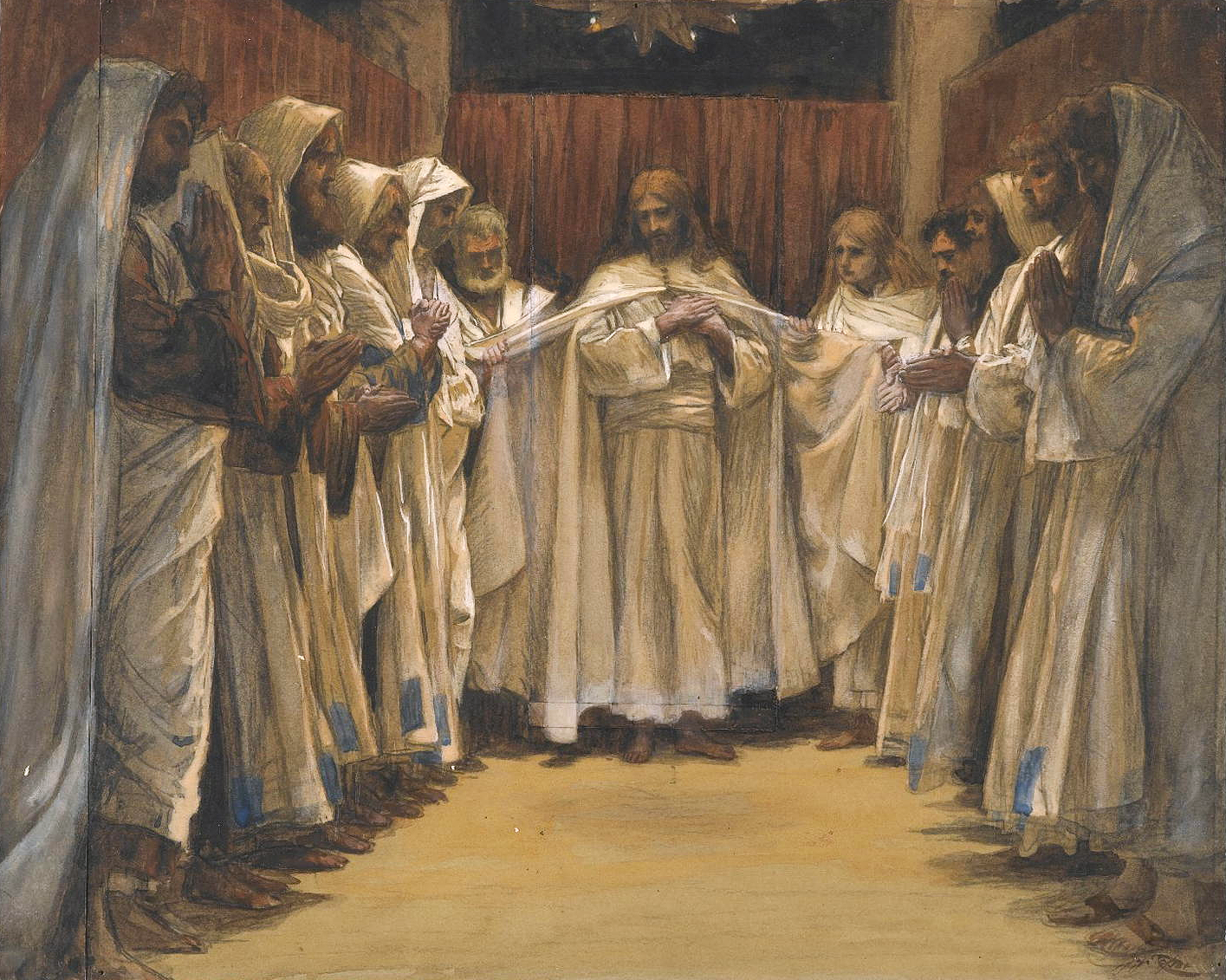
James Tissot, 1886–94
Translation of the Epistle for the Third Sunday After Easter (I Peter 2:11-19)
Dearly beloved, I beseech you, as strangers and pilgrims, to refrain yourselves from carnal desires which war against the soul, Having your conversation good among the Gentiles: that whereas they speak against you as evildoers, they may, by the good works which they shall behold in you, glorify God in the day of visitation.
Be ye subject therefore to every human creature for God’s sake: whether it be to the king as excelling, Or to governors as sent by him for the punishment of evildoers and for the praise of the good. For so is the will of God, that by doing well you may put to silence the ignorance of foolish men: As free and not as making liberty a cloak for malice, but as the servants of God. Honour all men. Love the brotherhood. Fear God. Honour the king. Servants, be subject to your masters with all fear, not only to the good and gentle but also to the forward. For this is thankworthy before God, in Christ Jesus, our Lord.
Continuation of the Holy Gospel According to Saint John (16:16-22)
At that time, Jesus said to His disciples: “A little while, and now you shall not see Me: and again a little while, and you shall see Me: because I go to the Father.” Then some of his disciples said one to another: “What is this that he saith to us: A little while, and you shall not see me: and again a little while, and you shall see me, and, Because I go to the Father?” They said therefore: “What is this that he saith, A little while? We know not what he speaketh.”
And Jesus knew that they had a mind to ask him. And he said to them: “Of this do you inquire among yourselves, because I said: A little while, and you shall not see Me; and again a little while, and you shall see Me? Amen, amen, I say to you, that you shall lament and weep, but the world shall rejoice: and you shall be made sorrowful, but your sorrow shall be turned into joy. A woman, when she is in labour, hath sorrow, because her hour is come; but when she hath brought forth the child, she remembereth no more the anguish, for joy that a man is born into the world. So also you now indeed have sorrow: but I will see you again and your heart shall rejoice. And your joy no man shall take from you.”
The Saving Words of the Gospel
In the Name of the Father, and of the Son, and of the Holy Ghost. Amen.
Transcription of Homily
“You shall weep, and your sorrow shall be turned into joy.” Now there are different types of joy; there are different types of sorrow. Our Lord is referring to these various types, and Paul, with a little more precision, discusses what he calls worldly sorrow and godly sorrow, worldly joy and godly joy. We see a reference to this also by Peter in his Epistle, and he’s speaking about our station in life as strangers and sojourners, we’re pilgrims, we’re exiles from Heaven trying to get there. And so, he says on the way to Heaven that means not becoming slaves to carnal desires, which war against the soul. So, the problem here is not a problem of the will.
The problem here, this conflict, is not a problem of the will. Even addicts of every sort have a strong will. It’s something called ambivalence. They have multiple objects that are mutually exclusive. They want pleasure, they want Christ. They want pleasure. They want Christ. Well, many Catholics have a godly sorrow. And godly sorrow takes the shape of the beatitude, the blessed of those who mourn. And this regards repentance over our own sins, repentance over the insanity we see around us. And instead of becoming sad about that, we are about solutions. We make reparation to the Sacred Heart. We grieve with Him and bring Him consolation. That’s what we should be doing, anyway. And nonetheless, it’s easy to become somewhat absorbed by news and fall into what Francis de Sales calls the greatest evil that we can endure after sin. And he names it anxiety.
So, I wanted to discuss briefly a bit of what St. Thomas Aquinas says about this worldly sorrow, anxiety. And it’s not an episode for the person that’s anxious; it becomes an atmosphere. It’s not something that happens in his mind. It’s deeper than that. It’s a disorder in the soul. And what happens with anxiety is the soul shrinks. It becomes smaller than it is. Too small for its vocation to holiness. And interestingly too, Thomas says that the cause of anxiety is not fear, fear of what might happen, fear of what’s going on around us. He says it’s sorrow. Sorrow is the cause of this disorder in the soul. And it produces a pain that pins the soul in place and makes it inert, makes it incapable of moving, makes it incapable of expanding, and it seems that escape is impossible. The mind is perplexed. It’s trapped. Thought itself no longer moves freely. And the soul finds it incapable to find rest.
And this, what these descriptions that Thomas gives, align perfectly with what modern psychology describes as rumination, looping thoughts, hypervigilance, the sense of being cornered by the future. And what Thomas says is that it’s not some imminent danger that presses on the soul, but it’s time. And it’s all about some nondescript nebulous problem in the future. And it’s obsessing about this becomes irresistible. Whereas hope recognizes that fear, dangers, difficulties are part of the package of following Christ, and yet they don’t have the last word.
Because what is hope? Hope is a belief that the promise Our Lord has made to us in the past will come to fruition in the future. So, hope regards a future glory but anchored in a promise made in the past. And as a result, hope has within it an internal tension that keeps us anchored in the past and striving for this future glory. And that’s hope. The person who has succumbed to anxiety, forgets the promise, or disbelieves it, and is not so sure about a future glory. Rather, the future seems like a threat. It’s no longer a promise. This is what psychologists call the intolerance of uncertainty. Thomas calls it a failure of hope’s object. We don’t believe the promise. If you don’t believe the promise, then I’m going to, as Peter says, submit myself to carnal desires. What good is it to deny myself now if I don’t believe in what’s coming later?
Notice too that under this, kind of an unsaid aspect of this anxiety, is the primordial promise of Eden made by Satan. “You will be like gods.” What does that mean? With all of the responsibility and none of the power. And so, we’re set up for failure. Whereas Thomas tells us very clearly, he says, the future belongs to God. The present belongs to you. So, what we do now, then, is in function of our future. What we do now is in function of this promise made in the past. The future is in God’s hands. The past is in God’s hands. The only thing we have is now. And so, this requires getting up from this inertia and acting.
People often think that addicts have a broken will, and that’s not true. Addicts of every stripe, people who are obsessively scrolling on their phones, they have a strong will because they’re using it to do this obsessive behavior. So, it’s not a problem of the will. It’s a problem of affection. What do I give my affection to? And when I have these broken wills, it’s not a problem of having multiple objects of affection. Well, it’s hard to worship.
But Our Lord wants us to worship Him in truth. And so, worship is not something that is relegated to Mass alone. This is the high point of worship. But our worship is to be our entire existence. Imagine, Heaven is that. It’s an eternal liturgy. For worldly and sensual minds, that sounds boring, but for lovers of Christ, it calls to us. That’s all we want. And nonetheless, Heaven is not something that comes later.
It ought to be something that we bear within us right now, by possessing the Blessed Trinity through the state of grace. And by bringing a certain integrity to my thoughts, my words, my actions that are born out of the grace of the sacraments I receive and then follow in consequence of this encounter with Christ in the sacraments. When we live like that, it’s not natural, it’s supernatural. When we live like that, then our lives are lives of worship. And we can have a certain concern about future or even present problems. But nonetheless, we see them in function of providence.
We see them in the context of an overarching plan that I did not create, and I’ve been made a part of. And therefore, I’ve got to make a choice. Am I going to be overcome by the unknown aspects of this overarching plan, most of which will be unknowable by me, or am I going to get beyond the factoids and go to the One who created it all, and simply entrust myself to Him?
And so, when I make this act of abandonment to Him, all of a sudden, I start to see myself, my relationships, my work, my prayer, my recreation, my entire being, everything in the context of this overarching plan, of which He is the author, and I am a participant. This gets us out of our inertia. This gets us to live the worldly…better said, to live the godly sorrow of the beatitude of “Blessed are those who mourn,” and, as a consequence, experience the godly joy of union with Christ.
~Fr. Ermatinger