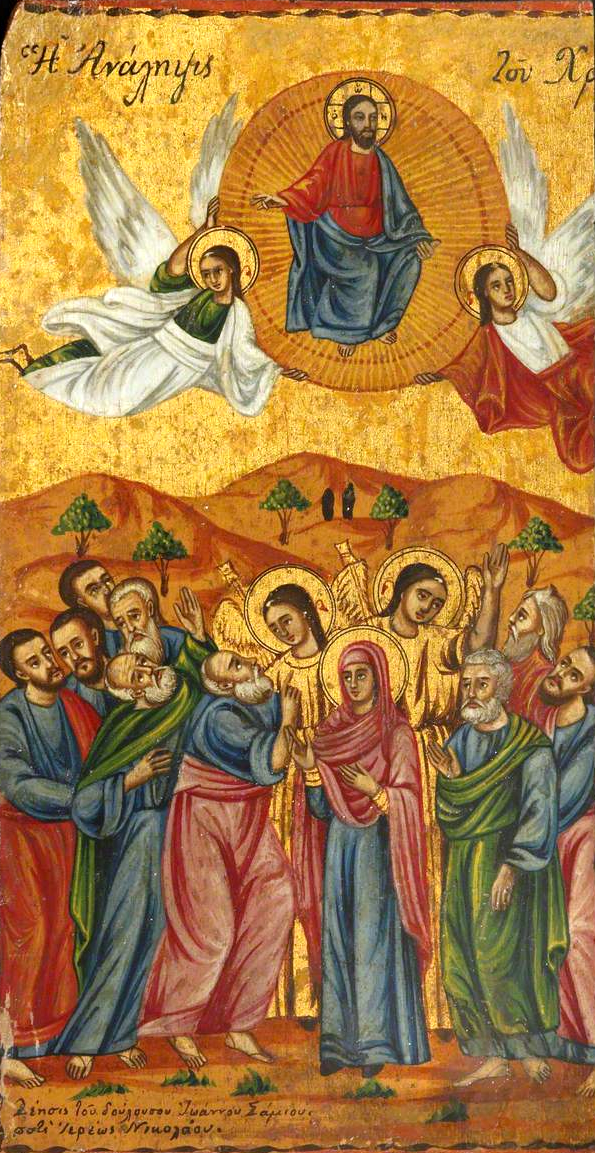
Byzantine – Southern Italian School, 19th c.
Translation of the Epistle for the Sunday within the Octave of Ascension (1 Peter 4:7-11)
Beloved: Be prudent and watchful in prayers. But above all things have a constant mutual charity among yourselves: for charity covers a multitude of sins. Be hospitable to one another without murmuring. According to the gift that each has received, minister it to one another as good stewards of the manifold grace of God. If anyone speaks, let it be as with words of God. If anyone ministers, let it be as from the strength that God furnishes; that in all things God may be honoured through Jesus Christ our Lord.
Continuation of the Holy Gospel according to St. John (15:26-27; 16:1-4)
At that time, Jesus said to His disciples: But when the Advocate has come, Whom I will send you from the Father, the Spirit of truth Who proceeds from the Father, He will bear witness concerning Me. And you also will bear witness, because from the beginning you are with Me. These things I have spoken to you that you may not be scandalized. They will expel you from the synagogues. Yes, the hour is coming for everyone who kills you to think he is offering worship to God. And these things they will do because they have not known the Father nor Me. But these things I have spoken to you, that when the time for them has come you may remember that I told you.
The Saving Words of the Gospel.
In the Name of the Father, and of the Son, and the Holy Ghost. Amen.
Transcription of Homily
~Fr. Ermatinger
Christ promises to send the Paraclete, Greek word, which means, one who is called to stand next to you. So, this is… basically He’s describing the work of a lawyer. A lawyer will tell you, “Don’t say anything, I’ll speak for you.” Well, that’s what Our Lord is using to describe the Holy Spirit, the Paraclete. One who speaks for us, one who inspires us, one who guides us. And He’s speaking of this in the context of the Last Supper, in the context of the First Mass, in the context of the greater discourse, which talks about the opposition His followers will endure at the hands of those who are at the service of the world, the flesh, and the devil.
I think it’s easy to read news and hear about gentle prelates who have lost their faith and want to change Catholic moral teaching about what they call emerging issues, a.k.a. aberrations that destroy souls and bring great sorrow to the Sacred Heart at the cost of what matters most for each one of us, which is a different conflict, not necessarily a faith, but an interior conflict of desire. It’s easy to become complacent when we look at other problems, because they can be a distraction from what’s most pressing for our ongoing conversion. If we have made a choice for Christ, it has to take shape in all of the subsequent choices.
And if we say we’ve made our definitive choice for Christ, why do we limp along in our spiritual life? Why aren’t we making giant steps, as St. Therese describes them, of the life of a lover of Christ? Think of a case of a person who goes to Confession rather frequently, saying the same thing over and over, with sincerity, truly not wanting to sin again, at least at the time of the Confession and of Communion. And then something happens. Outwardly, maybe it’s not noticeable to anybody else, but it resonates inside his own heart, and suddenly that choice for Christ that he made a short while ago turns out to have a rather short shelf life.
The context of a fall can often be something that is stress-related: disappointments at work, difficulties of life that press down upon us, or some unspoken association of circumstances that bring about bad, unhealed memories, or any other aspect of living as fallen men in a fallen world. A man of God, one who is a saint or working towards sanctity, sees the vicissitudes of living in a fallen life, living as a stranger and sojourner in this world, even with his own, perhaps, history of betrayals of Christ, sees the cross and the difficulties as a currency, not as a curse, something to be used to the God’s glory and to our own sanctification. He doesn’t blame God, he doesn’t complain to God, he doesn’t seek creature comfort. He knows how to navigate such things, burying them virtuously, offering them up in reparation for his own sins and in reparation for the sins of the world, faithfully bearing his cross.
On the other hand, the would-be saint is confronted with ambivalence. His affections are divided. He wants to serve Christ, and yet a certain moment comes when he wants something less than Christ. He doesn’t know how to sublimate one object of his desire for the other, and so they’re at odds, and there’s this interior conflict that goes nowhere good. A passing pleasure might deliver an immediate reward for the immature soul, and fidelity to Christ in these moments doesn’t seem to deliver an immediate payback. And in many cases, it’s not out of malice, but it’s become a sort of coping mechanism. And rather than wanting to offend God, or seemingly not caring about what this does to the Sacred Heart, the dynamic at work is a sort of escape from tedium, or pain, fatigue, bad memories, difficult situations.
A person in this situation seeks escape as a relief. It could be sensuality, it could be doom scrolling, it could be online shopping, it could be secret eating, it could be anything that isn’t Christ that becomes something of a habit, because it’s easier than the alternative of following Christ faithfully and everything, because that’s still an unknown. And we feel comfortable in what we know, even when that is ambivalence. So, he opts for the devil he knows rather than the Lord he does not know yet because of the lack of correspondence with grace, and it’s precisely this newness that’s a threat, this unknowing that engenders a certain temerity, a certain fearfulness.
The insanity of such decisions is that one knows where it will lead, and the increased sorrow that it brings about, yet it’s his choice anyway because it’s what he knows. And the reason these things become habits is because there’s an immediate relief, yet it doesn’t last. And when it becomes a habit, and the habit includes grave matter, it takes upon itself a kind of an anti-liturgical formalism in the habit. In all of this, there’s a sort of ambivalence, a divided heart. I want one thing, and I want something else that is at odds with that thing. And the problem here is not a problem of the intellect, it’s not even a problem of the will. It’s a question of what do I desire? We choose what we desire ultimately.
This isn’t resolved with further analysis, with thinking about it, with endless self-reflection and examinations. It is resolved with a choice. Sometimes people can have even a… almost a superstitious approach to these things. They want a special prayer that will get them out of this situation, as if the prayer is going to make the choice that they keep on putting off. What good does the prayer do if my will isn’t in it? What good does my prayer do if I’m attached to sin? It becomes empty words; it becomes something superstitious. It’s a form of delegation of responsibility. And sometimes, I’ve seen it, and people have told me about it, how they will say the prayers, and they keep on saying the prayers, and they say, “Well, they don’t work,” because they keep on making the same choices. But while you’re checking it to see that it doesn’t work, so you can’t continue to make the same choices. That’s the dynamic at work here. The prayer isn’t going to change you, and at the same time, we’re not enough to change us.
We have the Holy Spirit. But if we give Him space to act, beautiful things happen. It’s not a problem of the will.
If you know the life of Servant of God Matt Talbott. He’s a great figure, perhaps little known in this country, but he, at the age of 12, became a committed alcoholic. He worked on the Dublin docks, unloading ships, loading up carts and trucks. He had a hard job, and he used all of his money to spend at the bar until closing time. And he would sleep three hours, and it would start again. This is a man with a strong will. And imagine the toll it took on his body. He didn’t have a weak will. His will, he said he’d never give up prayer, but he wanted Christ, and he wanted the drink. This is called ambivalence, where we want opposite things, means at the same time, it doesn’t work. And we end up opting for the thing that delivers immediately, because we don’t have a profound experience of Our Lord, yet. When he had his conversion, he manifested that strength of will that was always there, when he made the mature decision to make reparation for his many sins. And he said, “If I could sleep three hours to party, if I could sleep three hours to pray and study the faith.” And so he did. And he became a spiritual giant, sought after for spiritual counsel from many priests and even bishops.
So, people wrongly attribute a broken will to many addicts, when the truth is that their addictions reveal a strength of will. Many addicts will do all sorts of things, rob houses, hold up people to get money, to help their habit. That’s a strong will. If our will is oriented towards Christ, we can also reveal that same strong will. It’s a question of what I want. Do I want Christ in every moment?
He’s a jealous lover. He doesn’t want to be number one in a series of loves. He wants to be our only love, and then everything else, our relationship, everything we use, all of the other things that we do, our work, our study, our recreation, all of it is to be sublimated, all of it is to be subsumed by this overarching love for Christ, so that all of that becomes sanctifying. As Paul says, “Whether you eat or drink; to the glory of God.” We’re not left alone in this endeavor.
Our Lord promises us the Paraclete, and that word, paraclete, that title for the Holy Spirit is translated in different ways. Advocate, as I said, the lawyer who comes to stand by your side to speak for you, is also called Comforter, not in the sense of warm and fuzzies, but a comforter, cum fortitudine, the one who comes to strengthen us, to strengthen us, and so our sanctification is a work of the Holy Spirit. Our reparation for our sins is a work of the Holy Spirit, but not without our 100% cooperation.
I would recommend for your reading St. Bernard of Clairvaux’s On Free Will and Grace, and he resolves the issue. Is it 50% grace? Is it 50% our will? He says, “No, it’s 100% grace, it’s 100% of our will.” Because that’s what a relationship is. A marriage isn’t 50/50. It’s not 60/40. It’s 100/100. And that’s what Our Lord wants from us, nothing less than that.
Does He deserve less than that? When we make that choice, one of the dynamics of overcoming our aberrations, overcoming our disordered attachments, is that there’s no immediate payback, and that’s all right, and that’s actually good. Because the harder the choice is, the more it strengthens our resolve. The more often we do it, the easier it becomes. The easier it becomes, the more likely it is to become a habit, and when that habit is in the order of grace, Thomas Aquinas calls that a virtue, and he also says that virtue is its own reward, that immediate payback we got from doing whatever wasn’t Christ, all of a sudden is replaced by the immediate payback of the virtuous choice built on the foundation of many generous choices for Christ.
And so, we’re not left to our own devices. Our Lord sends us the Holy Spirit, and we’re in the middle of this Novena of the Holy Spirit. We should implore Him to help us to have singularity of heart, so that everything that is in our life that is not of Christ be subsumed by Him, or purified and expunged, but all of it has to be submitted to this one overarching love for Christ, so that our love can be real.