
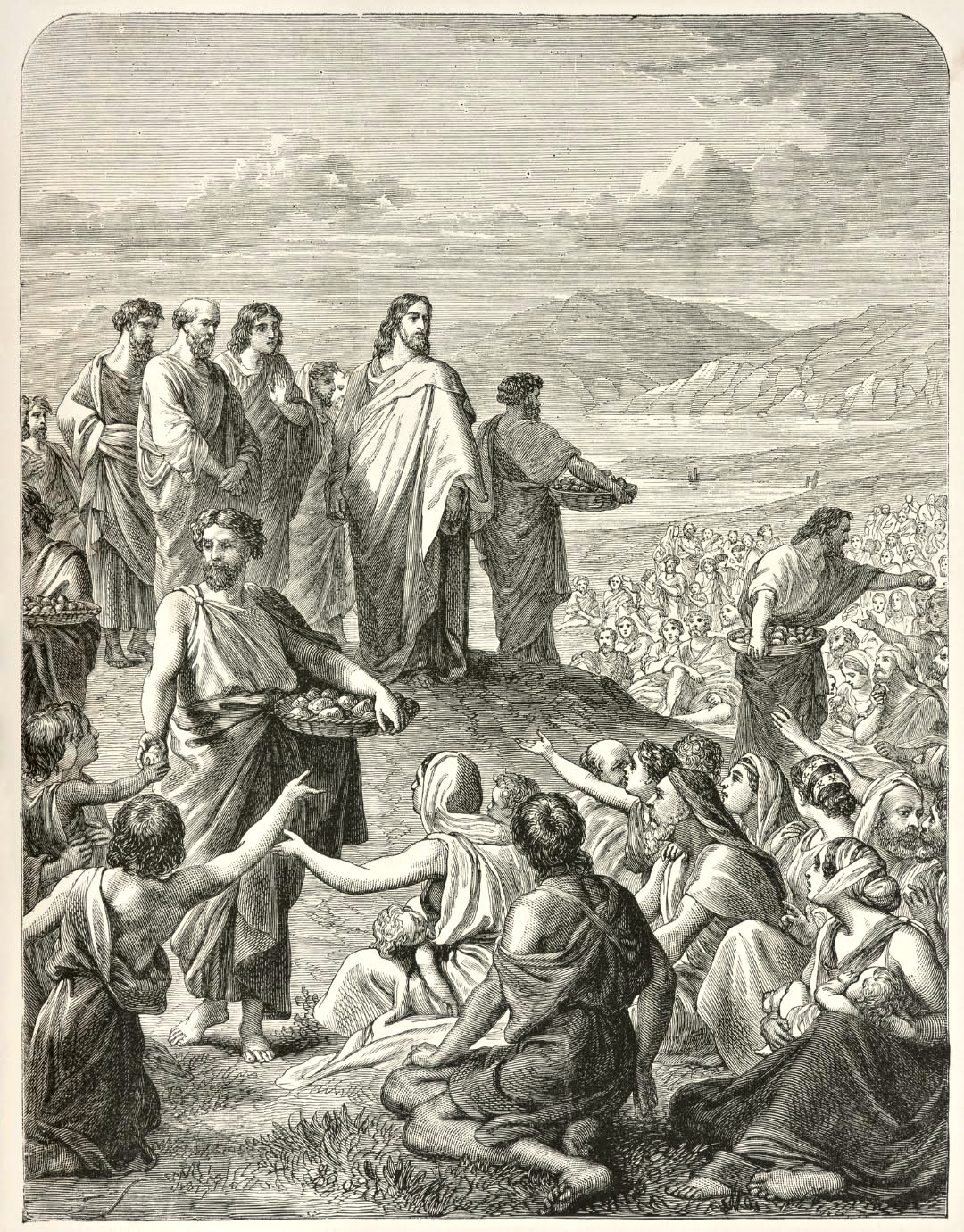
Translation of the Holy Gospel According to Mark (8:1-9)
At that time, when there was a great multitude with Jesus, and they had nothing to eat, calling His disciples together, He saith to them: I have compassion on the multitude, for behold they have now been with Me three days, and have nothing to eat and if I shall send them away fasting to their home, they will faint in the way: for some of them came from afar off. And His disciples answered Him: From whence can any one fill them here with bread in the wilderness? And he asked them: How many loaves have ye? Who said: Seven. And He commanded the people to sit down on the ground. And taking the seven loaves, giving thanks, He broke and gave to His disciples to set before the people. And they had a few little fishes, and He blessed them, and commanded them to be set before them. And they did eat, and were filled: and they took up that which was left of the fragments, seven baskets: and they that had eaten, were about four thousand: and He sent them away.
A Message From the Venerable Bede’s Commentary on the Gospel of Mark
Chapter 30. In those days, when there was again a great multitude, and they had nothing to eat, etc. | And in this lesson, the distinct operation of the divinity and humanity in one and the same Redeemer of ours must be considered; and the error of Eutyches, who presumes to assert only one operation in Christ, must be expelled far from Christian boundaries. For who does not see that the Lord’s pity upon the multitude, lest they should faint from hunger or the labor of a long journey, was an affection and compassion of human frailty? But that He satisfied four thousand men with seven loaves and a few small fish, was it not the work of divine power? Mystically, this miracle signifies that we cannot otherwise safely pass through the way of this present world, unless the grace of our Redeemer refreshes us with the food of His word. Furthermore, the difference typically between this feeding and that of the five loaves and two fish is that there the letter of the Old Testament was marked as full of spiritual grace, but here the truth and grace of the New Testament is shown to be administered to the faithful. Indeed, both feedings were celebrated on a mountain, as the narrative of the other evangelists declares: because the scripture of both testaments, when rightly understood, commands for us the height of heavenly things, both precepts and rewards: both proclaim with a consonant voice the height of Christ, who is the mountain of the house of the Lord on the top of the mountains. For He who raises the city built upon Himself, or the house of the Lord, that is, the Church, to the height of good works, and exhibits it manifest to all nations, He Himself refreshes it, when withdrawn from the lowest delights, with the bread of heaven, and kindles the desire for supernal sweetness by the pledge of spiritual food given.
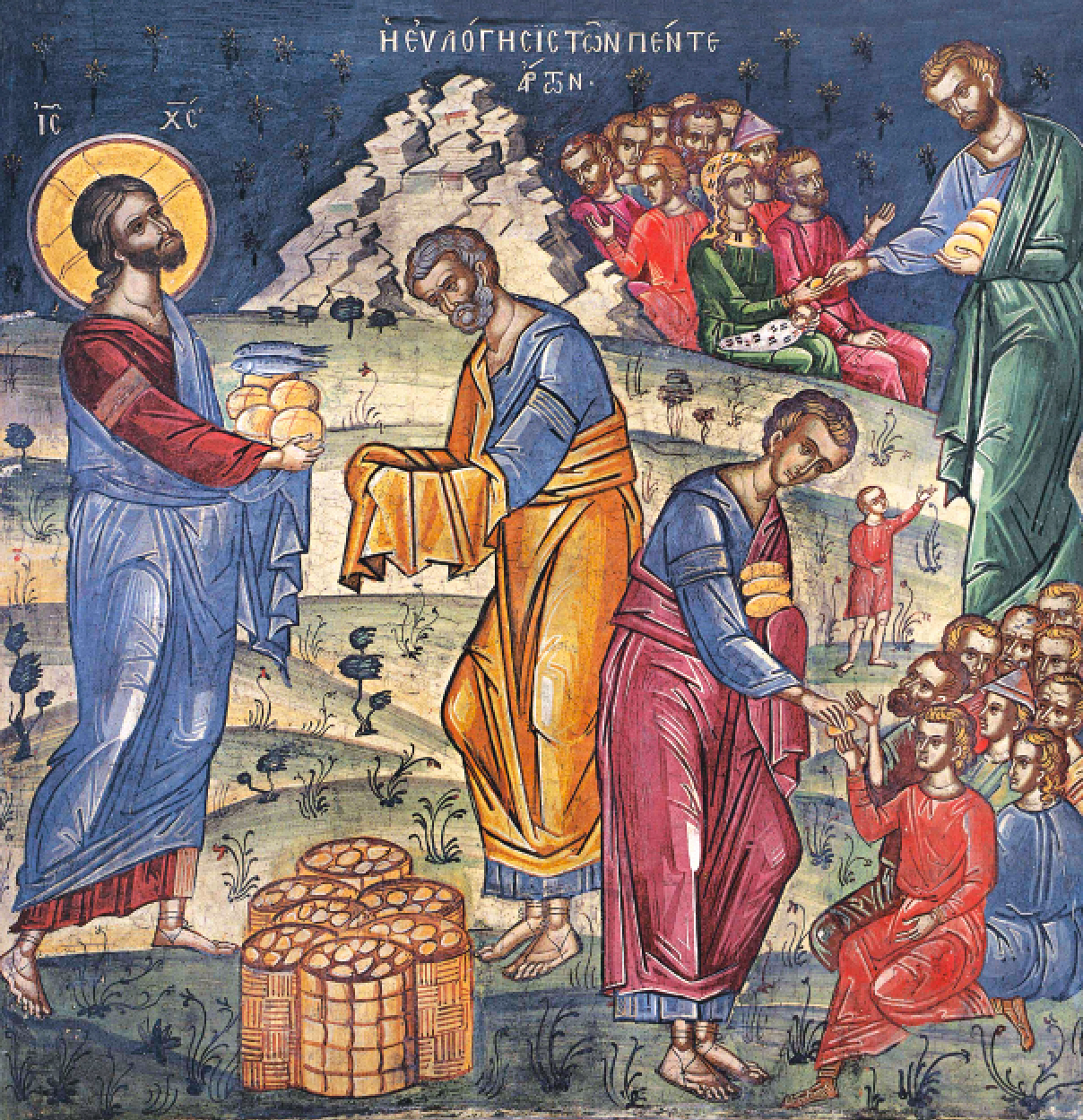
I have compassion, He says, on the multitude, etc. | Why the multitude endured the Lord for three days, Matthew explains more fully, who says: And ascending the mountain, He sat there. And great multitudes came to Him, having with them the mute, blind, lame, disabled, and many others, and they cast them at His feet, and He healed them. Therefore, the multitude endures the Lord for three days because of the healing of their sick, when the elect, who are illuminated by faith in the Holy Trinity, supplicate the Lord with persistent urgency for their sins and those of their people, that is, the infirmities of their souls. Likewise, the multitude endures the Lord for three days when the multitude of the faithful, declining the sins they have perpetrated through penance, turn to the Lord in deed, in speech, and in thought: whom the Lord does not wish to send away hungry to their home, lest they faint on the way; because, namely, converted sinners faint on the way of the present life if they are dismissed in their conscience without the nourishment of holy doctrine. Therefore, lest they should become weary on the journey of this pilgrimage, they must be fed with sacred admonition. Moreover, the pious saying that proceeded from the mouth of Truth must be greatly considered, where it is said: For some of them have come from afar. | For there is one who, having experienced neither deceit nor carnal corruption, hastened to the service of Almighty God. This one did not come from afar, because he was near through incorruption and innocence. Another, defiled by no impurity, by no scandalous acts, but having experienced only marriage, was converted to spiritual ministry. Neither did this one come from afar, because in the use of permitted union he did not err through unlawful things. But others, after the scandalous acts of the flesh, others after false testimonies, others after thefts committed, others after injuries and violence inflicted, others after homicides perpetrated, return to penance and are converted to the service of Almighty God. These, namely, come to the Lord from afar. For the more anyone has erred in wicked work, the farther he has withdrawn from the Almighty Lord. Therefore, let food be given even to those who come from afar, because the food of holy doctrine must be offered to converted sinners, so that they may recover in God the strength they lost in their misdeeds. Likewise, whatever Jews believed in Christ, they came near to Him, because they were instructed about Him by the letters of the law and the prophets. But believers from the Gentiles certainly came to Christ from afar, because they were not forewarned about His faith by any records of the sacred pages.
And He asked them, “How many loaves have you?” etc. | Seven loaves are rightly placed in the mystery of the New Testament, in which the sevenfold grace of the Holy Spirit is more fully revealed to all the faithful as things to be believed, and is given as things believed. Nor are they stated to have been of barley, like those five, with which five thousand men were satisfied, lest again, as in the law, the vital food of the soul should be covered by corporal sacraments. For the kernel of barley is covered by the toughest chaff.
And He commanded the multitude to sit down on the ground. | Above, in the feeding with five loaves, the multitude reclined on green grass; now, when it is to be refreshed with seven loaves, it is commanded to recline on the ground, because through the scripture of the law we are commanded to tread upon and suppress the desires of the flesh. For all flesh is grass, and all its glory is like the flower of the grass. In the New Testament, however, we are commanded to abandon the earth itself and temporal possessions. Or certainly, because the mountain on which the multitude was refreshed with the Lord’s loaves signifies the height of our Redeemer (as we said above), there it is refreshed upon grass, here upon the ground. For there the eminence of Christ is covered for the sake of carnal men and the earthly Jerusalem, with carnal hope and desire: but here, with all carnal desire removed, the solidity of the mountain itself, as it were, without any grass interposed, contained the guests of the New Testament, who possessed the certainty of permanent hope.
And taking the seven loaves, He gave thanks and broke them, etc. | The Lord, taking the loaves, gave them to the disciples so that they might place what they received before the multitude, because, giving the gifts of spiritual knowledge to the apostles, He willed the sustenance of life to be distributed to His Church throughout the world through their ministry. Moreover, that He broke the loaves which He gave to the disciples designates the opening of the sacraments, with which the world was to be nourished for perpetual salvation. For when the Lord Himself says, “And no one knows the Son except the Father, nor does anyone know the Father except the Son, and he to whom the Son wills to reveal Him”; what did He show but the bread of life to be opened by Himself for us, to the understanding of whose inward parts we ourselves could not penetrate? Against whom the prophet, lamenting the miserable hunger of some, said: “The little ones have asked for bread, and there was no one to break it for them”: which is to say in other words: The unlearned sought the nourishment of the word of God, with which they might be strengthened and refreshed for the virtue of good work, but there was no one, because teachers were lacking, who would reveal the secrets of the Scriptures to them and instruct them in the way of truth. Moreover, having received the loaves to be broken, the Lord gives thanks, so that He might both show how much He Himself rejoices in the salvation of the human race, and instruct us to always give thanks to God, when we refresh either the flesh with earthly bread, or the soul with heavenly sustenance by the granting of supernal grace.
And they had a few small fish, etc. | If in the seven loaves the Scripture of the New Testament is designated, in the reading of which we find the internal feast of the mind through the grace of the Holy Spirit, what do we understand by the small fish which the Lord, likewise blessing, commanded to be placed before the multitude, if not the saints of that time in which the same scripture was composed, or whose faith, life, and sufferings the scripture itself contains? Who, snatched from the turbulent waves of this world and consecrated by divine blessing, have provided internal refreshment for us, lest we should faint in the passage of this passing world, by the example of their life or death.
And they ate and were satisfied. | They eat of the loaves and fish of the Lord and are satisfied, who, hearing the words of God and looking upon the examples, hasten to be aroused and rise up to the progress of a corrected life through these things. To whom that saying of the Psalmist aptly corresponds, “The poor shall eat and be satisfied, and they that seek the Lord shall praise Him. Their heart shall live forever and ever.” Which is to say openly: The humble will hear the word of God and do it, and they will refer all the good things they do not to their own praise, but to the supreme Giver. Hence, deservedly, they will attain the eternal life of the inner man, as those who are satisfied with the bread of life. Against whom, on the other hand, it is reproached through the prophet to slow hearers, “You have eaten, and have not been satisfied.” For they eat and are not satisfied who taste the bread of the word of God by hearing, but by not doing what they hear, they receive none of that internal sweetness into the inner part of their memory by which their heart may be strengthened.
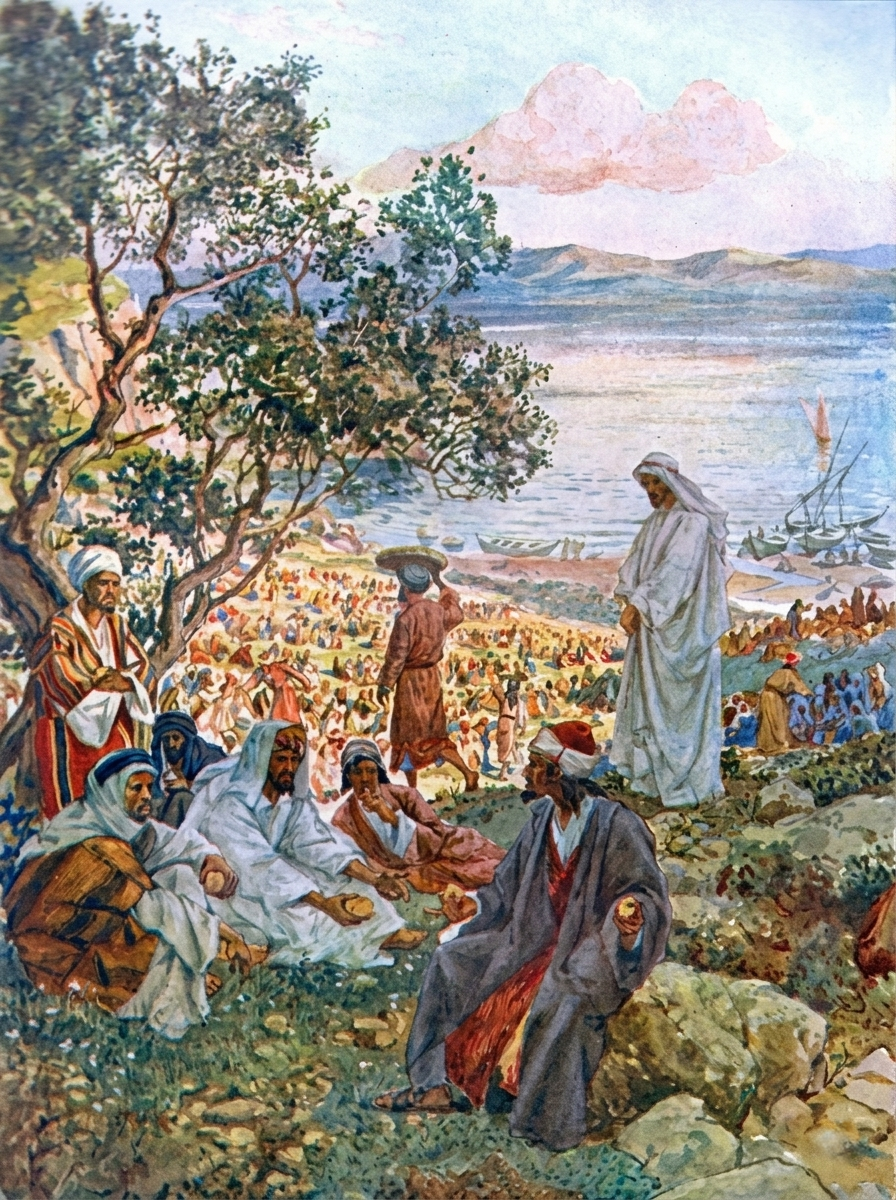
William Brassey Hole, cir. 1905
And they took up what remained of the fragments, seven baskets. | What remains after the multitude is satisfied, the apostles take up and fill seven baskets, because there are higher precepts of perfection, or rather exhortations and counsels, which the general multitude of the faithful cannot attain by observing and fulfilling: the execution of which properly regards those who, full of greater grace of the Holy Spirit, transcend the general conversion of the people of God in the sublimity of mind and work. To such it is said, “If you wish to be perfect, go, sell all that you have,” etc. Hence, the baskets, in which the fragments of the Lord’s food were placed, are rightly remembered to have been seven, because of the sevenfold grace of the Spirit. For since baskets are usually woven from rushes and palm leaves, they are rightly placed in the signification of the saints. For the rush is accustomed to grow over the waters, and the palm adorns the victorious hand. And the elect are rightly compared to rush vessels when they place the root of their heart in the very fountain of life, lest it should happen to dry up from the love of eternity. They are also likened to those woven from palm leaves when they retain the unfailing memory of eternal retribution in a pure heart. And the multitude is rightly narrated to have eaten and been satisfied, even though it did not take the leftovers of the Lord’s meal; because there are some who, although they cannot abandon all their possessions, nor fulfill what is said about virgins, “He who can receive it, let him receive it,” and other things of this kind: yet they who hunger and thirst for righteousness are satisfied when they attain eternal life by hearing the commandments of the law of God.
And those who had eaten were about four thousand, etc. | Rightly four thousand, so that by the very number they might also teach that they were fed with evangelical food.
And immediately going into the ship with His disciples, He came into the parts of Dalmanutha. | For this, we read in Matthew, “And having dismissed the multitude, He went into the boat, and came into the borders of Magedan.” It must not be doubted, however, that the place is the same under both names: for many codices also have Magedan only, according to Mark.
https://archive.org/details/completeworksofv10bede/page/114/mode/2up