

Philippe de Champaigne, ca. 1650-60
Translation of the Holy Gospel According to Mark (7:31-37)
At that time, Jesus going out to the coasts of Tyre, came by Sidon to the Sea of Galilee, through the midst of the coasts of Decapolis. And they bring to Him one deaf and dumb, and they besought Him that He would lay His hand upon him. And taking him from the multitude apart, He put His fingers into his ears, and spitting, He touched his tongue and looking up to heaven, He groaned and said to him: Ephpheta, that is, Be thou opened: and immediately his ears were opened, and the string of his tongue was loosed, and he spoke right. And He charged them that they should tell no man: but the more He charged them so much the more a great deal did they publish it; and so much the more did they wonder, saying: He hath done all things well; He hath made both the deaf to hear, and the dumb to speak.
A Message from St. Anthony of Padua’s Sermons, “11th Sunday After Pentecost.”
A Moral Sermon on the Misery of Our Body: Three Sorts.
Three sorts my soul hateth, and I am greatly grieved at their life: a poor man that is proud; a rich man that is a liar; an old man that is a fool and doting. (Sir 25:3-4).
Ecclesiasticus says:

The most High hath created medicines out of the earth: and a wise man will not abhor them. (Sir 38:4)
The most High, Jesus Christ, has created from the earth (his flesh) the medicine of humility with which he has healed the human race. Alternatively: he created medicine from the earth when, by the affliction of the body, the wounds of the spirit are healed. So medicine is made from our flesh, as from a ‘healing serpent’. The flesh was like the serpent in relation to our guilt, but it will give healing in our punishment. The wise man will not abhor this medicine, the humility of Christ and the affliction of the flesh; but the proud, the liar and the senseless reject it. Of them it is said: Three sorts my soul hateth: a poor man that is proud, etc.
The proud poor man is our wretched body; the rich liar is this world; and the foolish old man is the devil. The body is subject to corruption- indeed, ‘corpse’ and ‘corrupt’ have a similar sound. It is poor, because it possesses little and controls little. Our body is poor, because it enters this exile naked, blind and weeping; and naked, blind and wretched it leaves this exile again (and would that it be not to eternal destruction!), subject to the necessities of hunger and cold, afflicted with infirmity, and full of corruption and uncleanness. Poor and unhappy creature, where does your pride come from? Whence comes your glory? If you want to be proud, you are being proud of a stinking sewer which you carry about with you. O wretch, wretched and poor, who do you think you are? What do you boast about? Are you not someone who was procreated from stinking seed in the secret cavern of your mother’s womb? For nine months you were nourished there on the blood of menstruation, that drives dogs mad if they taste it. Whence, then, is your pride? Are you proud, perhaps, of your parents’ blood? If you are, you are surely proud of the dunghill from which you were born! Is it perhaps of riches? Then you are proud of what belongs to another. It is not yours, it is just lent to you. It is not yours, because you cannot take it with you. Death’s gate is very narrow, and even the poor and naked can scarcely pass through it, taking only their sins with them, which are nothing. Maybe you glory in your wisdom and eloquence? Not to you, not to you the glory, but to him alone (cf. Psa 113:9), who gives a mouth and wisdom (cf. Luke 21:15), who made the dumb to speak and the deaf to hear (cf. Mark 7:37). O pauper, you body of miseries, seeing that you are in such need and wretchedness, are you proud of so much, do you glory in so much? What would you do if you were rich? Blessed be God, who hast humbled the proud one, as one that is slain (Psa 88:11), who has dried up the sea, the waters of the roaring deep, who has struck the dragon and put down the mighty. He has given you
instead of a sweet smell, a stench; instead of a girdle, a cord; instead of curled hair, baldness. (Isa 3:24)
Humble yourself, then, you poor wretch. Groan and weep, and say with Jeremiah:
I am the man that see my poverty by the rod of his indignation. He hath led me and brought me into darkness, and not into light. My skin and my flesh he hath made old: he hath broken my bones. He hath built round about me: and he hath compassed me with gall and labour. He hath set me in dark places, as those that are dead for ever. He hath built against me round about, that I may not get out: he hath made my fetters heavy. He hath filled me with bitterness, he hath inebriated me with wormwood. He hath broken my teeth one by one: he hath fed me with ashes. Remember my poverty and my transgression, the wormwood and the gall. (Lam 3:1-7, 15, 16, 19)
(The mendacity of the world: A rich man that is a liar.)
There follows: a rich man that is a liar. This rich man is the world, of whose riches the prophet Nahum says:
As for Ninive, her waters are like a great pool: but the men flee away. Stand, stand! But there is none that will return back. Take ye the spoil of the silver, take ye the spoil of the gold; for there is no end of the riches of all the precious vessels. (Nah 2:8-9)
Niniveh (meaning ‘beautiful’) stands for the world, fair with a deceitful beauty. Her waters (riches and pleasures) are like a pool that dries up in the summer heat. When the heat of death comes, riches and delights dry up. So Ecclesiasticus says:
In the end of a man is the stripping of his works. (Sir 11:29)
They all flee away, they all pay the debt of death. Niniveh, the fair harlot, laughs at them and says, Stand, stand! Take the silver, take the gold. The lovers of the world leave behind what they cannot take with them, because the days of man are like a shadow (cf. Job 8:9), and his life is like a wind (cf. Job 7:7) which passes and does not return. As there is no end to Niniveh’s riches, so there will be no end to her miseries. Of all the precious vessels: these vessels are the hearts of worldlings, so deep in their cupidity that, however great the multitude of riches, they cannot be satisfied.
The same prophet adds, concerning the world’s lies:
Woe to thee, O city of blood, all full of lies and violence: rapine shall not depart from thee. (Nam 3:1)
Woe to the world of guilt and punishment, the city of blood (that is, sins) in which there is no truth, only lies. As the Psalm says:
Truths are decayed from among the children of men. (Psa 11:2)
This city is all full of lies and violence. St. Gregory says, “This present life can only be had with tears, and so it can only be loved with tears.” In Jeremiah, the Lord says of its lying:
It is become to me as the falsehood of deceitful waters that cannot be trusted. (Jer 15:18)
These faithless waters are riches, which keep no faith with their possessor. They promise him much, but deliver nothing. When their lovers abound with them, they praise God: He will praise thee when thou shalt do well with him (Psa 48:19). St. Gregory says, “Useless praise, that springs from prosperity! More meritorious is that which the power of sorrow does not take away.” Carnal folk praise God while they enjoy riches, but when these are taken from them, they lie to the Lord.
(The Folly of the Devil, and the Obedience of Christ: An Old Man that is a Fool.)
There follows: An old man that is a fool and doting. This old fool is the devil, of whom Ecclesiastes says:
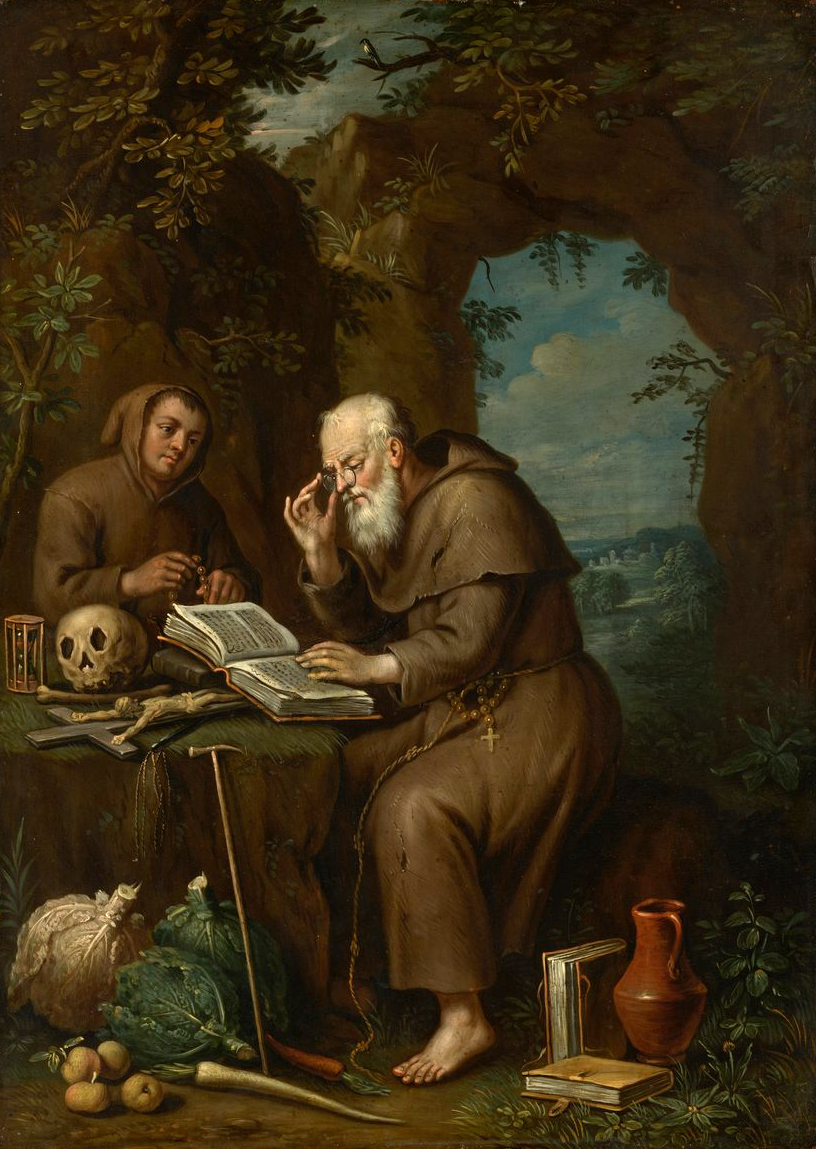
Circle of Balthasar Beschey, 18th c.
Better is a child that is poor and wise than a king that is old and foolish, who knoweth not to foresee for hereafter. (Ecc. 4:13)
He did not keep the wisdom that was given him among the angels, because he would not be subject to his Creator. Those who refuse to be subject to the yoke of obedience, for the sake of him who was obedient even to the Cross, are made the devil’s members. Every time you contumaciously despise obedience to your superior, you become like to the apostate angels. You despise not men, but God who places men over the heads of men.
So Job says:
Who made a weight for the winds. (Job 28:25)
The wind is strong and violent. Human nature is prone to evil from its youth, and is like a wind, light yet violent. So God makes a weight for it, obedience to prelates, so that being made heavy by that weight it may not be foolishly lifted up above itself, like the devil, and so miserably fall below itself. In Lamentations, Jeremiah says:
It is good for a man when he hath borne the yoke from his youth. He shall sit solitary and hold his peace: because he hath taken himself above himself. (Lam 3:27-28)
When you humbly place others above yourself, then you will wonderfully raise yourself up above yourself. A yoke is something that joins two things together. Bear, then, my son, the yoke of obedience with Christ the Son of God. The young calf, Jesus Christ, bound by the yoke of obedience, has drawn all by himself the burden of all our sins. So Isaiah says:
The Lord hath laid on him the iniquity of us all. (Isa 53:6)
The Jews, like countrymen with a goad, prodded him to make him go faster. See how this young child of ours, all alone, pulled the weight that men and angels were unable to bear; and no one thinks about it, or perceives in his heart. O brother, run, I pray you, and join yourself to that yoke, and bear it with Jesus, lift it up with Jesus! Isaiah says:
I looked about, and there was none to help; I sought, and there was none to give aid. (Isa 63:5)
Help him, then, brother! Help Jesus, because if you become a sharer in his trials, you will also share in his consolations.
We ask you, then, Lord Jesus, to make us humble poor men, truthful rich men, wise old men: so that we may be fit to come to your eternal delights and riches. Grant this, you who are blessed for ever and ever. Amen.