
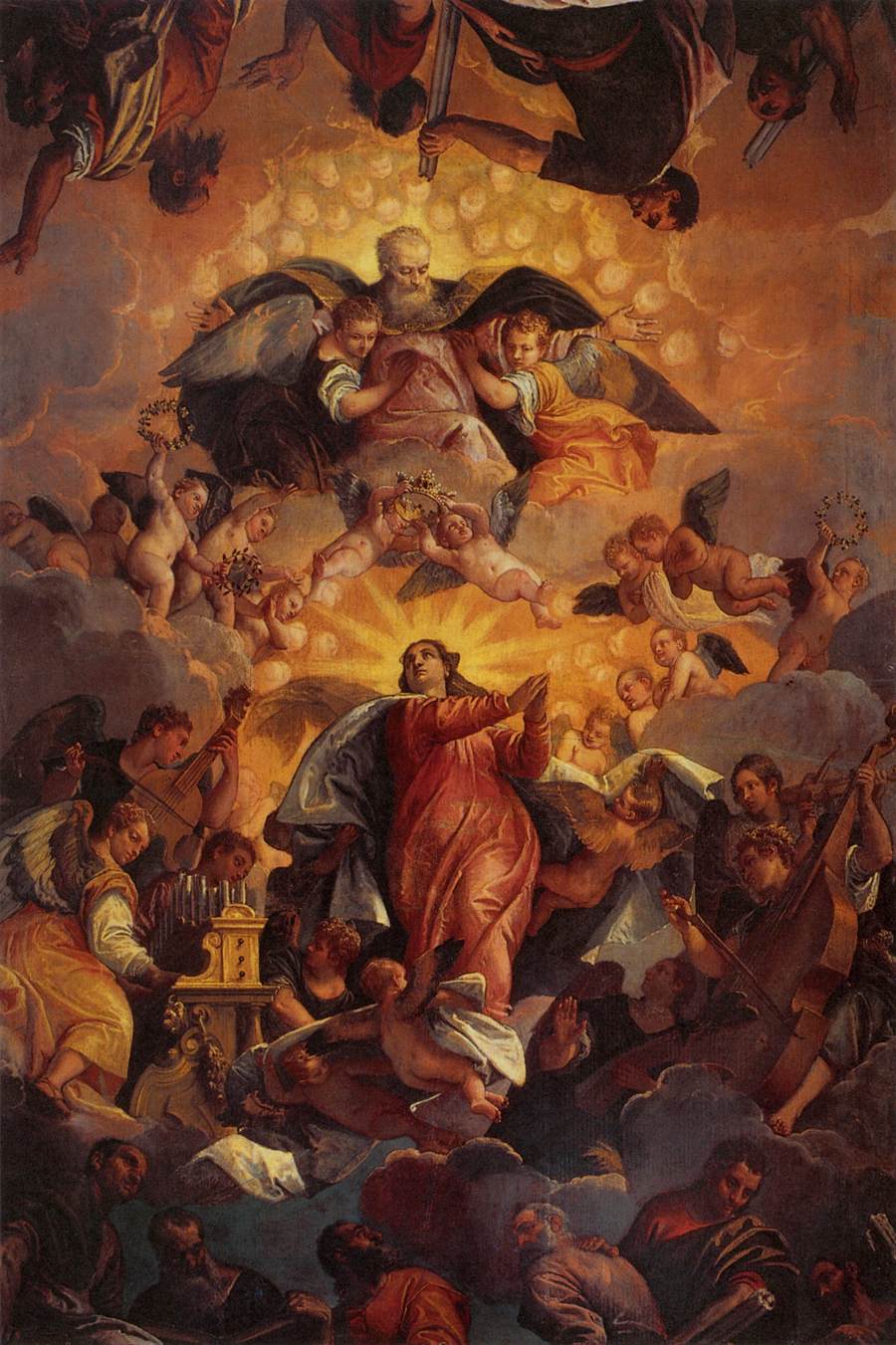
Paolo Veronese, between 1585-1587
Translation of the Epistle for the Feast of the Assumption
The Lord hath blessed thee by His power, because by thee He hath brought our enemies to nought. Blessed art thou, O daughter, by the Lord the most high God, above all women upon the earth. Blessed be the Lord who made heaven and earth, who hath directed thee to the cutting off the head of the prince of our enemies. Because He hath so magnified thy name this day that thy praise shall not depart out of the mouth of men who shall be mindful of the power of the Lord, for ever: for that thou hast not spared thy life, by reason of the distress and tribulation of thy people; but hast prevented our ruin in the presence of our God. Thou art the glory of Jerusalem, thou art the joy of Israel, thou art the honor of our people.
Continuation of the Holy Gospel According to Saint Luke
At that time: Elizabeth was filled with the Holy Ghost. And she cried out with a loud voice and said: Blessed art thou among women and blessed is the fruit of thy womb. And whence is this to me that the mother of my Lord should come to me? For behold as soon as the voice of thy salutation sounded in my ears, the infant in my womb leaped for joy. And blessed art thou that hast believed, because those things shall be accomplished that were spoken to thee by the Lord. And Mary said: My soul doth magnify the Lord. And my spirit hath rejoiced in God my Savior. Because He hath regarded the humility of His handmaid: for behold from henceforth all generations shall call me blessed. Because He that is mighty hath done great things to me: and holy is His name. And His mercy is from generations to generations to them that fear Him.
Transcription of Sermon
The Saving Words of the Gospel.
In the Name of the Father, and of the Son, of the Holy Ghost. Amen.
Saint Augustine famously said that the Old Testament is the New Testament concealed, and the New Testament is the Old Testament revealed. Last Sunday, you may recall, we heard Paul use this term “type,” and he was speaking about things that happened in the book of Exodus as a type of what was to take place later. So, what is a type?
A type is a person, a thing, or an event in the Old Testament that foreshadows something that will reach its fruition in the New Testament. We see a type today in the Epistle where Judith cuts off the head of the enemy prince, Holofernes, right? And this is a type of, for the Blessed Mother, who will, as we see in Genesis, is prophesied to stand on the head of Satan. Paul says that Adam was a type of the one who was to come, the new Adam, Christ. Satan is the same in the Old Testament and the New Testament. And if Eve was a real person and a type, who is the new Eve? Obviously, the new Eve is the Blessed Mother.
In Exodus 25 through 27, we see a very detailed order of events of how the Ark of the Covenant and the Tabernacle are to be fashioned. And Our Lord is very meticulous in what He expects this to look like in its end product. And inside the Ark of the Covenant go the engraved words of God. In other words, the Old Covenant, the Law. That’s what it says in Exodus. If you read Hebrews, St. Paul tells us that there were other items in the Ark of the Covenant. There was manna, which was the bread that Our Lord gave to feed His people in the desert. There was also the rod of Aaron that was budding, which is a symbol of his priesthood. So, these are the things, these precious relics, that are in the Ark of the Covenant, the most holy thing on earth until the apparition of the Blessed Mother.
And she appears on earth. She is conceived and born, nothing holier than her, and she is the New Ark because she is going to hold within her womb the New Law. She’s going to bear within her womb the True Priest, not just a symbol of priesthood, but the True Priest. She’s going to bear within her womb Him who is the Bread of Life, not a bread that will get us through a day, as the manna was, but the Bread of Life that brings us to Heaven. And Luke uses all sorts of language that harkens back to the Old Ark. And we see even certain… an order of events that hearken back to the old Ark of the Covenant, so that any reader who’s familiar with those words in the Old Testament is going to recognize something similar, but even greater is happening now with the New Covenant.
When the Ark was kept in Shiloh for 200 years, and everything was calm, there was a war. Philistines attack. Things aren’t looking good for the Jews. And so, what do they do? They go and get the Ark, thinking that if we can bring the Ark to the front lines, it will vanquish our enemies. Well, what happened was the Philistines stole the Ark, and if you read Samuel, the first book of Samuel, you’ll see what happened to the Philistines when they sacrilegiously took the Ark as some booty from war. They all broke out into pustules and boils, and they started to suffer all sorts of plagues. And so, they finally just sent the Ark back, said, “We don’t want it. It’s too much trouble for us.”
And as they’re transporting the Ark, it’s on a carriage and they’re going up a hill, and it starts to waver, and Uzzah reaches out his hand to steady it, and because he touched it without being prepared and being worthy, he dies. And David is supposed to take the Ark and now take care of it. And he says, “Who am I that the Ark of the Covenant can come to me?” And he’s thinking, “If Uzzah died from touching it, what am I going to do with this?” But it’s his responsibility, and so, what does he do?
He in haste goes to the hill country in Judea, and goes to a place called Abul-Gosh, and the House of Obed there is called blessed, because it bears the Ark, and it stayed there for three months. When the Ark arrived, David is wearing an ephod, this priestly garment, and he starts dancing out of joy, because the Ark has come to a safe place, a place where it will be honored. And he leaps and dances, and the House is called blessed because it bears the Ark. And then, what does he do? After three months, he brings it back to Jerusalem.
Well, an attentive reader of Luke 1 is going to see a similar order of events where Our Lady, after the Annunciation, she is now the new Ark. She’s got the eternal High Priest in her womb. She’s got the word of God in her womb. She’s got the Bread of Life in her womb. She has the New Covenant in her womb. And she goes with haste to Judea, the hill country of Judea, and goes to Ayn Karim. Ayn Karim is within walking distance of Abul-Ghosh. And what does Elizabeth say? “Who am I that the Mother of my Lord should come to me?” She echoes David’s trepidation, and then she exclaims in this, with this rare use of a verb ἀναφωνέω (anaphoneo), which is really a liturgical term which you see in the Old Testament with regard to liturgical indications and use of the ark. And so, she’s using this very proper Ark language when she exclaims, and then, better said Luke is using this language, and then she said, “Blessed are you.”
We hear the word blessed three times, just as the House of Obed was blessed because of the Ark’s presence there, Mary is called blessed, and then what happens? John, in the womb of Elizabeth, leaps and dances. So, this is the encounter of this priest in the womb with the presence of God, the Ark of the New Covenant.
When John the Evangelist retires to Patmos, he has this vision of heaven. And in 11:19, he says, “And behold, I saw the City of Heaven, and there I saw the Ark of the Covenant.” And then he goes on to describe it: a Woman clothed in the Sun with the crown of 12 stars on her head. She was with child. So clearly, John is saying that this Woman, this Heavenly Mother, is the New Ark of the Covenant. Now, what does all this have to do with the mystery that we’re celebrating today?
Well, the Assumption of Our Lady was something that was never contested. When it was finally defined on November 1st, 1950, by Pius XII, it wasn’t because there was any rejection of this teaching. When the Holy Father defines something in an extraordinary way, it’s not just to clear up confusion – there was no confusion about the Assumption – it’s also to assure blessings, so that we can say this is what we’ve always believed, and now we can officially say that it’s defined. Doesn’t mean that he invented the teaching. It wasn’t something that came about later in the history of the Church. It was always there.
There’s a certain sacramental nature that the Church has always had. We have sacraments. We also have sacramentals. We have a sacramental here. It’s a relic of the veil of the Blessed Mother. The Church was very jealous of its relics, of the bodies of the saints, and they understood that these sanctified physical bodies, even after the death of the saint, had a certain efficacy as an agent of grace. And so, there are relics of the first Apostles. There are relics of St. Stephen. There are relics of all of the first martyrs. No one ever claimed to have a relic of the Blessed Mother. No one ever claimed to have a part of the body of the Blessed Mother. No one. There’s absolutely no instance in history or tradition. All of the other saints we see in Scripture of the New Testament, we’ve got relics. They’ve got burial places.
I have a relic of the True Cross. If you put all of the official relics of the True Cross together, it forms a third of the Cross, which means two-thirds have gone missing.
So, that’s just from logic, but there’s also a certain argument from propriety. If Our Lord wanted to protect His Mother from destruction, well, He protected her not only from physical destruction, but also from moral destruction. That’s why we have the other definition regarding the Blessed Mother of the Immaculate Conception. She was protected from spiritual destruction. She was also protected from physical destruction. Why? Because He could. Because God had the privilege of making His own mother and because He made His own mother, He made her just the way He wanted; not somebody who would be corrupted through sin, not somebody to be corrupted through being buried in the ground.
And so, the Church, with great joy and love, all humility and gratitude, praises not only the Blessed Mother but also Our Lord who created her and shared her with us on this beautiful Feast.
In the Name of the Father, and of the Son, of the Holy Ghost. Amen.
~Fr. Ermatinger