
Translation of the Holy Gospel According to Luke (5:1-11)
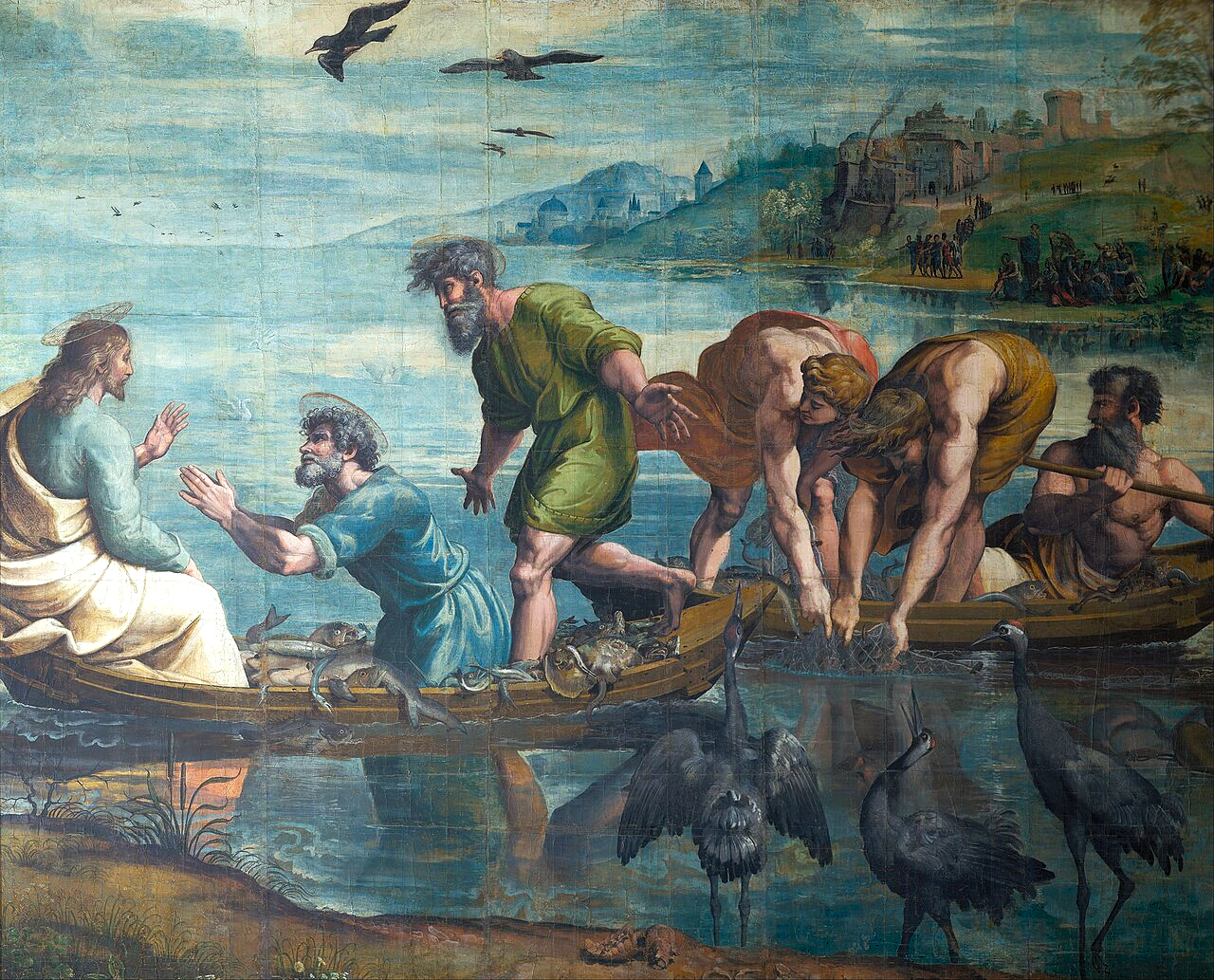
At that time, when the multitude pressed upon Jesus to hear the word of God, He stood by the lake of Genesareth. And He saw two ships standing by the lake; but the fishermen were gone out of them, and were washing their nets. And going up into one of the ships that was Simon’s, He desired him to draw back a little from the land: and sitting He taught the multitudes out of the ship. Now when He had ceased to speak, He said to Simon: Launch out into the deep, and let down your nets for a draught. And Simon, answering, said to Him: Master, we have labored all the night, and have taken nothing, but at Thy word I will let down the net. And when they had done this, they enclosed a very great multitude of fishes and their net broke: and they beckoned to their partners that were in the other ship, that they should come and help them and they came, and filled both the ships, so that they were almost sinking. Which when Simon Peter saw, he fell down at Jesus’ knees, saying: Depart from me, for I am a sinful man, O Lord. For he was wholly astonished, and all that were with him, at the draught of fishes which they had taken: and so were also James and John the sons of Zebedee, who were Simon’s partners. And Jesus saith to Simon: Fear not, from henceforth thou shalt catch men. And having brought their ships to land, leaving all things, they followed Him.
A Message From St. Pope John Paul II’s “General Audience for August 9th, 2000”
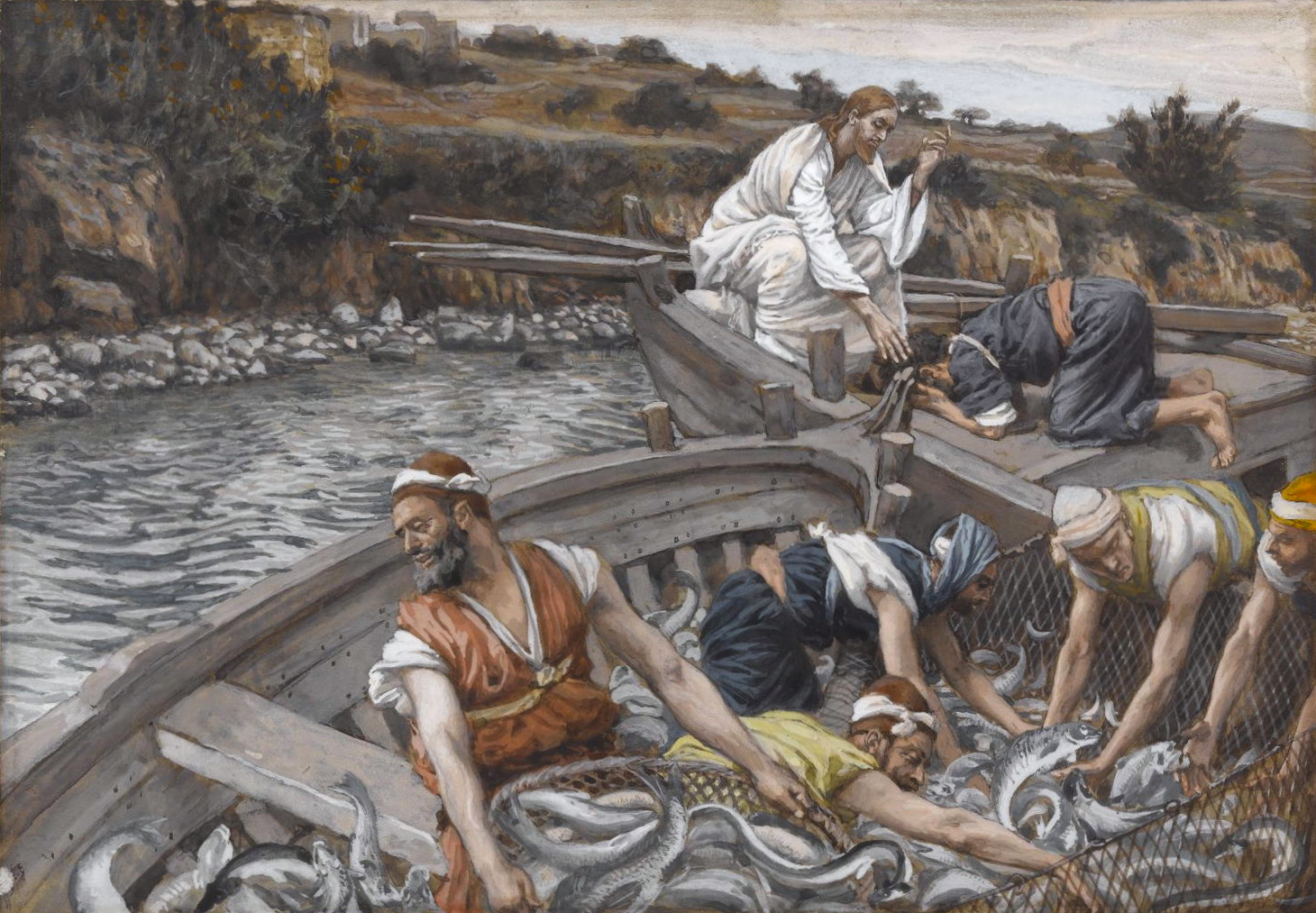
James Tissot, 1886-96
In our previous reflections, we have followed humanity in its encounter with God who created it and walks on its paths to seek it out. Today we will meditate on the supreme encounter between God and man which took place in Jesus Christ, the divine Word who became flesh and dwelt among us (cf. John 1:14). The definitive revelation of God – as St Irenaeus, Bishop of Lyons, observed in the second century – was accomplished when the Word became man, making himself like man and man like him, so that man might become precious to God through his likeness to the Son (Adversus Haereses V, 16, 2). This intimate embrace of divinity and humanity, which St. Bernard compares to the “kiss” mentioned in the Song of Songs (cf. Sermones super Cantica canticorum II), expands from the person of Christ to those he touches. This encounter of love has various dimensions which we will now try to illustrate.
It is an encounter that takes place in everyday life, in time and in space. The passage of John’s Gospel which was just read (cf. John 1:35-42) is descriptive in this regard. There we find a precise chronological indication of the day and time, locality and house where Jesus was staying. There are people who lead a simple life and are transformed, even in name, through that meeting. In fact, to have Christ enter one’s life means to see one’s history and projects disrupted. When those fishermen of Galilee found Jesus at the lakeside and heard his call, they left everything and followed him (Luke 5:11). This is a radical turning-point which allows no hesitation and sets one on a path fraught with difficulties but very liberating: If any man would come after me, let him deny himself and take up his cross and follow me (Matt 16:24).
When he crosses a person’s life, Christ disquiets his conscience and reads his heart, as happened with the Samaritan woman when he told her all that she ever did (John 4:29). Above all, he moves her to repentance and love, as occured with Zacchaeus, who gives half of his goods to the poor and restores fourfold to anyone he may have defrauded (cf. Luke 19:8). This is also what happened with the repentant woman sinner whose sins were forgiven because she loved much (Luke 7:47), and with the adulteress who is not judged but urged to lead a new and sinless life (cf. John 8:11). The encounter with Jesus is like a rebirth: it brings forth the new creature who is capable of true adoration, which consists in worshiping the Father in spirit and truth (John 4:23-24).
Encountering Christ on one’s path through life often means finding physical healing. Jesus would entrust to his disciples themselves the mission of proclaiming God’s kingdom, conversion and the forgiveness of sins (cf. Luke 24:47), and also of healing the sick, delivering people from every evil, giving comfort and support. For the disciples preached that men should repent. And they cast out many demons, and anointed with oil many that were sick and healed them (Mark 6:12-13). Christ came to seek, meet and save the whole person. As a condition of salvation, Jesus demands faith, by which a person abandons himself totally to God who acts in him. Indeed, Jesus said to the woman with a hemorrhage who had touched his garment as her last hope: Daughter, your faith has made you well; go in peace, and be healed of your disease (Mark 5:34).
The purpose of Christ’s coming among us is to lead us to the Father. For no one has ever seen God; the only Son, who is in the bosom of the Father, he has made him known (John 1:18). This historical revelation accomplished by Jesus in his words and deeds touches us deeply, through the Father’s interior action (cf. Matt 16:17; John 6,44-45) and the enlightenment of the Holy Spirit (cf. John 14:26, 16:13). For this reason, the risen Jesus pours him forth as the principle of the forgiveness of sins (cf. John 20:22-23) and the source of divine love within us (cf. Rom 5:5). Thus we have a Trinitarian communion which already begins in earthly life and whose final goal is the fullness of vision, when we shall be like him, for we shall see him as he is (1 John 3,2).
Now Christ continues to walk beside us on the paths of history, as he promised: Lo, I am with you always, to the close of the age (Matt 28:20). He is present through his Word, a Word who calls, who invites, who personally summons, as happened to the Apostles. When a person is touched by the Word, obedience is born, that is, the listening which changes life. Every day (the believer) is nourished by the bread of the Word. Deprived of it, he is as though dead and has nothing left to communicate to his brothers and sisters, because the Word is Christ (Orientale lumen, n. 10).
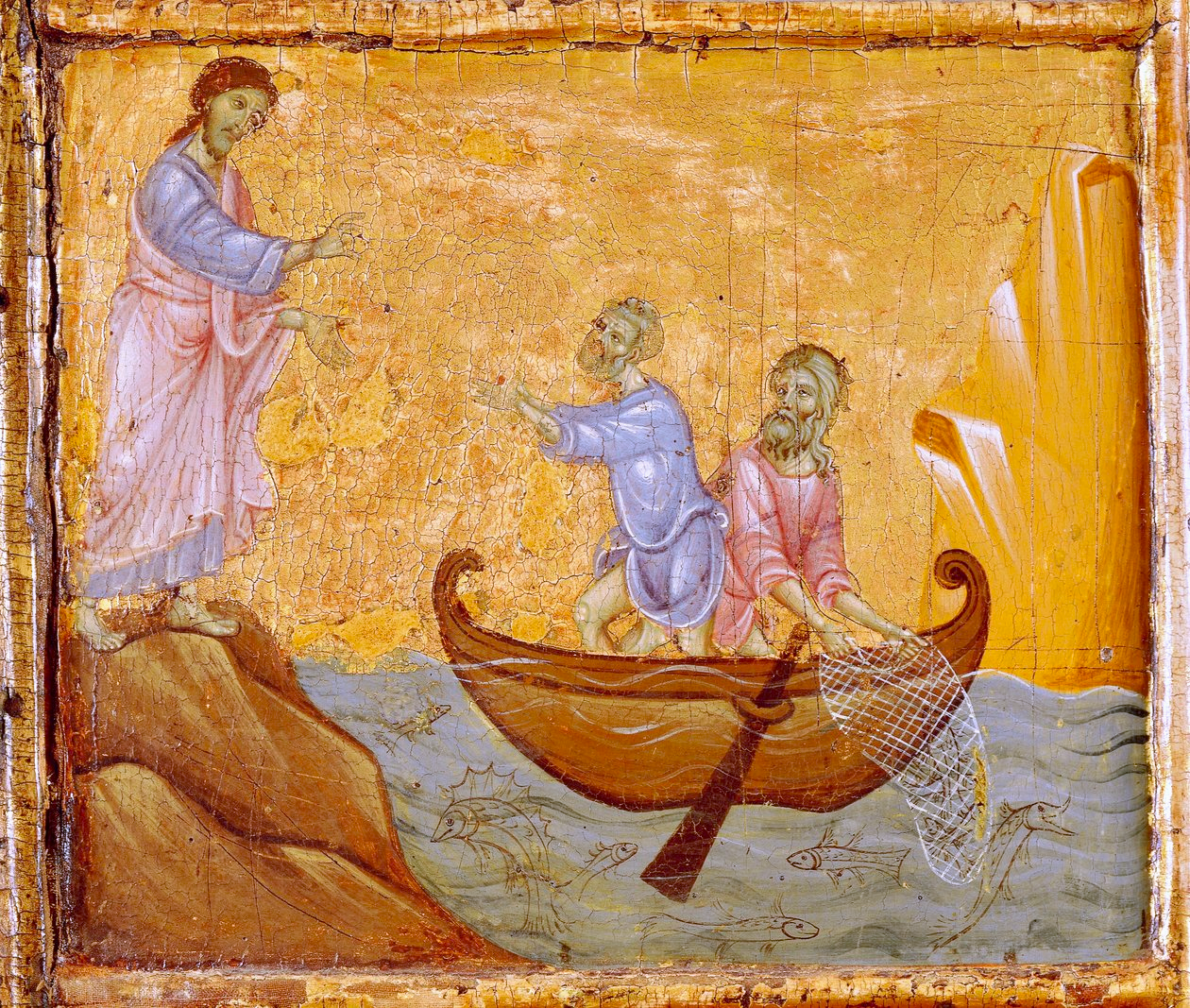
(detail from Antependium of St. Peter Enthroned), Guido da Siena, 13th c.
Christ is also present in the Eucharist, the source of love, unity and salvation. The words he spoke one day at the synagogue in the little town of Capernaum on Lake Tiberias echo constantly in our churches. They are words of hope and life: He who eats my flesh and drinks my blood abides in me, and I in him … he who eats my flesh and drinks my blood has eternal life, and I will raise him up at the last day (John 6:54, 56).