
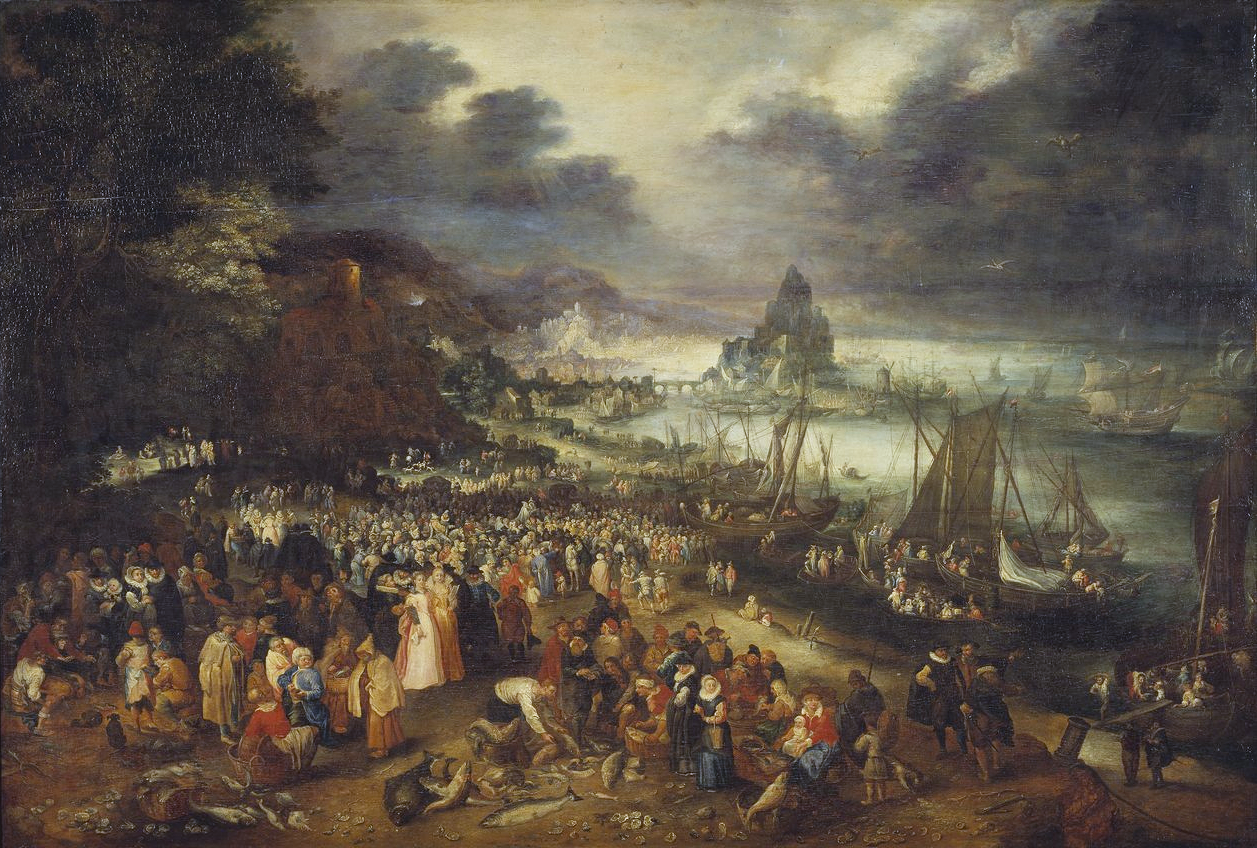
Jan Brueghel the Elder, 1606
Translation of the Epistle for the Fourth Sunday after Pentecost
Brethren: I reckon that the sufferings of the present time are not worthy to be compared with the glory to come that will be revealed in us. For the eager longing of creation awaits the revelation of the sons of God. For creation was made subject to vanity – not by its own will but by reason of Him Who made it subject – in hope, because creation itself also will be delivered from its slavery to corruption into the freedom of the glory of the sons of God. For we know that all creation groans and travails in pain until now. And not only it, but we ourselves also who have the first-fruits of the Spirit – we ourselves groan within ourselves, waiting for the adoption as sons of God, the redemption of our body, in Christ Jesus our Lord.
Continuation of the Holy Gospel According to St. Luke
At that time, while the crowds were pressing upon Jesus to hear the word of God, He was standing by Lake Genesareth. And He saw two boats moored by the lake, but the fishermen had left them and were washing their nets. And getting into one of the boats, the one that was Simon’s, He asked him to put out a little from the land. And sitting down, He began to teach the crowds from the boat. But when He had ceased speaking, He said to Simon, Put out into the deep, and lower your nets for a catch. And Simon answered and said to Him, Master, the whole night through we have toiled and have taken nothing; but at Thy word I will lower the net. And when they had done so, they enclosed a great number of fishes, but their net was breaking. And they beckoned to their comrades in the other boat to come and help them. And they came and filled both the boats, so that they began to sink. But when Simon Peter saw this, he fell down at Jesus’ knees, saying, Depart from me, for I am a sinful man, O Lord. For he and all who were with him were amazed at the catch of fish they had made; and so were also James and John, the sons of Zebedee, who were partners with Simon. And Jesus said to Simon, Do not be afraid; henceforth thou shalt catch men. And when they had brought their boats to land, they left all and followed Him.
The Saving Words of the Gospel.
In the Name of the Father, and of the Son, and of the Holy Spirit. Amen.
Transcription of Homily Coming Soon!
~Fr. Ermatinger
At that time, while the crowds were pressing upon Jesus to hear the Word of God. These are words that we would do well to heed in our own lives. To press upon Our Lord in order to hear His Word.
There’s a little gem that St. Ambrose makes much of in this Gospel today. Ζώον (zóon). Which when Christ says, I will make you a fisher of men. The real translation is ζώον, which means to capture alive. So, we see this like when you take prisoners of war alive, or the Romans would go and catch animals alive for the zoo or the Colosseum. So, it wasn’t fishing with a hook to kill them. It was fishing with a net to keep them alive. Or hunting people. Hunting animals. Well, here Our Lord is going to make him into a hunter, a fisher of men who doesn’t just keep them alive but vivifies them through the life of grace. You can read St. Ambrose’s commentary on this passage, which is really beautiful, but what I wanted to focus on was in this first line.
They were pressing upon Jesus. Επικειμαι (epikeimai). Επικειμαι. Which means to lay upon, to rest on, or to press upon. And so, this reveals the eagerness, the longing, the devotion with which these hearers of the Word of God come to Him, and the expectation they have, and they give us a lesson of how we ought to be when we hear the Gospel. When we read it. When we study it. When we pray it. The same expectation as if it were the first time. As if it were the last time. As if it were the only time. So, as to be awake and alert to the graces that Our Lord has in store for us.
We can sometimes have an unhealthy familiarity with Scripture. You start to hear a Gospel and say, “Well, yeah, I know that one. I’ve got it memorized. I know what it’s going to say.” Well, something that saves us from this routine in our relationship with Scripture is to distinguish between study and prayer with Scripture.
Study, we’re trying to see the literal sense. We want to see what the Scripture says. We read the footnotes if it’s a good Bible, right? – The Ignatius Study Bible has excellent footnotes, has good introductions. – So, this is where we’re starting to understand the world of Scripture, but that ought not be happening during our prayer with Scripture, obviously. We ought not be reading footnotes or looking up introductions to understand the literal meaning.
There are four meanings of Scripture, says St. Augustine in his De Genesi ad Lituram. He talks about the four meanings of Scripture, which the Church has always accepted. Literal sense, allegorical sense, the tropological sense, and the anagogical sense. So, the literal sense is simply what it says. It’s a fact. If we apply it to this Scripture here, it’s the fact of this encounter, the miraculous catch, the vocation of Peter and his comrades. It’s a historical fact. Okay, now we have the data. But prayer is not made up of data.
So, when we go into mental prayer as opposed to study, we have at our disposal the three other senses. Allegorical regards the faith. It’s something that is, so to say, under the surface of the facts. Something that is going to be very personal, could be very intimate, something that Our Lord reveals to us about the episode, about ourselves, about Himself. When God the Father talks to St. Catherine of Siena in the Dialogue of Divine Providence, He says, ” When you are praying, when you’re doing your devotions,” he says, “I often come to visit you.” He says, “And I will reveal one of four things: Something about yourself. I’ll bring you to greater contrition. I’ll reveal something of My love. Or I’ll reveal something about My Son.” He calls Him His Truth.
When we go into our mental prayer – and I’ll just describe at the end how to do it with Scripture – when we go into our mental prayer with Scripture, there’s something below the surface. It’s called the allegorical sense. What does it have to do with faith? Not just data, not just the historical facts that we just read, but there’s something there for me, something that’s unrepeatable, something that is particular, even to this moment when I’m praying the Scripture, because tomorrow, if I go back to the same Scripture, perhaps He’s got something else in store for me, because these encounters are very personal, they’re intimate, and they’re occasions of grace.
I know some people, I’ve heard people tell me that, well, we’re not supposed to be reading the Bible because we might make heretical interpretations. We don’t have our contact with Scripture in order to come up with solemn, definitive definitions. We have an encounter with Christ, and we ought to not be guided by fear, but by trust that His Word is truly His Word, and His Word is not a dead letter that was written down a long time ago. It’s alive and active. When we pray with it, He works on us. It’s a very privileged place of encounter with Christ.
And so, we apply that allegorical sense to today’s Gospel. Well, we see how Our Lord entered not only the boat, but He also entered the lives and the souls of Peter and his comrades, and gives them a mission. At the end of it, it says, they left everything and followed Him. And so, this moves to what’s called the tropological, or the moral, sense of Scripture, which is the third sense of Scripture. ‘What to do? What am I supposed to do as a result?’ So, we start with the logical order of the literary sense, the allegorical or the faithful sense, and then, ‘What am I supposed to do as a result?’ Notice how it’s moving towards action, not just contemplation, but action. Because Our Lord wants to penetrate our souls, transform them, purify our hearts, our minds, our affections, so that He possesses it all. And then we are more apt instruments.
Notice too how, in the tropological sense, they left everything and followed Him immediately, this responsiveness to grace. This is something that we have to learn from in this passage. This same obedience to the interior movements of grace, promptings of the Holy Spirit. We ought to, in a certain sense, expect them, but not get used to them. We have to keep them alive. The way we keep them alive is by obeying them, just as Peter obeyed.
Then there’s what’s called the anagogical sense. The anagogical sense, which anago has to do with raising something up, lifting something up. In other words, how does this passage relate to salvation, eternal life? This is what’s called the anagogical sense. So, notice, literal sense – the facts –, the allegorical sense – the faith –, tropological sense – the moral sense, the action –, and then the result of that action is salvation. So, the anagogical sense here is pretty clear. I will make you fishers of men. I will make you ζώον those who give vivifying grace, salvation to men. And the nets then are a symbol of the apostolic work of the Apostles of the Church that goes down to the depths, the dark depths of sin, and rescues people to bring them into the Barque of Peter, and then to salvation. So, this is the anagogical sense.
These are, there’s a particular order of these senses that we ought to be respectful for… respectful of. And when we are going to do Lectio Divina, our mental prayer, it’s very simple. And there are four steps. The first step, the is to prayerfully read the Gospel passage and simply see what does it say. What does it say? That’s all. That’s the first question that guides the first step. Read it slowly. Read it methodically. Let it work on you. And that leads logically to the next step, which is, so the first step is Lectio. Then we have meditatio. What does it say to me? So, there’s something personal. There’s could be a movement of the Holy Spirit in my soul, calling my attention to something, correcting me, moving me, strengthening me, revealing something about the goodness of God, et cetera. So, what does it say to me?
Second question. What does it say? What does it say to me now? What does it make me say? Oratio. Now I talk to Christ about what he just talked to me about in His revealed Word. So, there’s a logical progress in this Lectio Divina. What does it say? What does it say to me? What does it make me say? Now I dialogue with Him with trust.
An enemy of mental prayer, and Lectio Divina is reading too much, too fast, talking too much, thinking too much. We want to simplify things. And as we get used to it, it gets easier. Be patient with yourselves. Start small, maybe 15 minutes a day. And after a week, add five. Then after a week, add five. After a month, you’re at a half an hour. And then Our Lord starts working on your interior. And purifying your affection, so that He possesses you more and more.
The fourth step is the hardest to attain, because it doesn’t always happen. It’s called contemplatio. The fourth step of Lectio Divina, we don’t read anything. We don’t say anything. We don’t think too much. We have one loving regard for Our Lord. Is there more thought or more affection there? No. They’re the same. They’re kind of simplified. They’re fine-tuned. And is it a loving regard? Is it a loving thought? It doesn’t matter. It’s both of those things at the same time, where we just love Him, and we let Him love us. It’s very simple. These things usually don’t last very long. When it happens to you, you know what it is. It’s very peaceful. And it strengthens us. It helps us to work on the topological part of our encounter with Christ. What am I supposed to do? So Our Lord strengthens us as we spend time with Him.
We would do well to learn from these first hearers of the word of God and have that same eagerness, that same anticipation, to press upon Christ, to rest on Him, rest with Him, listen to Him, let Him reveal the love of His Sacred Heart to our little hearts, and be strengthened by Him.
In the Name of the Father, and the Son, and the Holy Ghost. Amen.