
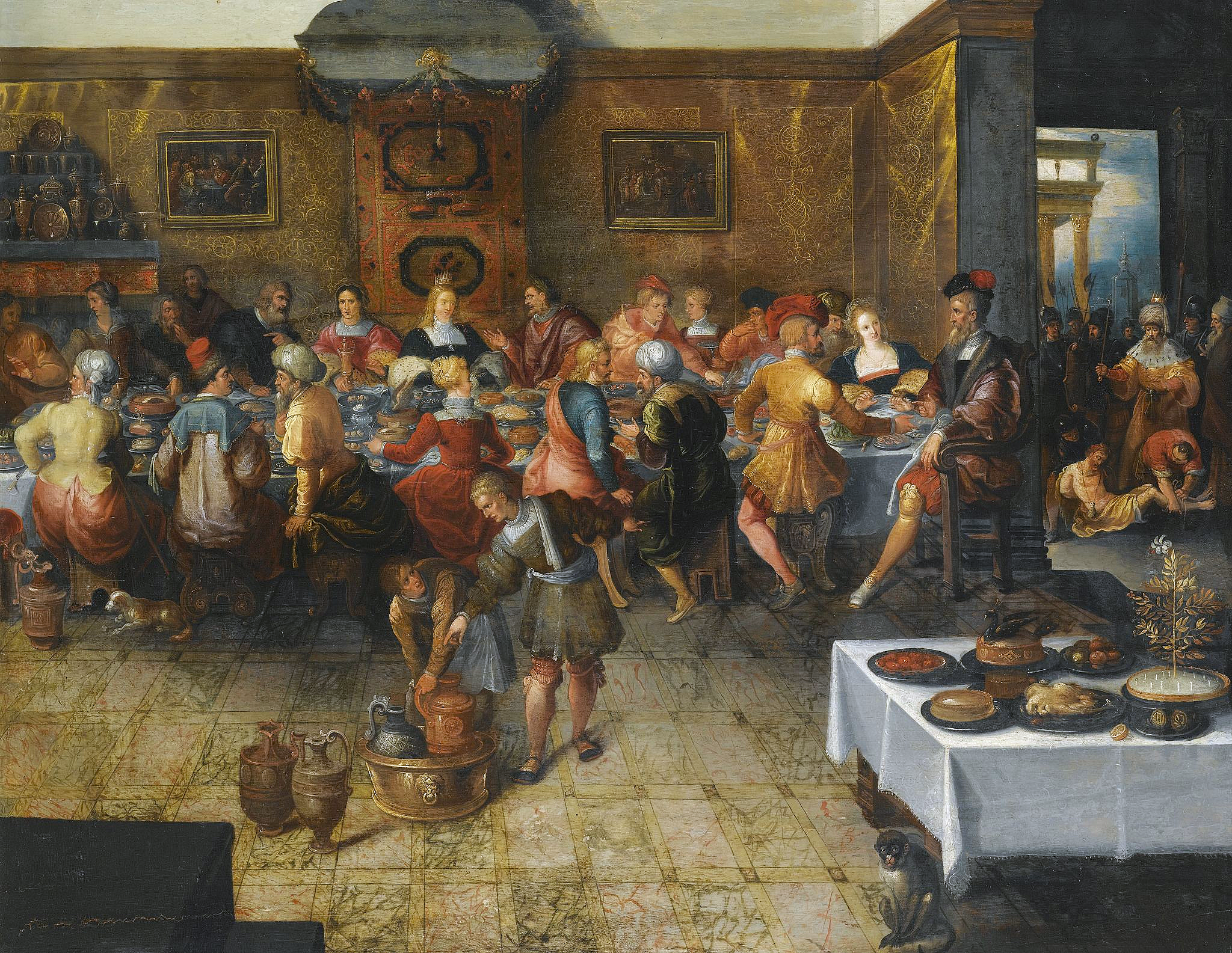
Frans Francken the Younger, early 17th c.
Translation From the Holy Gospel According to Matthew (22:1-14)
At that time, Jesus spoke to the chief priests and the Pharisees in parables, saying: The kingdom of Heaven is likened to a king, who made a marriage for his son; and he sent his servants, to call them that were invited to the marriage, and they would not come. Again he sent other servants, saying: Tell them that were invited: Behold, I have prepared my dinner; my oxen and fatlings are killed, and all things are ready: come ye to the marriage. But they neglected and went their way, one to his farm, and another to his merchandise; and the rest laid their hands on his servants, and having treated them abusively, put them to death. But when the king heard of it, he was angry and sending his armies, he destroyed those murderers, and burnt their city. Then he saith to his servants: The marriage indeed is ready, but they that were invited were not worthy, Go ye therefore into the highways, and as many as you shall find, call to the marriage. And his servants going forth into the ways, gathered together all that they found, both bad and good and the marriage was filled with guests. And the king went in to see the guests, and he saw there a man who had not on a wedding garment: and he saith to him: Friend, how came thou in hither, not having on a wedding garment? But he was silent. Then the king said to the waiters: Bind his hands and feet, and cast him into the exterior darkness: there shall be weeping and gnashing of teeth. For many are called, but few are chosen.
A Message From St. John Chrysostom’s Homilies on Matthew: LXIX.
And Christ not suddenly, but a long time before. For, Tell,” He saith, “them that are bidden (Matt 22:3); and again, Call them that were bidden (Matt 22:4); which circumstance makes the charge against them heavier. And when were they bidden? By all the prophets; by John again; for unto Christ he would pass all on, saying, He must increase, I must decrease (John 3:30); by the Son Himself again, Come unto me, all ye that labor and are heavy laden, and I will refresh you (Matt 11:28); and again, If any man thirst, let him come unto me, and drink (John 7:37).
But not by words only, but also by actions did He bid them, after His ascension by Peter, and those with him. For He that wrought effectually in Peter, it is said, to the apostleship of the circumcision, was mighty also in me towards the Gentiles (Gal 2:8).
For since on seeing the Son, they were wroth and slew Him, He bids them again by His servants. And unto what cloth He bid them? Unto labors, and toils, and sweat? Nay but unto pleasure. For, My oxen,” He saith, “and my fatlings are killed (Matt 22:4). See how complete His banquet? how great His munificence.
And not even this shamed them, but the more long-suffering He showed, so much the more were they hardened. For not for press of business, but from making light of they did not come (Matt 22:5).
“How then do some bring forward marriages, others yokes of oxen? these things surely are of want of leisure.”
By no means, for when spiritual things call us, there is no press of business that has the power of necessity.
And to me they seem moreover to make use of these excuses, putting forward these things as cloke for their negligence, And not this only is the grievous thing, that they came not, but also that which is a far more violent and furious act, to have even beaten them that came, and to have used them despitefully, and to have slain them; this is worse than the former. For those others came, demanding produce and fruits, and were slain; but these, bidding them to the marriage of Him that had been slain by them, and these again are murdered.
What is equal to this madness? This Paul also was laying to their charge, when he said, Who both killed the Lord, and their own prophets, and have persecuted us (1 Thes 2:15).
Moreover, that they may not say, “He is an adversary of God, and therefore we do not come,” hear what they say who are bidding them; that it is the father who is making the marriage, and that it is He who is bidding them.
What then did He after these things? Since they were not willing to come, yea and also slew those that came unto them; He burns up their cities, and sent His armies and slew them.
And these things He saith, declaring beforehand the things that took place under Vespasian and Titus, and that they provoked the father also, by not believing in Him; it is the father at any rate who was avenging.
And for this reason let me add, not straightway after Christ was slain did the capture take place, but after forty years, that He might show His long suffering, when they had slain Stephen, when they had put James to death, when they had spitefully entreated the apostles.
Seest thou the truth of the event, and its quickness? For while John was yet living, and many other of them that were with Christ, these things came to pass, and they that had heard these words were witnesses of the events.
See then care utterable. He had planted a vineyard; He had done all things, and finished; when His servants had been put to death, He sent other servants; when those had been slain, He sent the son; and when He was put to death, He bids them to the marriage. They would not come, After this He sends other servants, and they slew these also.
Then upon this He slays them, as being incurably diseased. For that they were incurably diseased, was proved not by their acts only, but by the fact, that even when harlots and publicans had believed, they did these things. So that, not by their own crimes alone, but also from what others were able to do aright, these men are condemned,
But if any one should say, that not then were they out of the Gentiles called, I mean, when the apostles had been beaten and had suffered ten thousand things, but straightway after the resurrection (for then He said to them, Go ye and make disciples of all nations Matt 28:19). We would say, that both before the crucifixion, and after the crucifixion, they addressed themselves to them first. For both before the crucifixion, He saith to them, Go to the lost sheep of the house of Israel (Matt 10:5-6); and after the crucifixion, so far from forbidding, He even commanded them to address themselves to the Jews. For though He said, “Make disciples of all nations,” yet when on the point of ascending into Heaven, He declared that unto those first they were to address themselves; For, ye shall receive power, saith He, after that the Holy Ghost is come upon you, and ye shall be witnesses unto me both in Jerusalem, and in all Judaea, and unto the uttermost part of the earth (Acts 1:8); and Paul again, He that wrought effectually in Peter to the apostleship of the circumcision, was mighty in me also toward the Gentiles (Gal 2:8). Therefore the apostles also went first unto the Jews, and when they had tarried a long time in Jerusalem, and then had been driven away by them, in this way they were scattered abroad unto the Gentiles.
And see thou even herein His bounty; As many as ye shall find,” saith He, bid to the marriage (Matt: 22:9) For before this, as I said, they addressed themselves both to Jews and Greeks, tarrying for the most part in Judaea; but since they continued to lay plots against them, hear Paul interpreting this parable, and saying thus, It was necessary that the word of God should first have been spoken to you, but since ye judge yourselves unworthy, lo, we turn to the Gentiles (Acts 13,46).
Therefore Christ also saith, The wedding is ready, but they which were bidden were not worthy (Matt 22:8).
He knew this indeed even before, but that He might leave them no pretext of a shameless sort of contradiction, although He knew it, to them first He both came and sent, both stopping their mouths, and teaching us to fulfill all our parts, though no one should derive any profit.
Since then they were not worthy, go ye, saith He, into the highways, and as many as ye shall find, bid; both the common sort, and the outcasts. For because He had said m every way. The harlots and publicans shall inherit heaven (Matt 21:31); and, The first shall be last, and the last first (Matt 20:16); He shows that justly do these things come to pass; which more than anything stung the Jews, and goaded them far more grievously than their overthrow, to see those from the Gentiles brought into their privileges, and into far greater than theirs.
Then in order that not even these should put confidence in their faith alone, He discourses unto them also concerning the judgment to be passed upon wicked actions; to them that have not yet believed, of coming unto Him by faith, and to them that have believed, of care with respect to their life. For the garment is life and practice.
And yet the calling was of grace; wherefore then doth He take a strict account? Because although to be called and to be cleansed was of grace, yet, when called and clothed in clean garments, to continue keeping them so, this is of the diligence of them that are called.
The being called was not of merit, but of grace. It was fit therefore to make a return for the grace, and not to show forth such great wickedness after the honor. “But I have not enjoyed,” one may say, “so much advantage as the Jews.” Nay, but thou hast enjoyed far greater benefits. For what things were being prepared for them throughout all their time, these thou hast received at once, not being worthy. Wherefore Paul also saith, And that the Gentiles might glorify God for His mercy (Rom 15:9). For what things were due to them, these thou hast received.
Wherefore also great is the punishment appointed for them that have been remiss. For as they did despite by not coming, so also thou by thus sitting down with a corrupt life. For to come in with filthy garments is this namely, to depart hence having one’s life impure; wherefore also he was speechless.
Seest thou how, although the fact was so manifest, He doth not punish at once, until he himself, who has sinned, has passed the sentence? For by having nothing to reply he condemned himself, and so is taken away to the unutterable torments.
For do not now, on hearing of darkness, suppose he is punished by this, by sending into a place where there is no light only, but where there is “also” weeping and gnashing of teeth (Matt 22:13). And this He saith, indicating the intolerable pains.
Hear ye, as many as having partaken of the mysteries, and having been present at the marriage, clothe your souls with filthy deeds Hear whence ye were called.
From the highway. Being what? Lame and halt in soul, which is a much more grievous thing than the mutilation of the body. Reverence the love of Him, who called you, and let no one continue to have filthy garments, but let each of you busy himself about the clothing of your soul.
Hear, ye women; hear, ye men; we need not these garments that are bespangled with gold, that adorn our outward parts, but those others, that adorn the inward. Whilst we have these former, it is difficult to put on those latter. It is not possible at the same time to deck both soul and body. It is not possible at the same time both to serve mammon, and to obey Christ as we ought.
Let us put off us therefore this grievous tyranny. For neither if any one were to adorn thy house by hanging it with golden curtains, and were to make thee sit there in rags, naked, wouldest thou endure it with meekness. But lo, now thou doest this to thyself, decking the house of thy soul, I mean the body, with curtains beyond number, but leaving the soul itself to sit in rags. Knowest thou not that the king ought to be adorned more than the city? so therefore while for the city hangings are prepared of linen, for the king there is a purple robe and a diadem. Even so do thou wrap the body with a much meaner dress, but the mind do thou clothe in purple, and put a crown on it, and set it on a high and conspicuous chariot. For now thou art doing the opposite, decking the city in various ways, but suffering the king, the mind, to be dragged bound after the brute passions.
Rememberest thou not, that thou art bidden to a marriage, and to God’s marriage? Considerest thou not how the soul that is bidden ought to enter into those chambers, clad, and decked with fringes of gold.
9 (John 7:37).
10 (Gal 2:8).
12 (1 Thes 2:15).
13 (Matt 28:19).
14 (Matt 10:6).
15 (Acts 1:8).
16 (Gal 2:8).
17 (Acts 13,46).
18
19.
20