
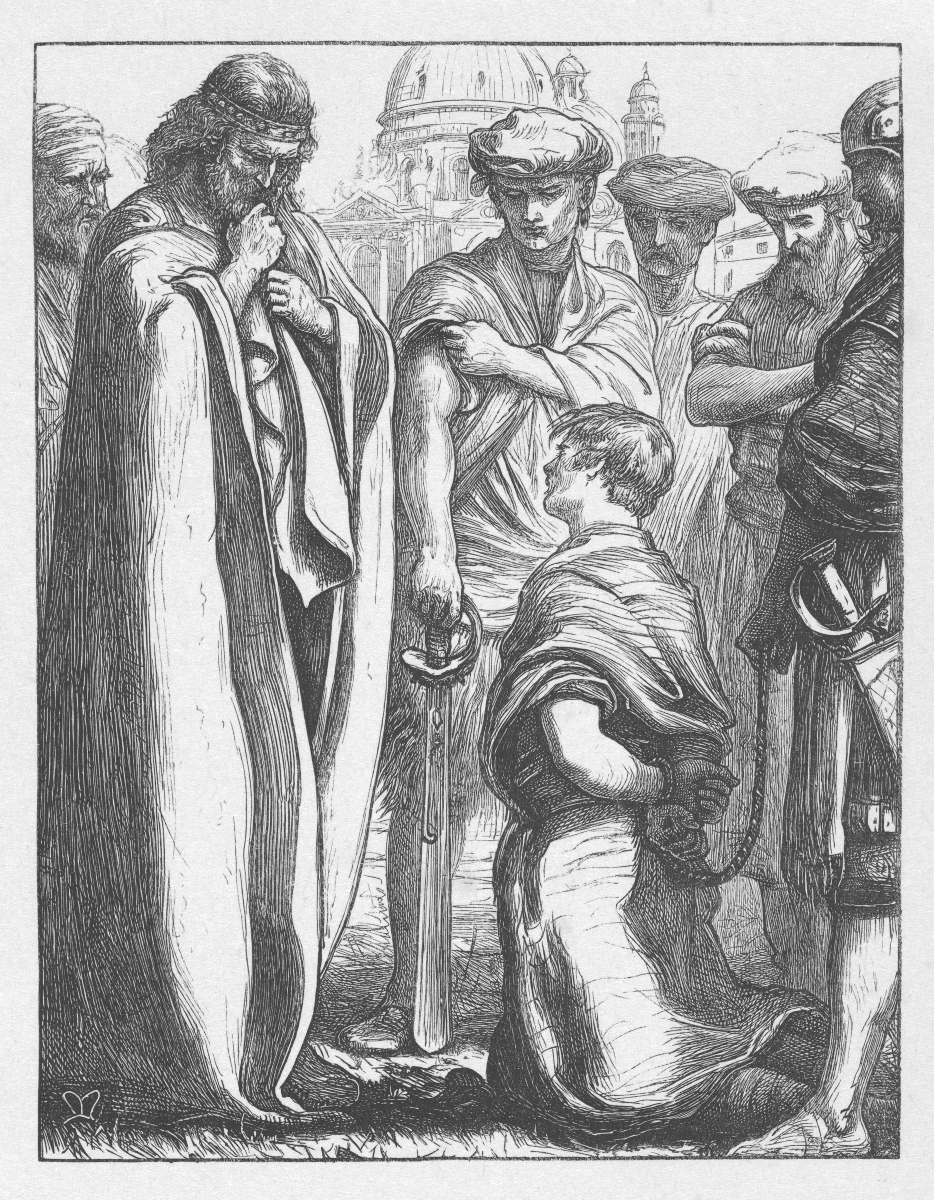
after Sir John Everett Millais, 1864
Translation of the Holy Gospel According to St. Matthew (18:23-35)
At that time, Jesus spoke to His disciples this parable: The kingdom of heaven is likened to a king, who would take an account of his servants. And when he had begun to take the account, one was brought to him that owed him ten thousand talents: and as he had not wherewith to pay it, his lord commanded that he should be sold, and his wife and children, and all that he had, and payment be made. But that servant falling down, besought him saying: Have patience with me, and I will pay thee all. And the lord of that servant, being moved with pity, let him go and forgave him the debt. But when that servant was gone out, he found one of his fellow servants that owed him a hundred pence: and laying hold of him, he throttled him, saying: Pay what thou owest. And his fellow-servant falling down besought him, saying: Have patience with me, and I will pay thee all. And he would not but went and cast him into prison till he paid the debt. Now his fellow servants, seeing what was done, were very much grieved; and they came and told their lord all that was done. Then his lord called him and saith to him: Thou wicked servant, I forgave thee all the debt, because thou besought me; should not thou have had compassion also on thy fellow servant, even as I had compassion on thee? And his lord being angry, delivered him to the torturers, until he paid all the debt. So also shall my heavenly Father do to you, if you forgive not every one his brother from your hearts.
A Message from St. Athanasius‘ Festal Letters: No III, 331 ad.
For what else is the [Mass], but the service of the soul? And what is that service, but prolonged prayer to God, and unceasing thanksgiving? The unthankful departing far from these are rightly deprived of the joy springing therefrom: for joy and gladness are taken from their mouth (Joel 1:5). Therefore, the [divine] word doth not allow them to have peace; For there is no peace to the wicked, saith the Lord (Isa 48:22), they labour in pain and grief. So, not even to him who owed ten thousand talents did the Gospel grant forgiveness in the sight of the Lord (cf. Matt 18:24). For even he, having received forgiveness of great things, was forgetful of kindness in little ones, so that he paid the penalty also of those former things. And justly indeed, for having himself experienced kindness, he was required to be merciful to his fellow servant. He too that received the one talent, and bound it up in a napkin, and hid it in the earth, was in consequence cast out for unthankfulness, hearing the words, Thou wicked and slothful servant, thou knewest that I reap where I sowed not, and gather where I have not strawed; thou oughtest therefore to have put my money to the exchangers, and on my return, I should have received mine own. Take therefore the talent from him, and give it to him that hath ten talents (Matt 25:26). For, of course, when he was required to deliver up to his lord that which belonged to him, he should have acknowledged the kindness of him who gave it, and the value of that which was given. For he who gave was not a hard man, had he been so, he would not have given even in the first instance; neither was that which was given unprofitable and vain, for then he had not found fault. But both he who gave was good, and that which was given was capable of bearing fruit. As therefore he who withholdeth corn in seed-time is cursed (Pro 11:26), according to the divine proverb, so he who neglects grace, and hides it without culture, is properly cast out as a wicked and unthankful person. On this account, he praises those who increased [their talents], saying, Well done, good and faithful servant; thou hast been faithful in a little, I will place thee over much; enter into the joy of thy Lord (Matt 25:23).
This was right and reasonable; for, as the Scripture declares, they had gained as much as they had received. Now, my beloved, our will ought to keep pace with the grace of God, and not fall short; lest while our will remains idle, the grace given us should begin to depart, and the enemy finding us empty and naked, should enter [into us], as was the case with him spoken of in the Gospel, from whom the devil went out; for having gone through dry places, he took seven other spirits more wicked than himself; and returning and finding the house empty, he dwelt there, and the last state of that man was worse than the first (Matt 12:43-45). For the departure from virtue gives place for the entrance of the unclean spirit. There is, moreover, the apostolic injunction, that the grace given us should not be unprofitable; for those things which he wrote particularly to his disciple, he enforces on us through him, saying, ‘Neglect not the gift that is in thee. For he who tilleth his land shall be satisfied with bread; but the paths of the slothful are strewn with thorns;’ so that the Spirit forewarns a man not to fall into them, saying, Break up your fallow ground, sow not among thorns (Jer 4:3). For when a man despises the grace given him; and forthwith falls into the cares of the world, he delivers himself over to his lusts; and thus in the time of persecution he is offended (cf. Matt 13:21), and becomes altogether unfruitful. Now the prophet points out the end of such negligence, saying, Cursed is he who doeth the work of the Lord carelessly (Jer 48:10). For a servant of the Lord should be diligent and careful, yea, moreover, burning like a flame, so that when, by an ardent spirit, he has destroyed all carnal sin, he may be able to draw near to God who, according to the expression of the saints, is called a consuming fire (Det 4:24, 9:3; Heb 12:29).
Therefore, the God of all, Who maketh His angels [spirits], is a spirit, and His ministers a flame of fire (Psa 104:4). Wherefore, in the departure from Egypt, He forbade the multitude to touch the mountain, where God was appointing them the law, because they were not of this character. But He called blessed Moses to it, as being fervent in spirit, and possessing unquenchable grace, saying, Let Moses alone draw near (Exo 24:2). He entered into the cloud also, and when the mountain was smoking, he was not injured; but rather, through the words of the Lord, which are choice silver purified in the earth (Psa 12:6), he descended purified. Therefore the blessed Paul, when desirous that the grace of the Spirit given to us should not grow cold, exhorts, saying, Quench not the Spirit (1 Thes 5:19). For so shall we remain partakers of Christ, if we hold fast to the end the Spirit given at the beginning. For he said, ‘Quench not;’ not because the Spirit is placed in the power of men, and is able to suffer anything from them; but because bad and unthankful men are such as manifestly wish to quench it, since they, like the impure, persecute the Spirit with unholy deeds. For the holy Spirit of discipline will flee deceit, nor dwell in a body that is subject unto sin; but will remove from thoughts that are without understanding (Wis 1:5). Now they being without understanding, and deceitful, and lovers of sin, walk still as in darkness, not having that Light which lighteth every man that cometh into the world (John 1:9). Now a fire such as this laid hold of Jeremiah the prophet, when the word was in him as a fire, and he said, I pass away from every place, and am not able to endure it (Jer 20:9). And our Lord Jesus Christ, being good and a lover of men, came that He might cast this upon earth, and said, And what? would that it were already kindled (Luke 12:49). For He desired, as He testified in Ezekiel 18, the repentance of a man rather than his death; so that evil should be entirely consumed in all men, that the soul, being purified, might be able to bring forth fruit; for the word which is sown by Him will be productive, some thirty, some sixty, some an hundred (cf. Mark 4:20) Thus, for instance, those who were with Cleopas (cf. Luke 24), although infirm at first from lack of knowledge, yet afterwards were inflamed with the words of the Saviour, and brought forth the fruits of the knowledge of Him. The blessed Paul also, when seized by this fire, revealed it not to flesh and blood, but having experienced the grace, he became a preacher of the Word. But not such were those nine lepers who were cleansed from their leprosy, and yet were unthankful to the Lord who healed them; nor Judas, who obtained the lot of an apostle, and was named a disciple of the Lord, but at last, while eating bread with the Saviour, lifted up his heel against Him, and became a traitor (Psa 41:9; John 13:18). But such men have the due reward of their folly, since their expectation will be vain through their ingratitude; for there is no hope for the ungrateful, the last fire, prepared for the devil and his angels, awaits those who have neglected divine light. Such then is the end of the unthankful.
But the faithful and true servants of the Lord, knowing that the Lord loves the thankful, never cease to praise Him, ever giving thanks unto the Lord. And whether the time is one of ease or of affliction, they offer up praise to God with thanksgiving, not reckoning these things of time, but worshipping the Lord, the God of times. Thus of old time, Job, who possessed fortitude above all men, thought of these things when in prosperity; and when in adversity, he patiently endured, and when he suffered, gave thanks. As also the humble David, in the very time of affliction sang praises and said, I will bless the Lord at all times (Psa 34:1). And the blessed Paul, in all his Epistles, so to say, ceased not to thank God. In times of ease, he failed not, and in afflictions he gloried, knowing that tribulation worketh patience, and patience experience, and experience hope, and that hope maketh not ashamed (Rom 5:3). Let us, being followers of such men, pass no season without thanksgiving, but especially now, when the time is one of tribulation, which the heretics excite against us, will we praise the Lord, uttering the words of the saints; All these things have come upon us, yet have we not forgotten Thee (Psa 44:17). For as the Jews at that time, although suffering an assault from the tabernacles (compare Psa 83:6) of the Edomites, and oppressed by the enemies of Jerusalem, did not give themselves up, but all the more sang praises to God; so we, my beloved brethren, though hindered from speaking the word of the Lord, will the more proclaim it, and being afflicted, we will sing Psalms (cf. Jam 5:13), in that we are accounted worthy to be despised, and to labour anxiously for the truth. Yea, moreover, being grievously vexed, we will give thanks. For the blessed Apostle, who gave thanks at all times, urges us in the same manner to draw near to God saying, Let your requests, with thanksgiving, be made known unto God (Phil 4:6). And being desirous that we should always continue in this resolution, he says, At all times give thanks; pray without ceasing (1 Thes 5:17). For he knew that believers are strong while employed in thanksgiving, and that rejoicing they pass over the walls of the enemy, like those saints who said, Through Thee will we pierce through our enemies, and by my God I will leap over a walls (Psa 18:29). At all times let us stand firm, but especially now, although many afflictions overtake us, and many heretics are furious against us. Let us then, my beloved brethren, celebrate with thanksgiving the holy feast which now draws near to us, girding up the loins of our minds (1 Pet 1:13), like our Saviour Jesus Christ, of Whom it is written, Righteousness shall be the girdle of His loins, and faithfulness the girdle of His reins (Isa 11:5). Each one of us having in his hand the staff which came out of the root of Jesse, and our feet shod with the preparation of the Gospel (cf. Isa 11:1; Eph 6:15), let us keep the feast as Paul saith, Not with the old leaven, but with the unleavened bread of sincerity and truth (1 Cor 5:8); reverently trusting that we are reconciled through Christ, and not departing from faith in Him, nor do we defile ourselves together with heretics, and strangers to the truth, whose conversation and whose will degrade them. But rejoicing in afflictions, we break through the furnace of iron and darkness, and pass, unharmed, over that terrible Red Sea. Thus also, when we look upon the confusion of heretics, we shall, with Moses, sing that great song of praise, and say, We will sing unto the Lord, for He is to be gloriously praised (Exo 15:1). Thus, singing praises, and seeing that the sin which is in us has been cast into the sea, we pass over to the wilderness. And being first purified by the fast of forty days, by prayers, and fastings, and discipline, and good works, we shall be able to eat the holy Passover in Jerusalem.