
Translation of the Epistle for the Sixth Sunday After Pentecost (Rom 6:3-11)
Brethren: All we who have been baptized into Christ Jesus have been baptized into His death. For we were buried with Him by means of Baptism into death, in order that, just as Christ has arisen from the dead through the glory of the Father, so we also may walk in newness of life. For if we have been united with Him in the likeness of His death, we shall be so in the likeness of His resurrection also. For we know that our old self has been crucified with Him, in order that the body of sin may be destroyed, that we may no longer be slaves to sin; for he who is dead is acquitted of sin. But if we have died with Christ, we believe that we shall also live together with Christ; for we know that Christ, having risen from the dead, dies now no more, death shall no longer have dominion over Him. For the death that He died, He died to sin once for all, but the life that He lives, He lives unto God. Thus do you consider yourselves also as dead to sin, but alive to God in Christ Jesus our Lord.
Continuation of the Holy Gospel According to Saint Mark (8:1-9)
At that time when there was a great crowd with Jesus and they had nothing to eat, he called his disciples together and said to them, “I have compassion on the crowd, for behold they have now been with me for three days and have nothing to eat. And if I send them away to their homes fasting they will faint on the way, for some of them have come from a distance.” And his disciples answered him, ‘How will anyone be able to satisfy these with bread here in a desert?’ And he asked them, ‘How many loaves have you?’ And they said, “Seven.” And he bade the crowd recline on the ground. Then taking the seven loaves, he gave thanks, broke them, and gave them to his disciples to distribute, and they set them before the crowd, and they had a few little fishes, and he blessed them, and ordered them to be distributed, and they ate and were satisfied, and they took up what was left of the fragments; seven baskets. Now those who had eaten were about four thousand, and he dismissed them.”
The Saving Words of the Gospel.
In the Name of the Father, and of the Son, and of the Holy Ghost. Amen.
Transcription of Audio
St. Paul says, “For we were buried with him by means of baptism into death, that we might walk in the newness of Christ.” This notion of death to sin is supposed to be definitive; begins with our baptism. If we should have the misfortune of falling, we have the opportunity for Confession. But the idea is that we take seriously what it means to live the life of grace, which is to walk in the newness of Christ and avoid anything that would contradict that. And so, mortal sin is not part of the program for a follower of Christ.
We can be very much edified by the example of the saints, and certainly helped by their assistance when we seek their aid, and nonetheless, sometimes when we read the lives of the saints, we might be tempted to some discouragement when we look at the radical nature of their following of Christ. And yet, even though we’re not called to imitate the externals, we’re obliged to follow the exact same principles of holiness that constituted their lives, their new lives, in the Way of Christ.
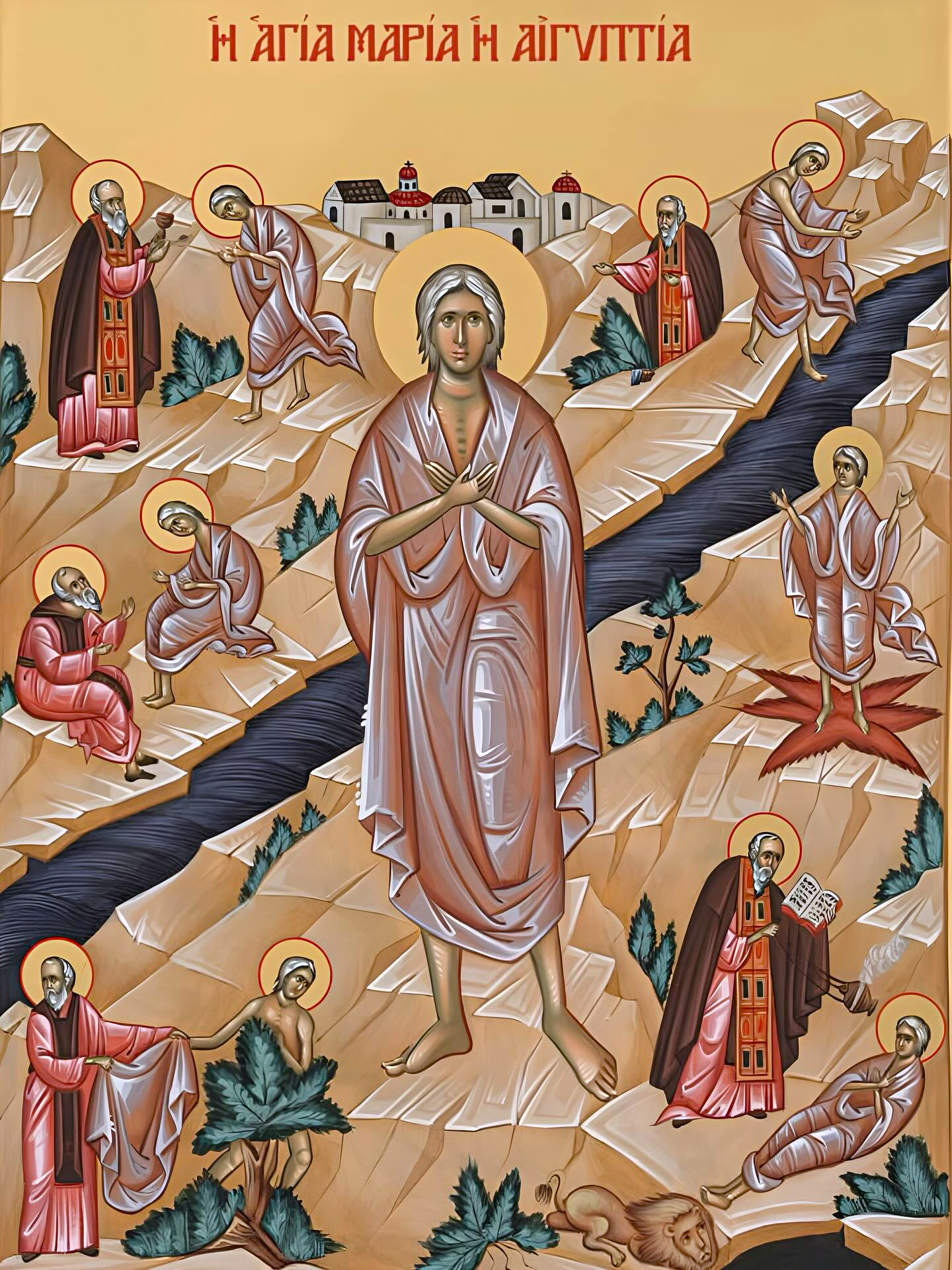
One of my favourites is St. Mary of Egypt, who came from a humble family and, at the age of twelve, ran away from home to live a dissolute life. And she lived on the streets, giving herself away for seventeen years. She begged food, and that’s how she chose to live. Sensual passion was her life. That’s what constituted her walking death.
And she saw a crowd of Catholics on a wharf getting ready for a trip across the Mediterranean to Jerusalem on pilgrimage to venerate the Holy Cross on September 14th. She inquired why they were all there. They explained it to her, meant nothing to her, but she saw potential customers in the group. And so, she joined with them, went on the ship, caused some of them to fall. And when they reached the Holy Sepulchre in Jerusalem, all of the pilgrims were entering, but she couldn’t. She was blocked by some invisible wall, and she understood why there was no entrance for her into the House of God.
And she went into the courtyard, and there wept bitterly and looked up and saw an image of the Blessed Mother, and she called her by three titles, Refuge of Sinners, Advocate of Sinners, Help of Christ, and received the grace of conversion. She wept bitterly and was able to walk back into the church now and worshiped at the foot of the of the Cross. As she left, she heard a voice, a beautiful feminine voice saying, “Go out to the desert, and there you shall find peace,” which is what she did.
But before she did on her way there, she stopped at a church on the Jordan, spent the entire night in prayer, confessed her sins, received the Eucharist, and went out to the desert with three loaves of bread. Her dress, the only thing she had with her, deteriorated after several months under the harshness of the desert sun, and all of the cold at night, and the harshness of the landscape. And she lived naked for forty-seven years in the desert. Once the bread was done, she ate roots and leaves and whatever she could find. And she recounted at the end of her life that the first seventeen years were hell on earth. She was physically beaten by demons, she had terrible temptations, everything hurt until seventeen years, basically her purgatory and earth, were up. After those seventeen years, the next thirty years were lived in peace and joy with Christ in the same conditions but with great consolation.
We looked at her life, and we think, ‘Well I could never do that,’ and that’s true; we’re not called to, but we are called to the same principles. Notice that she was not somebody who was continually confessing the same thing week after week or month after month. She had one confession and never fell after that. She had one Communion, and that was enough for the next forty-seven years. She would receive the viaticum the day before she died but, but that was it. And there was a forty-seven-year span in which she drew from the grace of those two sacraments and lived a profound life of silence, prayer, and penance with a habitual fast. Why do we have such different lives?
I’m not talking about the externals, because there are no two alike here. We’re talking about the internals of her conversion, the authenticity of her conversion, never returning to sin, living off of the Eucharist from one Holy Communion. She didn’t lose her passion, she didn’t lose her desire, she didn’t lose anything in her conversion. She took those same passions, those same longings, those same desires and transferred them from carnal pleasure to Christ. That was all. She changed the object of her affection. Christ became her everything. It wasn’t a problem of intellect, it wasn’t a problem of trauma in her childhood, it wasn’t a problem of a weak will. She just chose someone else to love outside of herself. It was Christ. This is the difference. And she lived in consequence of that in her contrition.
True contrition means I’m not going to commit this sin again, and I’m going to avoid all the near occasions of this sin. She understood the occasions of sin was simply being around men because of her addiction, and so she went out to the desert. Sometimes when I suggest to young men to get rid of their iPhones and get a flip phone because that’s the occasion of sin, they think that’s too radical. This is not going out to the desert; it’s just living like life was before 2008 when these things were created. It’s not radical. If we’re serious about our repentance, we will get rid of the occasions, and it’s presumptuous to confess and then return to the occasion of sin. That’s saying that I don’t really appreciate the mercy that I’ve received, and I’m willing to gamble on my own strength of will. Each one of us knows our own history of how strong our will is and how wayward our hearts can be, whether that’s a good idea or not, whether that’s prudent or not.
We see in Paul’s epistle that the old man of sin is to be buried. Sin is to be buried. That means we should have each our confession ought to be like a funeral for sin. And we don’t return to… we don’t circle around the cadaver of the old man of sin, deciding whether or not we’re going to resuscitate him. But rather we walk in the newness of Christ, which means towards Christ and away from that cadaver. Our contrition has to be real, and that means we have to be smart and take into account not only what are the occasions of sin in my life, but also where is my dominant vice. And I oughta identify… ask the guardian angel help… identify, the dominant vice and all of its manifestations. and then start picking them off one by one because that’s the enemy, and we don’t fight against the vice, that goes nowhere. We fight for its opposite virtue. Not, to be better people, but to give God what He deserves, the entirety of our being, to make Him the sole object of our affections; not sharing our heart, not making Him number one on a list of many other loves, but our only love, and anything else we love is in function of loving Him. He is a jealous lover; He doesn’t like competition, and He will respectfully step back if we haven’t made a choice for Him.
Why was her Holy Communion so efficacious, and how can we live a Eucharistic life that is equally efficacious? Well, there are times of preparation; there’s remote preparation for Communion, which is basically the baseline of our spiritual lives. How recollected am I? Am I giving my mind, my eyes, my ears to things that distract me from Christ? I’m not referring to duties in the state of life. I’m referring to things that are a distraction from what really matters. And so, when we have a certain baseline of recollection, that’s a good preparation for Communion because our hearts and our minds are already living in the presence of God.
Our proximate preparation is when we wake up on the day of Communion, and our first thoughts ought to be that Communion. I’m going to receive God today in my heart, in my body, im going to be made a living tabernacle today. We ought not get used to this, even if we go every day to Mass. We wake up, that’s our first thought, ‘I’m going to receive You, Lord. You’re coming to my heart, help me to be welcoming to You, help me to have no other concerns or distractions outside of You. Make all of the prior thoughts, words, and actions, and function of receiving You with more devotion and desire.’ How much we desire from Him has nothing to do with feelings; it has everything to do with affections and will.
Our immediate preparation for Communion is when Mass starts, when we live our preparation, our recollection, our longing, our desire, and we are focused on what’s happening. If we experience distractions in Mass, we just go back to what we’re doing. Something that helps is, at the beginning of Mass, to ask the guardian angel to help you to pray well and to pray along with you. He loves to do that. He will help you to be more focused so that when you come to receive Communion, you can do it with all of your heart and your mind without disparate thoughts.
When you receive Communion, it’s a good time to make reparation for all sacrileges, for contempts, for ingratitudes, for coldnesses, for all of these things that Our Lord has endured in the Eucharist from bad or mediocre Catholics. And then prolong our thanksgiving throughout the day.
Notice that the life that St. Mary lived is simply by degree of the exact same principles that we’re called of prayer, of contrition, and of penance. Our fasting and our penance ought to be regulated by several things. Our medical situation, not everybody can fast and do corporal penance in the same way. Our state in life, our fasting, and our corporal penance ought not be something that will hinder us, and they’re carrying out of our duties. The friends of penance are moderation and constancy. Making it a habit. The extremes are the enemy. So, the extreme is too much or too little. No penance is an extreme. The devil loves the extremes. He loves no penance or too much. He loves no fasting or too much fasting. St. John of the Cross says the devil hates a body that does penance and fasts. He hates a mind that does mental prayer.
And so, the more we adequate ourselves to receive Our Lord in the Eucharist through our penance, through our prayer, through our singularity of heart, our longing for Him, the more efficacious become those sacraments in all of their effects.
There are other things too, those unchosen penances. It could be people that are difficult to get along with, people that we have to forgive, the crosses and the difficulties that come with living with a fallen nature in a fallen world, the crosses that life serves up to us. All of those things offered with no complaint, offered in silence, offered in reparation for our sins and the sins of the world; all of this can be even more efficacious than the penances we impose upon us. One doesn’t cancel out the other, but we ought not lose sight of the value of mundane things offered to Our Lord.
So how much do we love Him? That’s a choice that we make each day.
When Thomas Aquinas’ sister asked him how can I be a saint, he answered with one word in Latin. He spoke to his sister in Latin, Velit. Will it. Will it.
In the name of the Father, and of the Son, the Holy Ghost. Amen.
~Fr. Ermatinger