
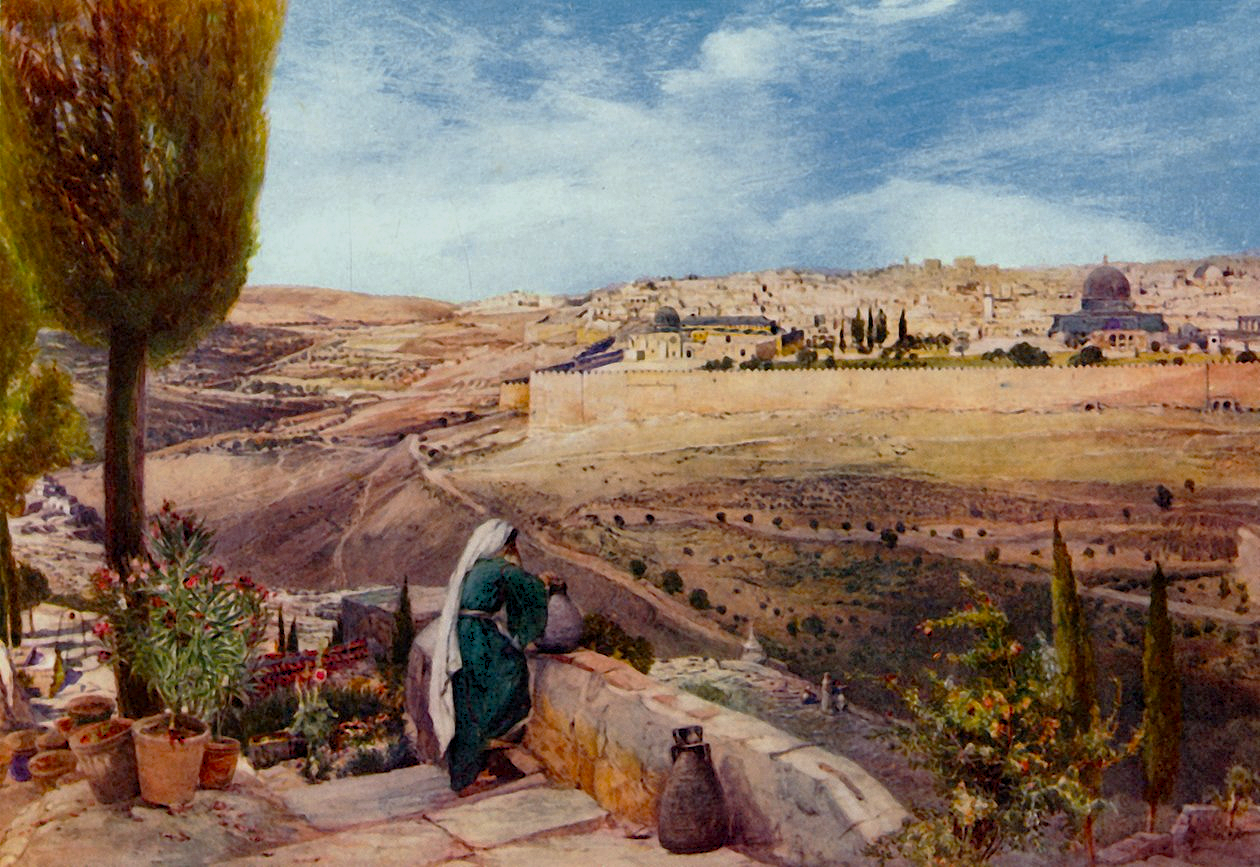
John Fulleylove, 1902
Translation of the Epistle for the Ninth Sunday After Pentecost.
Brethren, let us not covet evil things, as they also coveted. Neither become ye idolaters, as some of them: as it is written: The people sat down to eat and drink, and rose up to play. Neither let us commit fornication, as some of them committed fornication, and there fell in one day three and twenty thousand. Neither let us tempt Christ, as some of them tempted, and perished by the serpents. Neither do you murmur, as some of them murmured, and were destroyed by the destroyer. Now all these things happened to them in figure, and they are written for our correction, upon whom the ends of the world are come. Wherefore he that thinketh himself to stand, let him take heed lest he fall. Let no temptation take hold on you, but such as is human: and God is faithful, who will not suffer you to be tempted above that which you are able; but will make also with temptation issue, that you may be able to bear it.
Continuation of the Holy Gospel According to Saint Luke.
At that time, when Jesus drew near to Jerusalem, seeing the city, He wept over it saying: If thou also hadst known, and that in this day, the things that are to thy peace: but now they are hidden from thy eyes .For the days shall come upon thee, and thy enemies shall cast a trench about thee, and compass thee round, and straiten thee on every side; and beat thee flat to the ground, and thy children who are in thee; and they shall not leave in thee a stone upon a stone, because thou hast not known the time of thy visitation. And entering into the temple, He began to cast out them that sold therein, and them that bought, saying to them: It is written, My house is the house of prayer, but you have made it a den of thieves. And He was teaching daily in the temple.
The Saving Words of the Gospel.
In the Name of the Father, and the Son, and of the Holy Spirit. Amen.
Transcription of Sermon
In the Name of the Father, and the Son, and of the Holy Spirit. Amen.
Neither let us tempt Christ.
What does it mean to tempt God? Some of us perhaps know what it means to be tempted. And nonetheless, what does it mean to tempt God? Obviously, it’s got to be something a bit different than our own experience. The word to tempt in Greek can also mean to test, or to prove, to try out. So, to test Him is to make a trial of His goodness out of curiosity, or doubt, or unbelief, or rebelliousness. St. Teresa of Avila complained to God, said, “Why do you test me so?” And He said, “Because I want to see what you’re made of.” Obviously, God knew exactly what she was made of, but in His testing her, He was showing her what she could be in the midst of trials if she cooperated with grace. As Paul tells us today, that none of us are tempted beyond our ability, and He gives us the grace to withstand it all.
God is allowed to test us; we’re not allowed to test him. So, what does it mean really to tempt Him? Demanding proof of God’s power or His presence. Why is that a sin? Because it’s a manifestation of doubt. It’s revelatory of a lack of faith; a lack of hope. It’s also revelatory of a very immature relationship with Him. It’s not a game. Paul refers to this passage from Exodus today, in which the Jews tempted God and paid for it, twenty-three thousand of them.
Another way of testing God is to put oneself in danger heedlessly, thinking God will protect me. This is presumption in which one expects God to do what one ought to do for oneself. Christ’s providential plan includes all sorts of material means that He expects us to use. Question 97 of the third part of St. Thomas’ Summa Theologica discusses what this sin of tempting God looks like in four different articles. And, ultimately, he says that this is a sin against the virtue of religion. What is the virtue of religion?
Well, the Scholastics argued over the nature of the virtue of religion. They said, ‘We know we have many moral virtues, and there are three, or maybe four, theological virtues.’ Obviously, faith, hope, and charity are the theological virtues, but many of them were convinced, some of the scholastic theologians, that the virtue of religion was actually a theological virtue. Why? Because of the source and the end. Well, the end of faith is God. The end of hope is God. And the end of charity is God. The end of religion is worship of God. So, even that is a creature. And so, that was settled. It’s not a theological virtue; it’s a moral virtue, but it is a subset of the virtue of justice. And what does justice mean? To give each his due.
For example, when you enter into an agreement, you go into the store, you wanna buy a book. Well, if you pay the price, you have a right to the book. You have the responsibility of paying for it. The bookseller has the duty to give it to you, but he also has a right to your money. So, this is how justice works. Everybody clamors for more rights, few people clamor for more responsibilities, but rights and responsibilities are two sides of the same coin. With that banal example of buying a book, we understand the virtue of justice, a little perhaps.
So, when we understand the virtue of religion as our relating with God, there are rights and responsibilities. God, for who He is, has a right to our worship. And therefore, we have a responsibility to give it to Him on His terms. The bookseller determines the price of the book, and you decide whether you think it’s worth it or not. If you think it’s worth it, then you pay for it, and you take the book. Justice is done; rights and responsibilities. Our Lord demands from us true worship; what He asks of us is not a little. He asks everything, but the everything that he asks us is repaid with His everything, which infinitely exceeds whatever it is that we give Him, but there’s a minimum that He asks of us in this relationship of rights and responsibilities. Responsibilities: it’s our Sunday worship, and the precepts of the church, the commandments, etc.
And so, the virtue of religion is offended in three different ways- well, multiple ways- but a couple of them would be superstition, which is worse than tempting God, and then, the worst of all of the sins against religion would be idolatry of false gods. As we see in Psalm 95:5, All of the gods of the Gentiles are demons. And so, all of the false gods that are not the Trinity, whether it’s Aztec, Mayan, Roman mythology, they’re all real. They’re real, but they’re demons. All of the Hindu gods, the five-thousand-plus Hindu gods, they’re real, but they’re not gods; they’re demons. And so, to enter into any cultus, any worship of them is to fall into idolatry.
Although those, superstition and idolatry, are worse than tempting God, tempting God is no little thing. To demand that God prove Himself and show Himself is a lack of trust. The explicit ways of testing Him, for example, could be for example, saying a prayer to demand a physical sign from Him. But who am I to determine what signs He gives? He’s not our performing flea. We tell Him what to do. ‘If you do what I tell you to do, then I’ll believe in you.’ This is not a healthy relationship to have with the Almighty. It’s very disrespectful, and it’s very immature.
There could be also an implicit form of testing Him, which is perhaps not so crass as that, but takes the form of acting recklessly, expecting God to perform His wondrous deeds because He loves me. Well, yes, he does love me, but he also allows us to fall by our own weight when we make stupid decisions. So, this is a form of presumption, which is part of, it’s a manifestation of this sin of irreligiosity in tempting God. Thomas Aquinas talks about some very practical things. He says-we have this is in the thirteenth century- he says we have all sorts of advancements in medicine and science, and we’re obliged to take advantage of the legitimate means for our well-being, for our health, and as much as we can. And to eschew those things by saying Well God will heal me- well, yes, He may heal you, but He also wants you to use the means that we have at our disposition. So, we’re obliged to use these legitimate human means for our health and protection, and ignoring these things-that God will take care of me- is to disrespect Him.
Paul knew he was going to be killed in a certain town, and he escaped; he allowed himself to be lowered from the city wall in a basket. I was reminded of that where Paul didn’t needlessly expose himself to danger by saying, ‘ Well, God will take care of me,’ when Benedict XVI came to America, I remember a Protestant complaining about his visit, saying, “Well, if he believed that if he was the vicar of Christ, wouldn’t God protect him? Why does he have a security detail?” No. Paul also trusted in God’s providence, but he also saw God’s providence in the basket when he escaped the town. So, these things are not at odds with each other.
Thomas Aquinas allows for asking God for a sign, but it’s in very strict, limited conditions. It has to be useful, it has to be necessary, it has to be pious. And this is the only legitimate exercise of asking God for a sign; notice that it’s not demanding a sign, it’s not determining the sign. And there has to be a certain receptivity here which says, ‘That if you want. But my faith, hope, and charity are not gonna be altered by a sign, whether it’s there or not.’ The Apostles asked God for signs in the Acts of the Apostles, but that was for God to manifest for the salvation of souls. It wasn’t to test God to see if He acts. They weren’t playing a game with that. So, we ought to be all cautious and asking for signs.
When the Jews asked Christ for signs, what did he do? He said, ‘You wanna sign? I’ll give you a sign; I am the sign.’ And then He gave His long Bread of Life discourse in John 6. The real sign, if you wanna sign about God’s existence, if you wanna sign about His power, if you wanna sign of His goodness, He gave it to us; it’s the Eucharist.
In the name of the Father, and of the Son, the Holy Ghost.
~Fr.Ermatinger