
Translation of the Epistle for the 13th Sunday After Pentecost (Galatians 3:16-22)
Brethren, To Abraham were the promises made, and to his seed. He saith not: And to his seeds, as of many; but as of one: And to thy seed, which is Christ. Now this I say, that the testament which was confirmed by God, the law which was made after four hundred and thirty years, doth not disannul to make the promise of no effect. For if the inheritance be of the law it is no more of promise. But God gave it to Abraham by promise. Why then was the law? It was set because of transgressions until the seed should come, to whom He made the promise, being ordained by angels in the hand of a mediator. Now a mediator is not of one: but God is one. Was the law then against the promises of God? God forbid. For if there had been a law given, which could give life, verily justice should have been by the law. But the Scripture hath concluded all under sin, that the promise by the faith of Jesus Christ might be given to them that believe.
Continuation of the Holy Gospel According to St. Luke (17:11-19)
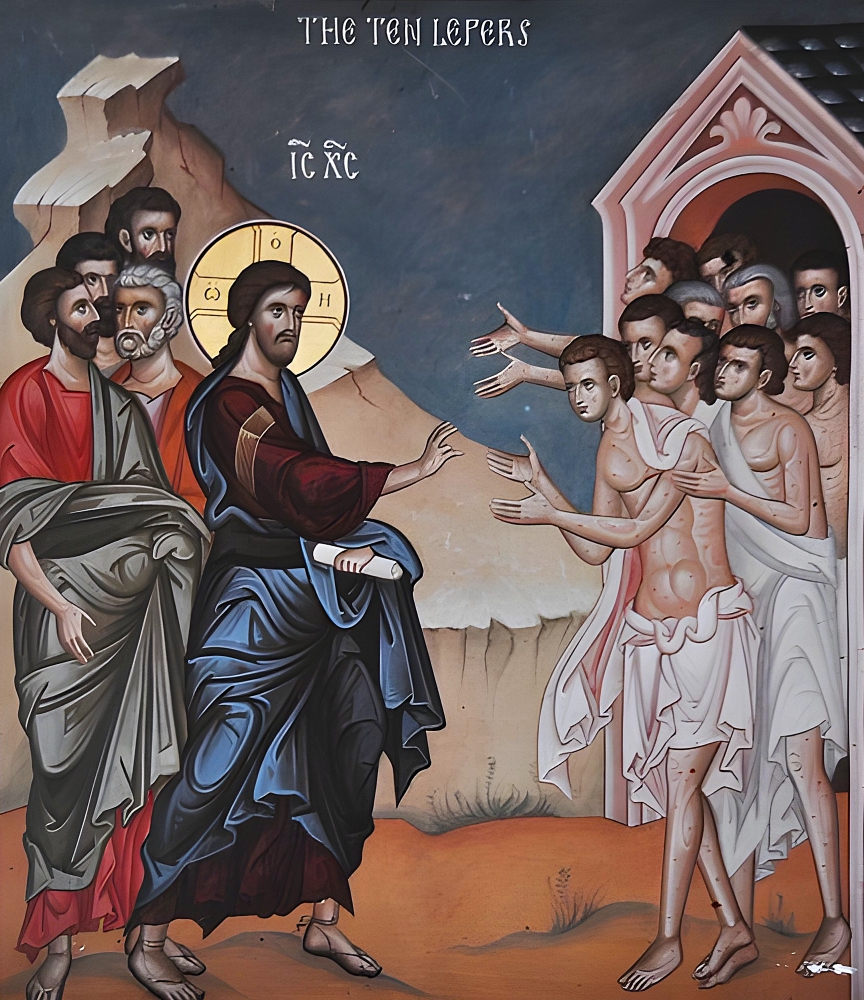
At that time, as Jesus was going to Jerusalem, He passed through the midst of Samaria and Galilee: and as He entered into a certain town, there met Him ten men that were lepers, who stood afar off, and lifted up their voice, saying: Jesus, Master, have mercy on us. Whom when He saw, He said: Go, show yourselves to the priests. And it came to pass, that, as they went, they were made clean. And one of them, when he saw that he was made clean, went back, with a loud voice glorifying God: and he fell on his face before His feet, giving thanks: and this was a Samaritan. And Jesus answering said: Were not ten made clean? And where are the nine? There is no one found to return, and give glory to God, but this stranger. And He said to him: Arise, go thy way for thy faith hath made thee whole.
The Saving Words of the Gospel.
In the Name of the Father, and of the Son, and of the Holy Ghost. Amen.
Transcription of Homily
If we read the book of 2 Kings, we see that Syrian general Naaman, who found himself with leprosy, and, in his fit of despair, had recourse to the king of Israel, and said, “Can you heal me?” And the king of Israel panicked. And he said, “Who can heal leprosy, except God?” And he’s right. Similarly, we see when Our Lord heals the Paralytic, He begins with forgiving his sins, and the Jews complain, “Only God can forgive sins,” and they’re right. So, true enough on both counts, and Christ does both. So, these miracles give us evidence, irrefutable evidence, of His divinity. And it’s in the context, in this case, of nine Jews and a Samaritan.
It sounds like the beginning of a joke: Nine Jews and a Samaritan.
Well, we get these suffering souls who are living a life that isn’t a life, so to say. They were excommunicated from society and from Temple Worship as unclean. This was not considered a moral failing on their part, but, because of their situation, they were not allowed to participate in worship. St. John Chrysostom said of these, “They are more dead than alive, but more pitiable than the dead.”
A few chapters earlier, Our Lord told the Parable of the Good Samaritan. And Samaritans were a heretical sect. They had intermingled with the Gentiles and had some strange beliefs foreign to Revelation. And so, they were considered impure. And so, now we’ve got this Samaritan who’s a leper, who’s doubly cursed, so to say. And Christ calls him allogenēs, which means… If you’re somewhat nerdy, that is a hapax legomenon, which means a term that is only used once in Scripture. And it means born of another race. And that’s precisely what Our Lord is manifesting in this miracle: that His salvation reaches outside of the previous Chosen People, that now with the Advent of Christ, with the institution of the Church, the Chosen People become now the Catholic Church. So, those who would reject Christ are no longer the Chosen People. And this then, this offer of salvation is presented to the Gentiles.
Pius Parsch says this passage has liturgical undertones. He says that the thanksgiving of the Samaritan is a Eucharistic thanksgiving. And the posture, throwing himself at the feet of Christ, is representative of the adoration we give Our Lord in the Eucharist, in Mass and in Adoration. And he is… this foreign-born man is the only example we have in Scripture of a recipient of a miracle saying thank you. And so, the liturgical structure of this passage is that they cry out for mercy. They begin with their Kyrie Eleison. And Christ gives them this liturgical proclamation: “Go and show yourselves to the priests.” And this miracle takes place in a hidden way but manifest in obedience.
The Samaritan realises what has taken place, and he comes back, singing his Gloria. And he falls prostrate at the feet of Christ, giving thanks. Eucharisteō is… eucharistia is thanksgiving; eucharisteō is he was giving thanks. And then Our Lord says, “Rise, go on your way; your faith has made you whole.” So, this is his ite est. And this is also Our Lord testifying to the fact that He not only healed his body, He healed his soul. This prostration is a prosopon, as it’s called, is falling on one’s face. We don’t do that before mortals. It’s a posture reserved for Divine Worship.
And, as Naaman’s flesh, the Syrian general, as his flesh was made as soft and pristine as a baby’s flesh, that’s exactly what happens to our souls in Baptism and in Confession. We experience this cleansing over and over for as many times as we ask Our Lord to forgive us. St. Augustine says of this passage, “Ten were made healthy, but only one was saved. Bodily health they all received, but he who is thankful received salvation of the soul.” So, this is a simple lesson for us that thanksgiving, then, is part of the substance of true worship. Thanksgiving. And why is that?
Faith and gratitude, under the action of grace, create the ability for us to have Communion. In the Old Testament, there were five types of Psalms. The highest form of Psalm was the todah psalm. Toda means thanksgiving. So, for the Jews, they understood that thanksgiving was the highest form of prayer. Why? Because in it we give something back. This is justice. Justice means giving each his due. And so, when justice regards relationships, and it inherently does that, its justice is what orders relationships; our thanksgiving ought to be in proportion to the gift given. And so, when Our Lord gives us Himself in the Eucharist, what must our thanksgiving be like?
And Our Lord has set this up precisely so that when we receive Him, and we give Him thanks for coming to us in the Blessed Sacrament, the deeper the thanks, the more He habituates and conditions our souls to receive still more graces. And so, there is a virtuous circle going on of Communion. He gives us Himself; we increase our thanks. We increase our thanks, and in doing so, He prepares us to receive Him still more profoundly. We don’t come to Mass like the Nine Jews simply seeking something for ourselves. We learn from this example that Our Lord puts before us: the Samaritan who receives everything. He receives his healing, he receives his salvation, and he gives thanks.
And so. when we come to our Lord and we follow this example of worship, when we fall at Our Lord’s feet, when we give Him ourselves in our worship, when we thank Him for the wonders that He does in our souls, we thank Him for taking away our spiritual leprosy of sin, which is much worse than any physical leprosy, because we show ourselves to the priest who absolves us. Then what happens? It becomes a deepening of holiness.
And this is exactly what Our Lord wants: for us to deepen our communion with Him. Y Ildefonso Schuster says, “The Church places this Gospel before us that we may learn to be grateful for the gifts of grace and assure our gratitude, not only by words, but returning again and again to the feet of Christ in the Eucharist.” The more devoutly we prepare ourselves to receive Our Lord, the more devoutly we receive Him, and the more devoutly we give Him thanks, the greater our communion with the Almighty. So, gratitude is at the heart of salvation.
We’re not consumerists of grace. We give something back. And what do you give the Almighty who’s got everything? Well, He doesn’t have our thanksgiving yet, and so we give Him our thanksgiving. And in each Mass we return to give Him thanks, and He gives us Himself, and we thank Him, and He gives us Himself, and we thank Him, and we fall on our knees, and we thank Him, and worship Him deeper still.
In the name of the Father, and of the Son, the Holy Ghost. Amen.
~Fr. Ermatinger