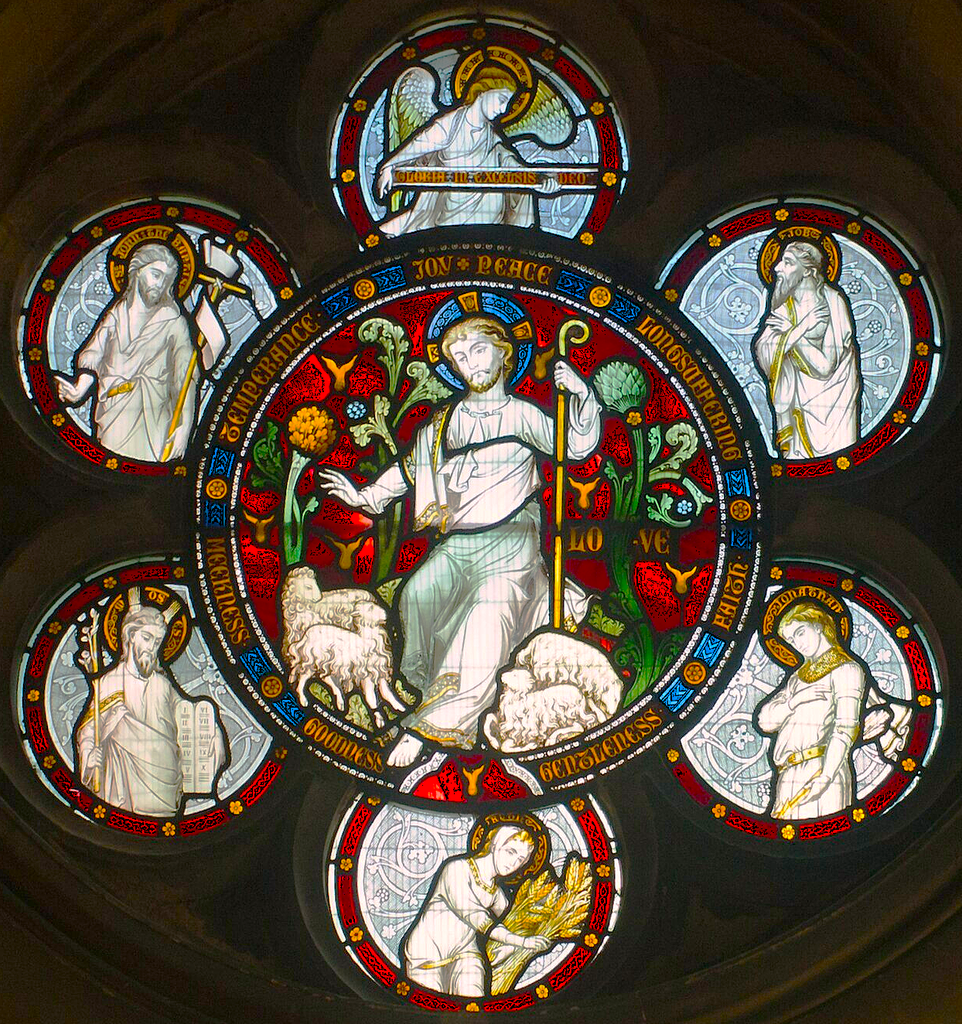
Hardman & Co., cir 1870s
Translation of the Epistle for the Fourteenth Sunday After Pentecost (Gal. 5:16-24)
Brethren: Walk in the Spirit, and you will not fulfill the lusts of the flesh. For the flesh lusts against the spirit, and the spirit against the flesh; for these are opposed to each other, so that you do not do what you would. But if you are led by the Spirit, you are not under the Law. Now the works of the flesh are manifest, which are immorality, uncleanness, licentiousness, idolatry, witchcrafts, enmities, contentions, jealousies, anger, quarrels, factions, parties, envies, murders, drunkenness, carousings, and suchlike. And concerning these I warn you, as I have warned you, that they who do such things will not attain the kingdom of God. But of the fruit of the Spirit is: charity, joy, peace, patience, kindness, goodness, long-suffering, mildness, faith, modesty, continency, chastity. Against such things there is no law. And they who belong to Christ have crucified their flesh with its passions and desires.
Continuation of the Holy Gospel According to St. Matthew (Matt 6:24-33)
At that time, Jesus said to His disciples: No man serve two masters; for either he will hate the one and love the other, or else he will stand by the one and despise the other. You cannot serve God and mammon. Therefore I say to you, do not be anxious for your life, what you shall eat; nor yet for your body, what you shall put on. Is not the life a greater thing than the food, and the body than the clothing? Look at the birds of the air: they do not sow, or reap, or gather into barns; yet your heavenly Father feeds them. Are not you of much more value than they? But which of you by being anxious about it can add to his stature a single cubit? And as for clothing, why are you anxious? Consider how the lilies of the field grow; they neither toil nor spin, yet I say to you that not even Solomon in all his glory was arrayed like one of those. But if God so clothes the grass of the field, which flourishes today but tomorrow is thrown into the oven, how much more you, O you of little faith! Therefore do not be anxious, saying, ‘What shall we eat?’ or, ‘What shall we drink?’ or, ‘What are we to put on?’ – for after all these things the Gentiles seek; – for your Father knows that you need all these things. But seek first the Kingdom of God and His justice, and all these things shall be given you besides.
The Saving Words of the Gospel.
In the Name of the Father, and of the Son, and the Holy Ghost. Amen.
Transcription of Homily
In the Name of the Father, and of the Son, and the Holy Ghost. Amen.
Our Lord uses some rather stark vocabulary in this Gospel passage from the Sermon on the Mount. He uses… well, the root of the word is δοῦλος (doulos), which means slave. And he says, δουλευεινto (duleueinto); do not be enslaved. To what? Masters? Well, that works. But the word is κυριοις (kuriois), which is the plural of lords; two lords. Do not be enslaved. You cannot be enslaved to two lords. If you and your employment had two bosses of equal stature, you would end up preferring one and not heeding the other; that’s just the way we are, and our Lord knows us quite well. And so, He tells us that we cannot be enslaved to two lords at the same time, for things that are much more existential than employment.
Sometimes people want to worship God and yet their attachments to mammon – mammon is a Punic word that means wealth – live in their hearts and their heads as a disordered attachment. Obviously, we’re not pure spirits; we need money, we need food, we need clothing, we need drink, we need all of these. But Our Lord is talking about the role they play in our hearts, and He’s talking about anxieties. Μεριμνάω – (merimnao) anxiety; it’s an interesting word because the root has to do with memory. Μεριμνάω. And so, what is an anxiety? It’s a fruitless cycle of thought that goes nowhere, and it keeps us from recollection. This is why St. Francis de Sales says that after venial sin, the worst evil that can befall us is anxiety.
Anxiety is a form of a false religion. It can consume us, and it takes us away from Our Lord. Our Lord moves the discourse from attachment to wealth to the role of some very basic necessities: food, drink, clothing, and in a rather impoverished agricultural society, those are existential necessities, and, nonetheless, Our Lord is saying even there we’re not allowed to fret. And He gives these examples from the natural world, like the birds that Our Lord cares for, and it says, Are you as children not much more valuable in the eyes of God than the birds and the lilies of the field? Then he says, Oh ye of little faith. Λιγόπιστος (oligopistos). Λιγόπιστος. We get the word … it means …well, πιστος can mean faith; it could also mean trust. And then oligarch means the rule of a few, so the one who has little trust; little faith. And this is the symptom of this waning – this dying trust – then is anxiety and attachments.
Obviously, we’re not pure spirits, and we need to use these basic necessities. But Our Lord is asking the question about the role they play: how much thought do we give to these things over Him? He’s a jealous lover. He doesn’t want to be number one in a series of loves. He wants to claim all of our heart, all of our mind, and then that orders the way we use things that we need. So, the question is, do I serve those things, or do they serve God’s purposes in my life? That’s really the question.
Thomas Aquinas, when he speaks about the danger of mammon, he says God has given us, through the precepts of the Church, the duty to give alms, and that it’s precisely in giving these alms, and our tithing, that we overcome our disordered attachments to wealth. When Our Lord says, You’ll love one and hate the other, Augustine says this notion of hatred of God, it’s not so crass and hard-hearted rebellious as it might sound. He says there are few cases of that, but more frequently this hatred of God takes the shape, he says, of lessening our esteem for Him, of taking His goodness for granted, of not heeding His will and ignoring our consciences. He says this is hatred of God because if He is number two, well whatever number one is in my thoughts and my words, in my thoughts and in my affections, then that’s really the master I’m serving. And so, we’re confronted with these existential choices.
If somebody has to confess mortal sins, this Gospel is speaking to that person; it’s speaking to all of us who have the tendency to attach our affections to things that are not God, to the things that we need and we use, and nonetheless they can have a disproportionate role in our lives.
This seeking of the Kingdom of God and righteousness is dealt with by St. Augustine and St. Thomas Aquinas. They reached the same end, which is the Beatific Vision; that’s where it should all be leading, but they have a different way of laying out the way there. St. Augustine says that seeking the Kingdom of God and His righteousness means an inward journey of the will, of the affections, of the emotions ordered towards our ultimate end, which is God. You can read about this in the Confessions of St. Augustine. If you haven’t already, I recommend it. There are many good translations; Frank J. Sheeds’ translation and also Anthony Esolen’s translation with wonderful footnotes are real gems. If you haven’t read the Confessions, I recommend it.
Notice that Augustine, when he’s talking about seeking the Kingdom of God, he’s talking about the role of the affections, the will, the psychology oriented towards the Godhead. Thomas takes a different approach when he lays out the seeking the Kingdom of God. He says that in creation we recognize order, and therefore there should be an ordo amoris, there should be ordered love, because our knowledge of the Natural Law, our ability to recognize order in creation, points us to the One who laid out that order, and so we’re already, in recognizing it, participating in the Divine Mind. St. Augustine says in his City of God, Two loves built two Cities; one the love of God to the contempt of the City of Man, and the other love for the City of Man to the contempt of God. The City of God, says Saint Augustine, is the union of the faithful in the Church living the life of grace out of love for God, which puts us in opposition to the City of Man to the contempt of mammon.
Thomas Aquinas says that the Kingdom of God is the Beatific Vision. The way there is the life of virtue elevated by grace, which gives us a participation in the Beatific Vision in a very limited way, a participation in the blessedness of heaven, the joy that comes from, well, he says it in his Treatises on the Virtues, he says, Virtue is its own reward. There’s a certain joy in living out virtue, because it makes us participate in the life of God. When Thomas talks about seeking first the Kingdom of God, he says this first is not chronological. On Sunday I seek God, Monday I seek my food and drink and clothing. No. He says this first is in the order of hierarchy, and that all of these other concurrent needs then are subsumed by this all-encompassing seeking of God’s Kingdom.
The destination is the same for both of them, obviously, for Augustine and Aquinas, and when our love is ordered towards Our Lord, we do not seek God in order to get things; rather, we take care of our worldly tasks to His glory. Seeking Him and His Kingdom and His providence is not the “health and wealth Gospel message,” but a question of ordering our affections for creatures towards Our Lord’s interests, and this requires lots of purity of intention. How do we do this?
We’re constantly pulled in different directions. We’re constantly, says Our Lord, tempted to anxiety. Paul shows us the method. He shows us the way out of attachments and anxiety. In Philippians 4:6, he gives a command, much like Our Lord gives a command to not be anxious. He says, have no anxiety, but in everything by prayer and supplication to God, be thankful. So, notice its prayer and gratitude on the heels of last Sunday’s Gospel, which is all about thanksgiving and gratitude, the role that plays in our spiritual lives, that this gratitude to God is not just for the apparent blessings, but also for the crosses, this gratitude to God for irritations, because all of this forms part of one overarching providential plan for our purification, for our union with Christ. Our gratitude for every aspect of His providence, not just for the ones we like. And this is the key to purity of intention. This shows Our Lord that our attachment to Him is not contingent on the perks. Rather, He possesses our hearts, He possesses our minds, and He, and this protects us from believing that our happiness is contingent on something less than God.
In the Name of the Father, and of the Son, the Holy Ghost. Amen.
~Fr. Ermatinger