

Pinned Post
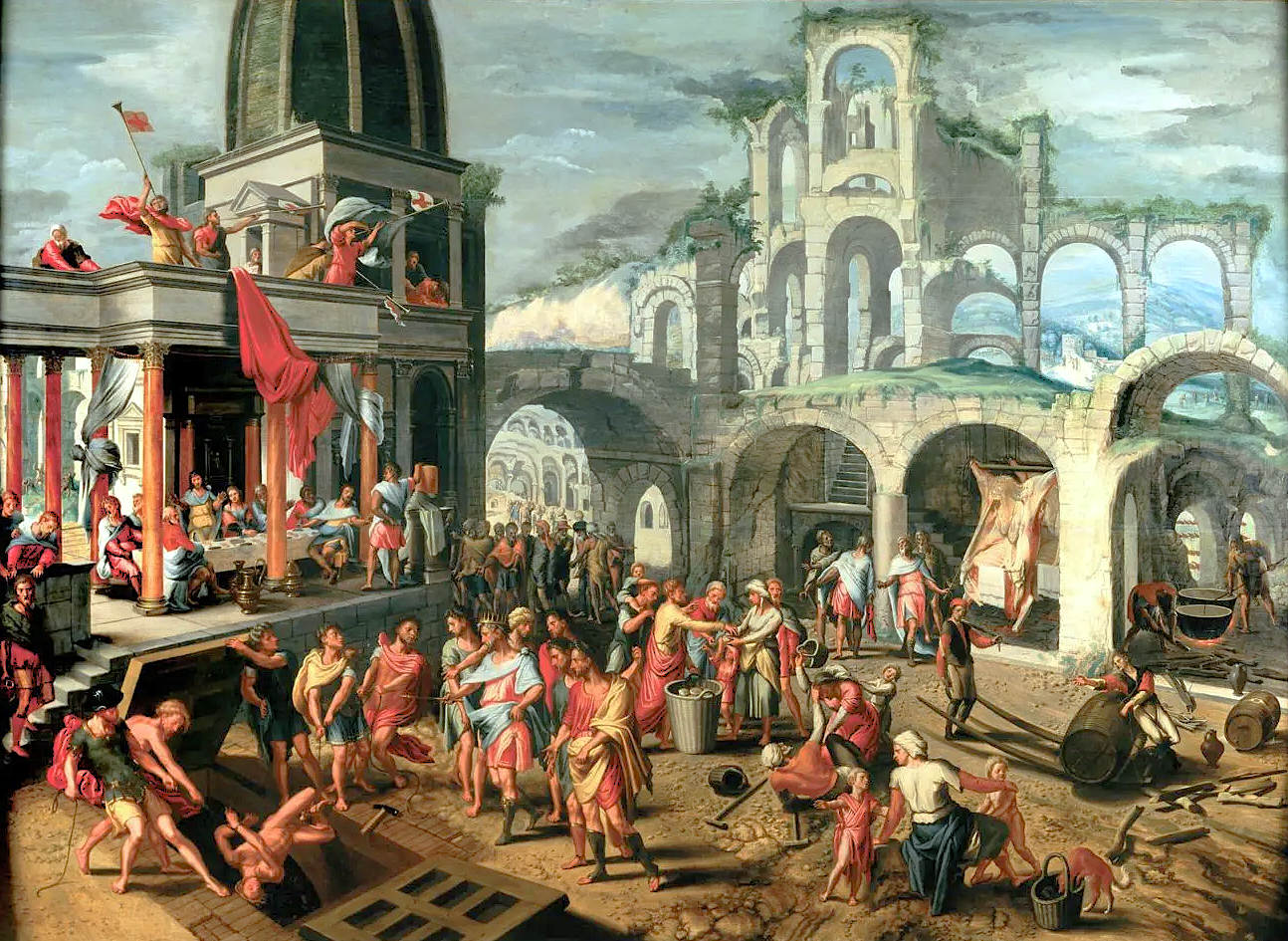
Pieter Aertsen. mid 16th c.
Translation of the Epistle for the Nineteenth Sunday After Pentecost (Ephesians 4:23-28)
Brethren: Be renewed in the spirit of your mind, and put on the new man, which has been created according to God in justice and holiness of truth. Wherefore, put away lying and speak truth each one with his neighbor, because we are members of one another. Be angry and do not sin; do not let the sun go down upon your anger; do not give place to the devil. He who was wont to steal, let him steal no longer; but rather let him labor, working with his hands at what is good, that he may have something to share with him who suffers need.
Continuation of the Holy Gospel According to Saint Matthew (22:1-14)
At that time, Jesus spoke to the chief priests and the Pharisees in parables, saying, The kingdom of heaven is like a king who made a marriage feast for his son. And he sent his servants to call in those invited to the marriage feast, but they would not come. Again he sent out other servants, saying, “Tell those who are invited, behold, I have prepared my dinner; my oxen and fatlings are killed, and everything is ready; come to the marriage feast.” But they made light of it, and went off, one to his farm, and another to his business; and the rest laid hold of his servants, treated them shamefully, and killed them. But when the king heard of it, he was angry; and he sent his armies, destroyed those murderers, and burnt their city. Then he said to his servants, “The marriage feast indeed is ready, but those who were invited were not worthy; go therefore to the crossroads, and invite to the marriage feast whomever you shall find.” And his servants went out into the roads, and gathered all whom they found, both good and bad; and the marriage feast was filled with guests. Now the king went in to see the guests, and he saw there a man who had not on a wedding garment. And he said to him, “Friend, how did you come in here without a wedding garment?” But he was speechless. Then the king said to the attendants, “Bind his hands and feet and cast him forth into the darkness outside, where there will be the weeping and the gnashing of teeth.” For many are called, but few are chosen.
And he saw there a man who had not on a wedding garment.
In the name of the Father, and of the Son, and the Holy Spirit. Amen.
Transcription of Homily
In the Name of the Father, and of the Son, and the Holy Spirit. Amen.
Well, clearly this is not your normal wedding invitation. This one comes with a couple of FYIs: one about dress code, and the other: “If you don’t come, I’ll burn down your city.” And so, this is actually a pretty important invitation to take seriously. Clearly. But what is this all about? This is not a cautionary tale about wedding dress etiquette. What’s going on?
Well, it all began in Eden when our First Parents relinquished their primordial wedding garments through sin. And when they sinned, they lost their wedding garment and realized they were naked. And so, in a pathetic attempt to cover up their nakedness, they gathered fig leaves. And Our Lord then realized that’s not going to work. And so, He gave them animal skins as another provisional garment. Obviously, those animals didn’t shed their skin; they had to be sacrificed. And so, this veil and the sacrifice are part of this provisional solution. There’s a veil that hides something, but it also reveals something that was lost. And the sacrifice is necessary. Interestingly, too, in the Temple of Jerusalem, in the Holy of Holies, there was a veil there which separated the Holy of Holies from everything else, and that was made of animal skins. That’s not a coincidence. All of this, though, was provisional. It was a substitute. Not efficacious, but pointing towards something future. Something that would be provided for us.
We have all been invited to the Wedding, and we are the Bride as the Church. We are the Bride. And yet we find ourselves in a quandary. As Saint Paul says in 2 Corinthians 5, In this present state it is true we groan as we wait, longing to put on our heavenly home over the other. We should like to be found wearing clothes and not without them; yes, we groan and find it a burden, being still in this tent. Not that we want to strip it off, but to put the second garment over it and have what must die taken up into life. This is the purpose for which God made us, and He has given us the pledge of the Spirit. So, where do we find the proper wedding garment for our own marriage feast, which will help us to survive Heaven?
Because, by nature, no one can survive Heaven by nature; only God. Therefore, even the angels required supernatural grace before the Beatific Vision. We can’t enter Heaven without supernatural grace. In Isaiah 61 we see… Interesting. Before I get to that quote about the wedding garment predicted, or prophesied, in 61, this is also the same passage that Our Lord alludes to when John the Baptist sends his disciples to ask Christ if he’s truly the Messiah. And then, what does Christ say? Tell John, the blind see, the lame walk, lepers are cleansed, deaf hear, dead are raised, and the good news is preached to the poor. And Christ stops there. He doesn’t say something else that was there in Isaiah about prisoners going free, ’cause he’s telling John. But Isaiah continues in 61:6-10; he says, I will greatly rejoice in the Lord, and my soul shall be joyful in my God. For He hath clothed me with the garments of salvation; with a robe of justice. He hath covered me as a bridegroom decked with a crown, and as a bride adorned with her jewels. Job also encourages us in 29; he says, Put on righteousness as a garment, as a robe. So, that’s the key: this, which is being justified through grace.
Trent is very clear about justification through grace, which the ordinary means of that is baptism. This is not something of our own doing. We’re not Pelagians. We can’t save ourselves. The angels themselves didn’t pull themselves up into Heaven through willing it. They had to be created in grace and then given an actual grace in order to make… there was an arduous choice each angel had to make. It had something to do with some self-denial. I won’t go into it now. We too. We require grace in order to carry out what are called righteous deeds. They’re meritorious on two conditions: inasmuch as we’re in a state of grace and we have a supernatural motivation. So, we have to offer it for something according to the mind of God. And this is the importance of a morning offering when we tell Him we’re gonna offer all of our works to Him throughout the day.
The pinnacle verse referring to this is in Revelation 19:7-8. Let us be glad and rejoice and give glory to Him for the marriage of the Lamb has come, and His bride hath prepared herself, and it is granted to her that she should clothe herself with fine linen. Glittering in white, for fine linen are the justifications. [The δικαιωματα (dikaiomata)] the righteous deeds of the saints. And He said to me, ‘Write: Blessed are they that are called to the marriage supper of the Lamb.’ There we have it: these righteous deeds, the clothing of the Bride in Heaven is made up of our righteous deeds. And what are these righteous deeds?
Our Lord warns us in Matthew 7; He says that not everyone who says Lord, Lord will be saved. ‘Well, I exercised demons in your Name; I worked miracles in Your Name.’ Well, it was His Name that brought those things about. It has its own efficacy. So, He’s saying that’s not a guarantee of salvation. There have to be good works. And He is very clear about this: the primacy of grace and ensuing good works. He talks about this in Matthew 5, referring to Final Judgment, when He divides the sheep and the goats. And what are those righteous deeds?
Our Lord is very concrete: feeding the hungry, satisfying the thirsty, welcoming strangers, clothing the naked, visiting the sick and the imprisoned- very concrete things. Nothing extraordinary, nothing miraculous, but those are works of charity that He points to. And the goat, the goats who will be cast out, who won’t make it to Heaven- it’s interesting too that He doesn’t point to horrible deeds. They’re not condemned for doing terrible sins, but for omitting these righteous deeds. So, if Our Lord is giving us the tools through grace, He expects something from His investment.
We see that also in the Parable of the Talents. He says, ‘Why did you bury the talent?’ The man didn’t lose it. He gave it he gave back what he received, but Our Lord said, ‘You could have invested this; you could have worked with this. I’m not getting My investment.’ And that’s a good question for each one of us.
With everything you’ve given me, Lord, are you getting back what you expect from Your investment?
In the parable of the Wise and the Foolish Virgins, we see: Awake! The Bridegroom comes in the middle of the night. In Byzantine iconography, there is a popular image, Ο Νυμφίος (Ho Nymphios), the Bridegroom. And it’s Christ the Bridegroom, dressed in His wedding garments. And what are the wedding garments of Christ? Crown of Thorns, the Robe of Humiliation, and He’s got a reed in His hand. The crown and the robe reveal His humility. And the reed represents humble service and good works. And this is why in Byzantine weddings the bride and the groom wear crowns.
Paul says in Romans 13:14: Clothe yourselves with Jesus Christ and do not think about how to gratify the desires of the flesh. And so, as we go about our lives, in a state of grace, we’re equipped to carry out these righteous deeds of the saints, to give Our Lord back something on His investment.
And what’s interesting is how beautifully robed the Bride of Christ, the Church, is in Heaven is something that you and I are determining through the degree, the number, of those righteous deeds that we carry out to His glory. For the angels, their place in Heaven is static. They can’t advance. They can’t go backwards. They’re static. And they’re happy where they’re at. Our place in Heaven is something that’s in flux, as long as we’re in this life. We can increase in grace and therefore achieve a better spot, a better quality of eternal life, or we can be selfish, and if we’re still in a state of grace, be in a lower spot, and therefore the Bride has fewer adornments. We’re deciding how beautifully adorned she will be, and we ought not see this as some onerous task, but as the way to live out a fruitful, loving relationship, making the Bride of Christ as beautiful as He wants her to be.
In the Name of the Father, and of the Son, the Holy Ghost. Amen.
~Fr. Ermatinger